The war on Russian sport has just found its ugliest stage yet
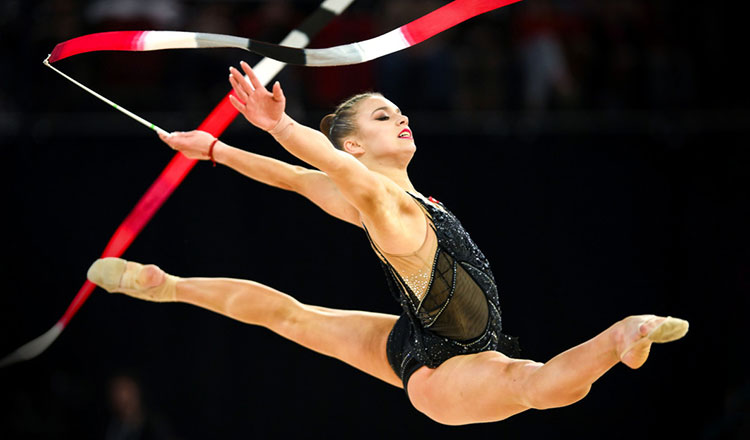 File photo of Maria Borisova performing a ribbon routine at a gymnastics competition. Supplied
#opinion
As a former international athlete, seeing your flag raised or hearing your anthem play is a nice bonus. Ultimately, you compete for yourself, and win or lose, you do it for yourself, too. Yes, family, club, coach, friends, pets, nation, etc, are important, but so long as you’re treated the same as those you’re up against, you can go and give it your best shot. However, after interviewing Russians since 2019 who saw their flag and anthem banned, I asked myself, what if, when I competed, the Irish flag and anthem were banned?
It’s Groundhog Day, and the sports world is marching to the beat of the anti-sport drum yet again. Despite ruling that Russian and Belarusian athletes be treated as equals, a Romanian city hosting a sports event for females decided the best way to empower young women was to humiliate them.
Acting against the spirit of sport and committing a major rule violation, the Romanian city of Cluj-Napoca told the Russian Gymnastics Federation (RGF) that their national flag and anthem would not be allowed at the World Challenge Cup this weekend. The move, made verbally so as to circumvent sanction, according to one Russian official, goes against a ruling last month by the global governing body World Gymnastics (WG).
In an effort to use sports to increase dialogue and normalise international contact, the WG are among 12 Olympic governing bodies that have ruled that the flags and anthems of Russia and Belarus can return to the arena.
The Russian team refused to take part due to a “gross violation of the competition regulations by the organisers of the competition,” according to federation press attaché Linar Ginatullin. The decision was “appreciated” by WG, according to reports.
Ginatullin confirmed, in a media release last week, that the event organisers “verbally notified” Moscow that Russia’s flag and anthem would not be seen or heard in the arena if any Russians were to win.
An RGF official from a regional committee told of the “betrayal” felt by the Russian rhythmic gymnastics community. “These girls train so hard to represent their country and then are told, right as they are going to compete, the rules don’t apply to you, you’re not worthy of this,” she said, pointing out that the way the information was given showed “extreme cowardice” and was designed to “cover” the organisers from WG sanction.
“They make it look [like] capricious Russians don’t take part,” she said.
It wasn’t only Russia that was feeling confused and annoyed. A number of national federation officials were disappointed that Russia pulled out, but equally disappointed by the organisers. And they pointed out that Kyiv has pushed Western nations to act against the interests of the sport and its athletes.
A Spanish official, speaking on condition of anonymity, said, “It is no longer about sports. The Russians, Belarusians too, are strong and in this [Challenge Cup] series are winning a lot. The Ukrainians have lobbied many [other nations’] officials to refuse even these girls to compete.”
Following WG’s ruling in May, Russian and Belarusian athletes competed under their own flags and anthems in the second round (of three) of the World Challenge Cup series in Beijing. With just the Romanian stop of the series left, Russia had four golds, three silvers and three bronzes. Belarus nabbed a silver and bronze. Fifteen-year-old Russian starlet Sofia Ilteriakova, in her debut senior season, was tipped to stay ahead of Chinese rival Wang Qi and add to her two golds, two silvers and a bronze won at Challenge Cup events in 2026.
Ufa-born Ilteriakova, who has become a darling of gymnastics fans, was the subject of unwarranted abuse and attacks by Ukrainian officials and online trolls when she was overcome with winning silver in her first major international event, the first World Cup series event in Sofia, Bulgaria, and faced the wrong way as the Ukrainian anthem was played.
Watching the video of the child looking more than a little lost as the Ukrainian anthem is played, anyone with a brain can see that she was poorly advised or directed by officials on what to do.
Ukraine’s gymnastics federation demanded that the youngster be stripped of her medal and banned for disrespecting Ukraine’s “state symbol.” WG, in giving her a warning to be careful in future, pointed out that they themselves needed to “clarify the protocol” of awards ceremonies.
This moment, according to the Spanish official, has been used as a stick to beat Russia’s back, but it has repercussions for the young girls in the competition.
“It’s disappointing for our girls,” the Spanish official noted, “they want to compete against the best. They [the gymnasts] are all young girls, highly competitive, but young girls. They said ‘It could be our flag next’.”
Ukraine, with the support of some EU nations, has used every means to “other” Russia, Russians, and even those of Russian origin. The stink raised by Ukrainian media and some Western outlets when Russia-born German gymnast Darja Varfolomeev dared to post pictures on her Instagram of her competing in Crimea in 2021, when she was just 14, forcing her to delete the “offending” material, was instructive. Nobody cared when she was just another competitor, but when she won Olympic individual all-around gold and Ukraine’s medal hope, Taisiia Onofriichuk, severely underperformed to finish 9th, Darja was subjected to an onslaught of hate.
Politics should have no place in sports, but they have. Using politics, social media and threats to defeat opponents, rather than in the arena, is not sport. It’s what sports are meant to eliminate.
Sadly, too many European nations seem hell-bent on preventing a normalisation of communication between people, while claiming that Israel, the US, and other favoured nations must be allowed to compete to normalise communication between people.
The final round of the rhythmic gymnastics World Cup is scheduled for Milan next month. Last week, WG officials would not be drawn on whether the Italian organisers would ensure that Russian athletes would be treated like their fellow competitors, or what sanctions the organisers in Romania would face for violating WG rules.
Chances are, those who made the decision to break the rules are sitting in Brussels and have confirmed that funding for the event will be released, and nobody will face prosecution for not allowing young Russian girls to take part in a sports event.
The author is a Vilnius-based sports journalist and host of Capital Sports 3.0. A former athlete, he has over 30 years of experience in professional sports and higher education across the globe.
-Khmer Times-
__________________