Australian envoy to lead Cambodia-Thailand maritime conciliation
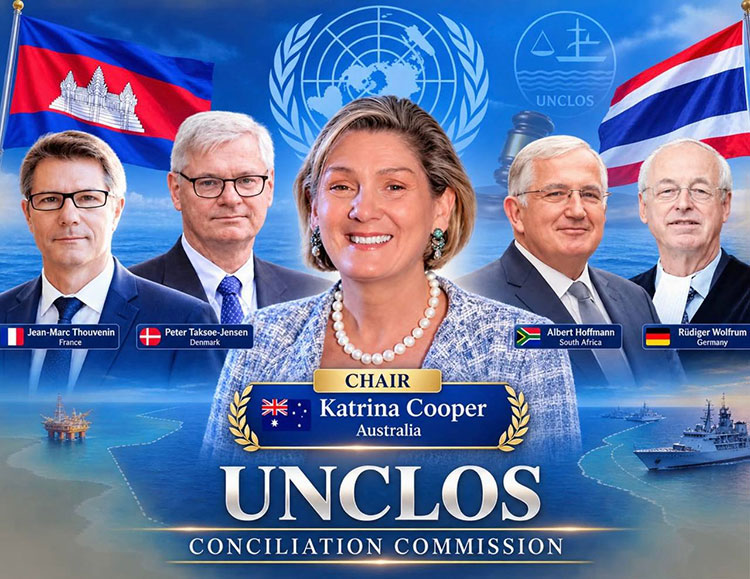 The five UNCLOS conciliators (from left): Professor Jean-Marc Thouvenin of France, Ambassador Peter Taksoe-Jensen of Denmark, lawyer Katrina Cooper of Australia, Judge Albert Hoffmann of South Africa and Judge Rudiger Wolfrum of Germany. Ministry of Information
Synopsis: Independent experts convene to address territorial boundaries and unlock shared energy resources in the overlapping zone.
Australian diplomat and international lawyer Katrina Cooper has been appointed chairperson of the five-member Conciliation Commission handling the maritime dispute between Cambodia and Thailand under the United Nations Convention on the Law of the Sea (UNCLOS), with the first procedural meeting expected in the coming weeks.
The Permanent Court of Arbitration (PCA) announced Cooper’s appointment on Friday after the four conciliators selected her as the fifth member and chair following consultations with Cambodia and Thailand.
Cambodia’s Ministry of Foreign Affairs and International Cooperation welcomed the appointment, thanking Cooper for accepting the responsibility and joining the other international experts on the commission.
“This is an important step in the conciliation process initiated by Cambodia,” the ministry said in a statement released on the same day.
The ministry said it was confident that the conciliation process would create an opportunity to resolve differences over the maritime boundary and develop significant oil and gas resources in the overlapping claims area, adding that progress on both issues comes at a critical time for regional energy security.
The Cambodian government remains committed to the peaceful resolution of maritime issues in accordance with international law and will continue to place its trust in the compulsory conciliation process under UNCLOS, the ministry said.
Cooper is an experienced Australian diplomat and international lawyer with expertise in international law and negotiations. She has held senior diplomatic positions, including serving as Australia’s Ambassador to Mexico and previously served as co-agent for Australia in compulsory conciliation proceedings under UNCLOS between Australia and Timor-Leste.
Thailand’s Ministry of Foreign Affairs said Cooper was among those supported by Thailand for the chairperson role, describing her as an experienced diplomat and international lawyer. Bangkok has indicated that it is prepared to cooperate with and support the commission’s work, Thai media reported.
The four other members of the commission are Ambassador Peter Taksoe-Jensen of Denmark, Professor Jean-Marc Thouvenin of France, Judge Albert Hoffmann of South Africa and Judge Rüdiger Wolfrum of Germany.
Cambodia appointed Taksoe-Jensen and Thouvenin, while Thailand appointed Hoffmann and Wolfrum. The four conciliators then appointed Cooper as chairperson in consultation with both parties.
The PCA said Cambodia initiated the conciliation on June 2 through a notification instituting conciliation under Article 11 of Annex V of UNCLOS, addressed to Thailand pursuant to Article 298 and Annex V of the convention. Thailand submitted its response to Cambodia’s notification on June 19, according to the PCA.
Cambodia has appointed Deputy Prime Minister and Foreign Affairs and International Cooperation Minister Prak Sokhonn as its agent for the proceedings, with Lam Chea, Minister in Charge of the State Secretariat of Border Affairs, serving as deputy agent.
Thailand has appointed Deputy Prime Minister and Minister of Foreign Affairs Sihasak Phuangketkeow as its agent, with Thai Ambassador to Kuwait Songchai Chaipatiyut serving as deputy agent. With the agreement of both parties, the PCA is acting as the registry for the proceedings.
The commission’s next step will be to set the date for its first procedural meeting, which is provisionally expected to take place in September. The meeting is expected to address the adoption of rules of procedure governing the commission’s work and subsequent proceedings.
The Cambodian government said the establishment of the commission marks an important stage in the process and provides an avenue for addressing differences over the maritime boundary and potential development of oil and gas resources through peaceful means and in accordance with international law.
Cambodian Centre for Regional Studies executive director and international relations expert Him Raksmey, who heads an independent think tank based in Phnom Penh, said Thursday’s appointment by the four party-appointed conciliators, following consultations with both countries, was a positive indication that the two sides were prepared to participate in the process.
Raksmey said the next stage would involve the commission establishing its rules of procedure, which would govern how it operates, makes decisions, engages with the parties and handles confidentiality.
The commission would then invite Cambodia and Thailand to present their views, either orally or in writing. If either party challenges the commission’s competence over the case, the commission would consider and decide the issue, he added.
Raksmey said the commission is required to submit its report within 12 months of its constitution. The report will record any agreements reached and, if no agreement is reached, set out conclusions on relevant questions of fact or law and any recommendations the commission considers appropriate for an amicable settlement.
He said that the recommendations would not be legally binding on either party. “The conciliation process under UNCLOS is not an adjudicatory proceeding and its recommendations are not binding,” Raksmey said.
For the process to succeed, Raksmey said both countries would need to maintain strong political will and a spirit of compromise throughout the proceedings.
Raksmey said the process would require both countries to engage consistently on key issues, including the rules of procedure, the commission’s competence and its role in promoting an amicable settlement.
He said the ultimate objective should be an outcome acceptable to both sides, with compromise, legal principles and diplomatic engagement forming the basis for resolving the maritime dispute.
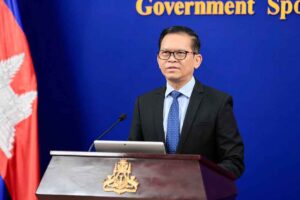
Government spokesman Pen Bona said Cooper’s appointment is an important step in the conciliation process. He noted that the administration believes the initiative will provide an opportunity to address boundary differences as well as explore significant resource development in the sector.
He said progress on both issues comes at a time when regional energy security is becoming an increasingly important concern.
Bona said officials will continue to place confidence in the compulsory conciliation process under UNCLOS.
-Khmer Times-