Cambodia-Thailand border dispute leaves Boeung Trakuon a shadow of its former self
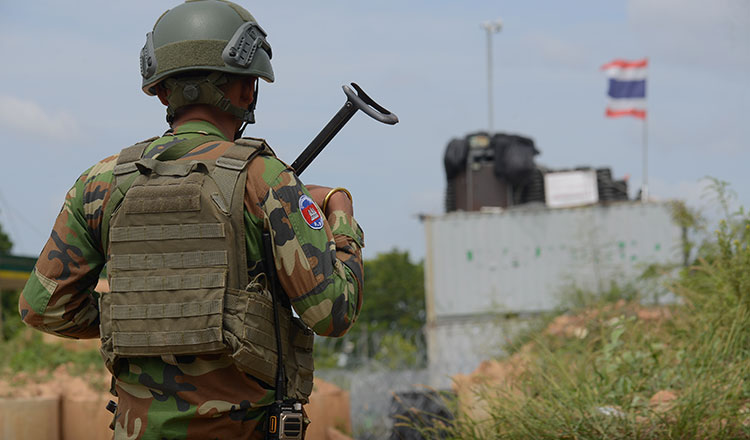 Containers, barbed wire and Thai flags deployed by the Thai military in Boeung Trakoun, Kouk Romiet commune, Thmar Puok district, Banteay Meanchey province. KT/Heng Chivoan
Synopsis: Hundreds of displaced families remain stranded in resettlement shelters months after a ceasefire, as military fortifications and allegations of looting transform a once-thriving trading hub into a heavily militarised zone.
Once a bustling border town where lorries queued to transport agricultural produce through a key Cambodia–Thailand checkpoint, Boeung Trakuon has become a place defined by silence, abandoned homes and military fortifications.
Today, the strategic border crossing in Thmar Puok district bears little resemblance to the thriving community where local villagers once earned their livelihoods from farming and cross-border trade.
Streets formerly crowded with traders are deserted. Homes stand empty, and schools and markets have fallen silent. Shipping containers, barbed wire, sniper positions, military trenches on both sides of the line of actual control, and heavy weapons now dominate the landscape. Displaced residents have also accused Thai troops of looting homes and property left behind after families were forced to flee.
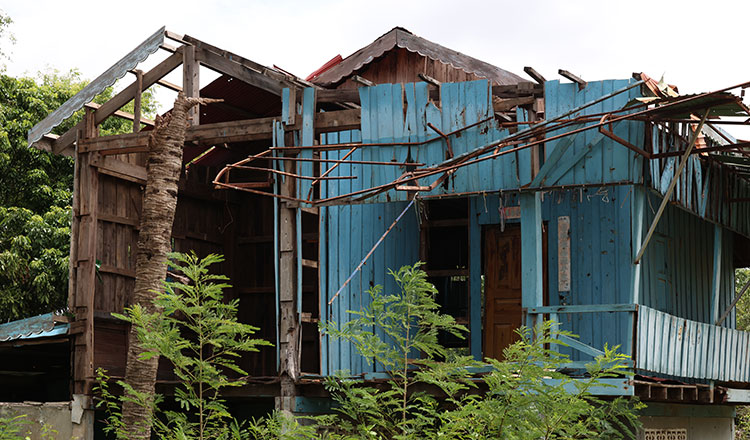
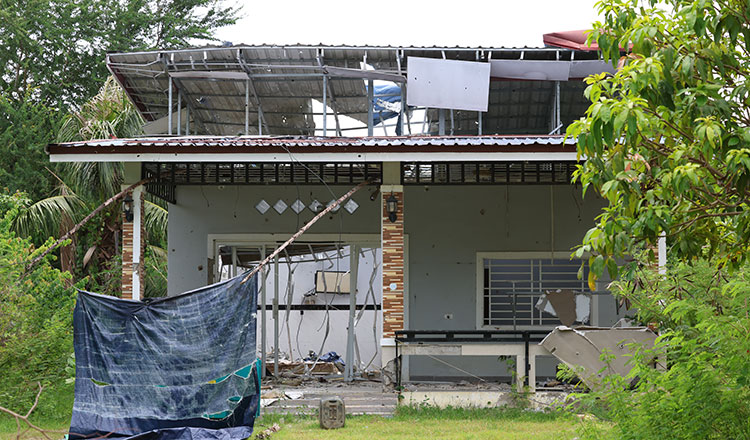
A rare visit by reporters to the restricted area – just a few hundred metres from the frontline where troops remain in close proximity – revealed that the roofs and walls of most homes were riddled with holes or reduced to rubble. The damage was the result of a 21-day Thai military incursion in December, which resulted in the partial occupation of Cambodian territory.
Located in Kouk Romiet commune, Boeung Trakuon serves as a key gateway linking Banteay Meanchey province with Thailand’s Sa Kaeo province. The area includes the Boeung Trakuon Border Checkpoint and the surrounding villages of Phlov Damrei, Samakki Meanchey, Banteay Mean Rith and Boeung Samraong.
The town became one of the main flashpoints during the border clashes in December last year. Although Cambodia and Thailand signed a ceasefire agreement on December 27, Cambodian authorities say Thai troops have continued to occupy parts of the territory by erecting barbed wire, placing shipping containers, establishing military positions and preventing residents from returning.
Despite the presence of a permanent border marker and a border checkpoint with immigration and customs offices marking the international boundary, Thailand continues to occupy the area.
Local authorities stated that Thai troops converted the roofs of abandoned Cambodian homes into military bunkers and sniper positions after the December 27 ceasefire came into effect.
Officials said these military installations were built inside Cambodian territory following the truce, constituting a violation of the agreement. They noted the actions run counter to confidence-building measures outlined in the Joint Statement adopted at the Third Extraordinary General Border Committee – GBC – meeting, which called for reducing tensions along the border.
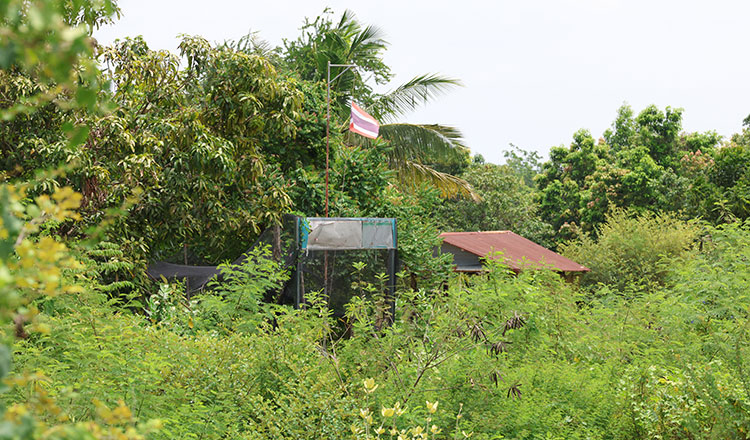
According to Banteay Meanchey Provincial Governor Oum Reatrey, Thai troops are occupying 584 hectares of Cambodian territory with the aid of 26 shipping-container blockages in 13 separate locations.
For hundreds of displaced families, the former commercial centre has become a symbol of loss. Among them are Phok Sucheat, 47, and his wife, Ang Sophat, 45, former residents of Banteay Mean Rith village. Like hundreds of other families, they fled when fighting erupted and were relocated to Rong Cham – or “Waiting Village” – a government-built resettlement site about 90 kilometres from the frontline.
The new settlement offers each family a permanent house, electricity, clean water and enough land to begin rebuilding their lives. Their children have returned to school, and families no longer live in temporary tents. Yet despite the improved conditions, Rong Cham is not home.
Sucheat said his family’s greatest wish is to return to Boeung Trakuon, where their farmland, home and memories remain. “We want to go home,” he said.
His hope is shared by hundreds of displaced villagers who continue following developments along the border while waiting for a peaceful resolution. Sam Sith, 63, and his wife, Suon Nhip, 62, now live on a 20-by-30-metre plot allocated to them in Rong Cham village, Svay Chek district. Sith alleged that Thai soldiers looted homes in the occupied villages after the ceasefire.
Video clips filmed by Thai soldiers themselves after the December ceasefire appear to show the destruction of police property and the widespread looting of villagers’ belongings, including vehicles, motorbikes, bicycles, household items and even pets.
“They looted everything, even household items and cattle,” Sith said, adding that he lost 28 head of cattle and more than 150 ducks and chickens, in addition to his home and farmland.
Speaking to reporters, Banteay Meanchey Deputy Governor Khlok Nouy said provincial authorities have classified affected residents into three groups based on security conditions.
The first group comprises families who have been able to return to their homes. The second includes those living in high-risk areas outside the barbed-wire barriers erected by Thai forces, where authorities say it remains unsafe for civilians to return.
He said 65 families from Boeung Sokrom village remain displaced because their homes are located between Cambodian military positions and the Thai barbed-wire fence. “Those families are still living at the displacement site because the area remains dangerous,” he said.
For these families, the primary question is whether they can one day return to the homes they abandoned, cultivate their land again and restore a border town that has become both a symbol of Cambodia’s territorial struggle and the resilience of its people. Until that day comes, Rong Cham remains a place of waiting.
Residents of Chouk Chey and Prey Chan villages in O’Chrov district have been relocated to Rong Cham, while provincial authorities estimate that a total of 1,869 families from the wider Boeung Trakuon area have been affected by the conflict.
Nouy said the situation on the ground has remained largely unchanged since the December 27 ceasefire agreement. “The figures have not changed since the ceasefire,” he said, adding that nearly 800 hectares across three locations remain under what Cambodia considers illegal Thai occupation.
Asked why villagers had not been allowed to return to homes outside the Thai barriers, he said security remained the overriding concern. “Even if we allowed them to return, they would not dare to go back,” he said.
He said Chouk Chey village alone was struck by around 60 artillery shells in a single day during the fighting. “The shelling was extremely intense,” he said.
Nouy said the decision on when displaced residents can return rests with the Royal Government, which continues to pursue a peaceful resolution through negotiations with Thailand. “The Royal Government is resolving the issue with the Thai side. As provincial authorities, we are waiting to implement whatever policy the government decides,” he said.
He added that displaced families will remain at Rong Cham until conditions are safe enough for their return. Provincial authorities also said there has been no change in the number of shipping containers, military positions and other fortifications erected by Thai forces in the Boeung Trakuon, Chouk Chey and Prey Chan areas since foreign diplomats visited the border earlier this year.
The government has repeatedly reaffirmed that Cambodia remains committed to resolving the border dispute peacefully through existing bilateral mechanisms and international law.
This week, Cambodia again urged Thailand to respect both the spirit and the substance of the December 27 GBC Joint Statement, arguing that the agreement does not permit either side to alter conditions on the ground through military construction or occupation.
A Cambodian official rejected Thailand’s call for Cambodia to rely solely on bilateral mechanisms, saying Bangkok has repeatedly delayed and obstructed the work of the Joint Boundary Commission – JBC –.
“Calling on Cambodia to use bilateral mechanisms while Thailand continues to delay the JBC process and pursue unilateral activities on the ground is clearly contradictory,” the official said.
The official urged Thailand to halt activities that could alter the status quo, respect the GBC Joint Statement and resume border demarcation through the JBC without further delay.
Meanwhile, Ministry of National Defence spokeswoman Lieutenant General Maly Socheata yesterday reiterated that Cambodia maintains a firm position on protecting the Cambodia–Thailand international border as established by the Indochina–Siam Boundary Commission.
She said this position is in accordance with international law, including the principle of uti possidetis juris – the Franco-Siamese conventions and treaties, official maps, the procès-verbaux of the Commission for the Delimitation of the Boundary between Indo-China and Siam, and other bilateral agreements previously accepted by both countries.
Cambodia does not recognise any alteration of the international border resulting from the use of force, she added.
But for the people of Boeung Trakuon, resolution is not simply about maps or boundary markers – it is about the future of their homes.
-Khmer Times-
________________
Photo:
– Containers, barbed wire and Thai flags deployed by the Thai military in Boeung Trakoun, Kouk Romiet commune, Thmar Puok district, Banteay Meanchey province. KT/Heng Chivoan
– A destroyed home in the Boeung Trakuon area of Banteay Meanchey province amid illegal occupation by Thai military since late December. KT/Khem Sovannara
– A Thai flag flies on Cambodia’s territory in Boeung Trakuon, Kouk Romiet commune, Thmar Puok district, Banteay Meanchey province. KT/Heng Chivoan
– Abandoned home in the Boeung Trakuon area of Banteay Meanchey province amid occupation the Thai military since late December. KT/Khem Sovannara