Cambodia’s growth engine is its skill set
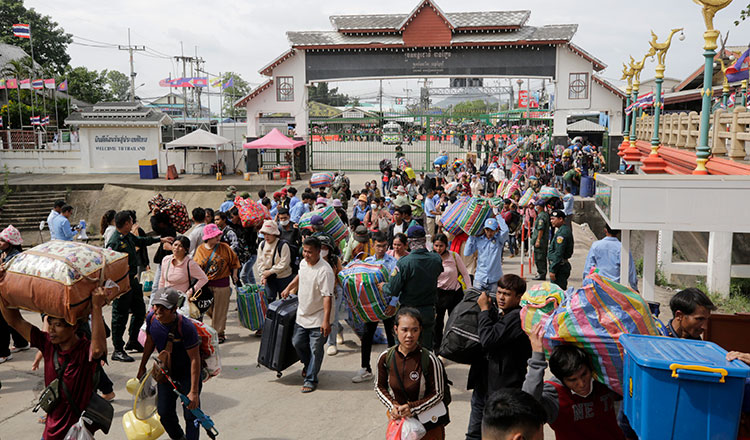 Cambodian migrant workers return from Thailand amid border tensions via the Daung International Border Checkpoint in Battambang province’s Kamrieng district last year. KT/Chor Sokunthea
#Editorial
Cambodia is facing a perfect storm.
The pressures come from outside: the erosion of international law and global governance, armed conflicts, geopolitical rivalry, trade wars, tech wars, climate crisis and the existential threat posed by Thailand.
They also come from inside: a slowing economy, a struggling banking sector, high energy cost, food inflation, online scams, fake news, and social contract or public trust in government.
Moments like this are fraught with risk. Yet crises also create the political space for reforms that would be difficult, if not impossible, to implement under normal circumstances.
Political leadership is therefore critical. The challenge is to govern a country like running a high-performing private enterprise – prioritising productivity, efficiency, innovation, and long-term competitiveness – while remaining accountable to the public interest. Cambodia can learn from Vietnam’s reform journey.
Currently, some government ministries and agencies are adept at producing overly optimistic reports, yet these are often not accompanied by clear, transparent and robust monitoring and evaluation mechanisms.
Some ministers should have enough courage to face the hard truth and execute reforms to improve their performance.
The state and the market now need to shift into crisis leadership mode – turning threats and risks into opportunities. Business as usual does not fit.
The state itself needs surgery, not another committee. Merge the ministries that duplicate each other, end the overlapping mandates, force the agencies to work from one plan, and cut out corruption and nepotism at every level. The public is already asking for this. The question is whether the state answers.
This editorial focuses on one part of that reform agenda: the workforce.
The problem is skills mismatch
The most striking finding in Cambodia’s recent labour data is not that people cannot find work. It is that people are in the wrong work.
The Skills and Job Mismatch Survey found that only 48.9% of workers are matched to their education level. Some 21.8% are underqualified for their jobs. Another 29.3 percent are overqualified.
Industry is expected to create about 292,000 jobs a year between 2025 and 2027. Services will add about 224,000 more.
Yet employers in these growing sectors still say they cannot find workers with the right technical and workplace skills.
Moreover, young people are drifting, too. Labour force participation among those aged 15 to 19 has fallen sharply – exactly when the move from school to work matters most.
Judge people by what they can do
Employers have long used degrees and past job titles as a shortcut for judging ability. That shortcut no longer works well.
It shuts out workers who learnt on a factory floor, in a family business or through an online course. It also overrates graduates whose training never covered the actual tasks of the job.
A skills-first approach flips this around. It asks what a person can do, not where they learnt to do it.
The tools already exist: skills taxonomies that describe ability in detail, practical assessments that test it directly, and microcredentials and workplace training that build it quickly.
Modern work needs four things at the same time – specialised technical and entrepreneurial skills, strong basic and problem-solving skills, social and emotional skills like teamwork and leadership, and digital skills across all of them.
A skills-first system widens the talent pool.
Four priorities are suggested.
1. Make recognition of prior learning the default
Cambodia’s informal economy is full of unrecognised skills – in construction, tourism and hospitality, trade, agriculture and household businesses.
Recognition of prior learning turns that experience into a credential a worker can carry and use.
It should be funded as permanent infrastructure and linked to employment services and TVET entry – not run as a small pilot.
2. Let employers help design training
The government’s plan to bring 1.5 million young people from poor and vulnerable families into TVET is the right decision.
But size alone will not fix a mismatch.
Expansion needs stronger employer involvement in curriculum design, better trainers, competency-based teaching, and real work-based learning.
Firms in electronics, electrical components, car assembly, food processing, and ICT are reshaping labour demand. They should sit at the design table – and public co-financing should depend on it.
3. Treat mismatch early
Jobs are concentrating in industrial centres and growth corridors.
Workers cannot respond to demand they cannot see.
Modern employment services, clear skills profiles, and support for skill development and on the job training.
For teenagers aged 15 to 19, this means visible pathways early – apprenticeships, internships and career guidance that start before they leave school, not after.
4. Formalise through productivity
The government is formalising the informal workforce, but the process should be gradual and based on voluntary participation rather than compulsion.
Formalisation is more likely to succeed when it offers tangible benefits to businesses, such as simpler administrative procedures, access to training, improved social protection for workers, and clear gains in productivity.
Noticeably, Cambodia’s industrial value added per worker remains well below that of Thailand and Vietnam. Closing this productivity gap will require stronger skills alignment, greater adoption of new technologies, improved workplace organisation and sustained investment by firms in developing their workforce.
The window is now
Skills systems take years to build, which is why the work has to start now.
The Ministry of Labour and Vocational Training will have to lead it – with new energy with systemic thinking and solutions. The current approach is not keeping pace with how quickly labour demand is changing.
What is needed is a new strategic direction, backed by performance targets that measure real outcomes: how many workers are placed in jobs matching their training, how many firms take part in designing courses, how far the mismatch rate actually falls.
Because what changes Cambodia’s trajectory is a workforce able to move – into higher-value manufacturing, into services, into work that competes on capability and productivity rather than low-cost workforce.
It needs to move up the value chain by investing in a highly skilled workforce and embracing a knowledge-based, technology-driven and innovation-led economy. -Khmer Times-