Four years on, Russia’s war on Ukraine has become a war on civilians
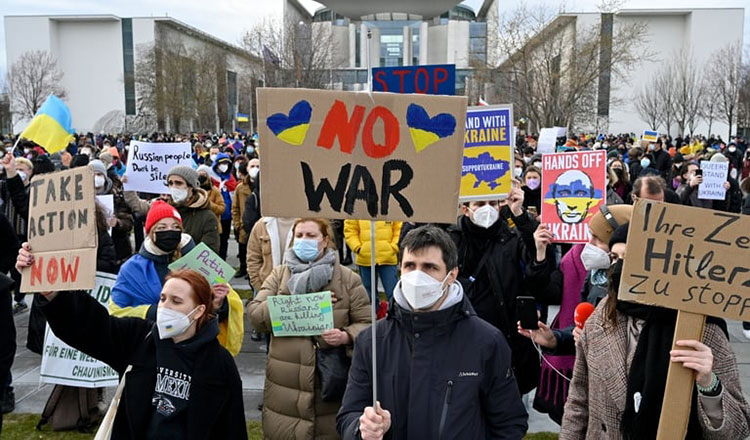 People protest against Russia’s invasion of Ukraine in front of the Chancellery in Berlin, February 2022. AFP
#opinion
Four years have passed since Russia’s full-scale invasion of its sovereign and independent neighbour, Ukraine. Russia’s aggression threatens the security of all states by violating the UN Charter and triggering severe global repercussions, including in ASEAN states. It has deepened political divisions, strained international institutions and diverted attention from global priorities such as development and climate action. Economically, it has disrupted food and energy supplies, fuelling inflation worldwide. Despite Russia’s attacks, Ukraine continues to contribute to global food security through EU-supported Solidarity Lanes and maritime corridors. The European Union remains committed to supporting Ukraine politically, economically, militarily and humanitarianly.
Since the start of the invasion, more than €193 billion in assistance has been provided by the EU and its member states.
A strategy built on civilian suffering
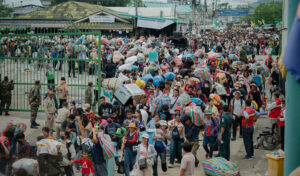
Russia’s war of aggression against Ukraine is no longer only about a vast territorial invasion —it has become a war on civilians. Since the start of the aggression, thousands of civilians have been killed and millions displaced. Russia has failed to achieve its goals on the battlefield despite the cost of more than one million soldiers injured, killed or detained. After bravely defending itself for four years, Ukraine remains a sovereign country with a democratically elected government, exposing the limits of Russia’s military power.
Unable to secure military gains, and contrary to its claims of seeking peace, Russia has turned to a cynical strategy: systematic attacks on civilians and energy infrastructure. These strikes are timed for maximum harm, intensifying as the bitter cold Ukrainian winter takes hold and turns blackouts into life-threatening emergencies. When power plants are hit, hospitals shut down, water systems fail, and families are left to freeze. Russian claims that these attacks are defensive ring hollow when the targets are apartment blocks, grain terminals and hospitals. The objective is clear: to break the will of the Ukrainian population by making daily life unbearable. And the message is unmistakable: surrender or freeze to death. Ukraine’s resilience in the face of these attacks is extraordinary, but international humanitarian law is clear: civilians and civilian infrastructure must not be targeted. Russia’s weaponisation of winter mock that principle.
Way forward
Four years on, one truth is evident: Russia’s war is against Ukraine as well as against the international order. The proper response is not fatigue or indifference but sustained solidarity and clarity about what is at stake. After four years of war, 2026 must be the year the Russian aggression against Ukraine comes to an end. Ukrainians have shown remarkable resilience and a clear commitment to a just and lasting peace. Jointly with the US and with Europe, Ukraine has called on Russia to finally come to the table and negotiate in earnest. Russia, however, speaks of peace during the day, but its attacks at night tell another story.
When a state seeks to win by freezing cities, attacking civilians, and denying sovereignty to established democracies, defence and support for the defending people becomes crucial. Evidently, defence and reconstruction of Ukrainian energy infrastructure is more than an engineering task. It becomes a defence of the very idea that civilians are not legitimate targets—and that Europe will not be intimidated by darkness.
The principles of the UN Charter—sovereignty, territorial integrity, and the peaceful settlement of disputes—are universal. If aggression is rewarded, these principles risk becoming negotiable, weakening global stability far beyond Europe. If borders can be changed by force in Ukraine, others will be tempted to try the same elsewhere.
The authors are Igor Driesmans, Ambassador of the European Union to Cambodia; Stefan Messerer, Ambassador of Germany to Cambodia;
Olivier Richard, Ambassador of France to Cambodia; and Markéta Kolc Hájková, Ambassador of the Czech Republic to Cambodia.
-Khmer Times-
—————-