Hun Sen-Kem Sokha overtures hailed as rare sign of political solidarity
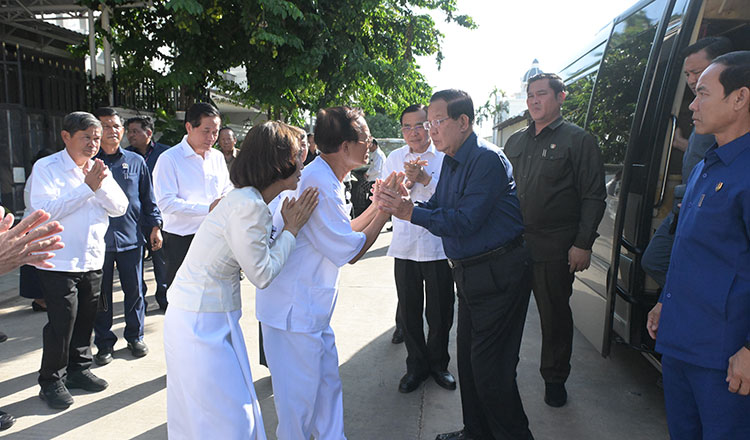 Kem Sokha (2-L) greets Senate President Hun Sen at the funeral of the former’s mother in Phnom Penh on July 10. KT/Khem Sovannara
Synopsis: Analysts praise Senate President for attending the funeral of ex-opposition leader’s mother and the family’s gracious response as a display of national unity.
The friendly exchange of words and gestures between the head of the ruling Cambodian People’s Party and the former leader of the defunct Cambodia National Rescue Party has been hailed as a positive sign for the political environment as the Kingdom faces external challenges.
Hours after the death of former CNRP President Kem Sokha’s mother, Sao Nget, was announced July 9, Senate and CPP President Hun Sen sent a condolences letter to Sokha and his family.
“During this time of profound grief, my wife and I would like to extend our heartfelt condolences, sympathy, and sorrow to you, your spouse, and your entire family over the loss of a beloved mother, mother-in-law, grandmother, and great-grandmother — a person of immeasurable value who embodied the virtues of compassion, kindness, and exemplary support for her children, children-in-law, and grandchildren,” he wrote.
In a reply letter, Sokha’s daughter, Kem Monovithya, on behalf of the family, thanked the leader for the letter.
“My family and I are profoundly grateful for Samdech Techo [Hun Sen]’s kindness, compassion, and humanitarian concern shown to our family during this difficult and sorrowful time,” she said.
On July 10, Mr Hun Sen attended Nget’s funeral. Senate spokesman Chea Thyrith said he visited the funeral after concluding a mission to Cambodia’s northeastern provinces.
The family said Nget was buried in Trapeang Trakiet village, Oudom Soriya commune, Tram Kak district, Takeo province. As part of traditional Buddhist mourning rites, Sokha was temporarily ordained as a monk on July 11 in front of the funeral pyre.
Senate Second Vice-President Thun Vathana, who also sent condolences, described the decision to attend the funeral as a demonstration of compassion that transcends political differences.
Vathana said the gesture underscored the importance of moral values in leadership, adding that leaders should show empathy for citizens during times of grief. He added that the act reflected a commitment to strengthening national unity.
“The leader’s condolences at the funeral of the opposition leader’s mother reflect kindness, humanity, moral integrity and unity across every divide — a good example for all to follow,” he said.
Such gestures, Vathana added, send a message that political differences should never undermine mutual respect.
“Acts of goodwill can contribute to reconciliation, foster trust and strengthen the spirit of cooperation within Cambodian society,” he said.
He added that Cambodia’s progress depends on a culture of dialogue, mutual understanding and national unity.
Seun Sam, a policy analyst at the Royal Academy of Cambodia, said the exchange between the two politicians on opposing sides of the aisle demonstrates solidarity.
“Although they may have different political views, there should be certain boundaries within which politicians at all levels in Cambodia show unity. One of those is expressing condolences whenever a politician, especially someone close to them, loses a loved one,” he said.
“This is a moment when Cambodian politicians should demonstrate solidarity with one another for the benefit of the nation.”
Sam added that showing solidarity and compassion towards one another is important for the country.
“This is especially true in the current circumstances, when Cambodia’s neighbouring country is looking for opportunities to create problems for Cambodia. That makes it even more important for all Cambodian politicians to demonstrate unity,” he said.
“We cannot remain in conflict with one another all the time. Political rivalry should be limited to differences over policies. When it comes to the national interest, we should unite and work together so that the country can continue to develop, maintain peace and stability, and achieve greater progress.”
Sokha, 72, was arrested in 2017, and sentenced to 27 years in prison on charges of colluding with a foreign power to overthrow the government.
He was granted a royal pardon on May 25, securing his release from house arrest, though he remains subject to a lifetime ban on political activity and a five-year restriction on foreign travel.
-Khmer Times-