A soldier’s memories of the Prey Chan border area
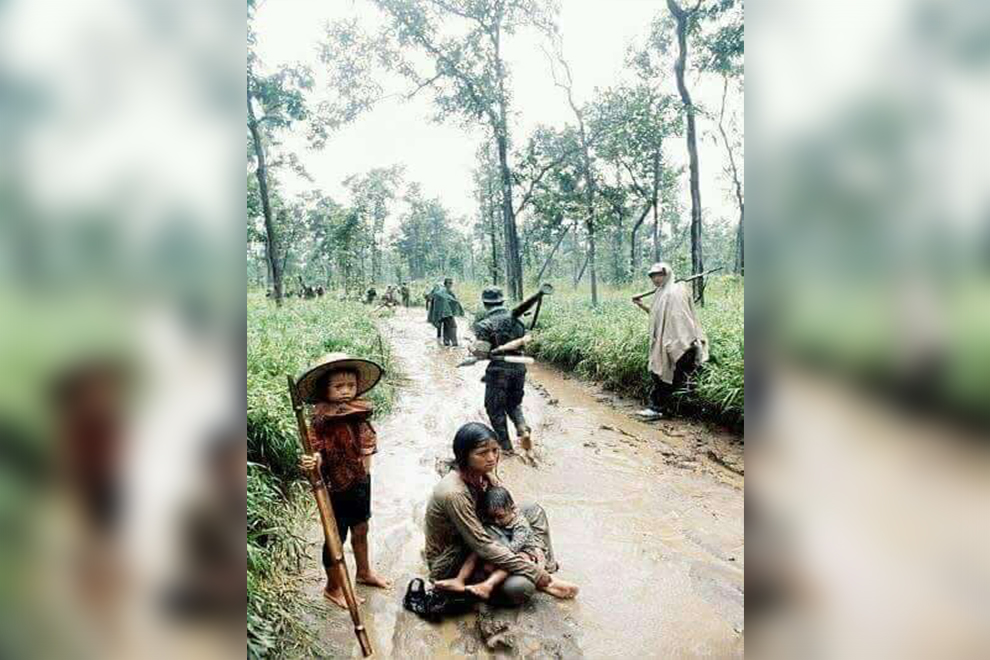 Soldiers march south, as a woman and her children sit, disconsolate, in the rain. This photograph was likely taken near Ang Sila in 1982, along the road leading to the Nong Chan refugee camp. Supplied
-Opinion-
This is a story that some may not know, but all should remember.
As a living eyewitness with clear memories of the border areas in the early 1980s, I remember the four major forts that served as strongholds in front of the Nong Chan Refugee Camp, protecting it from attacks.
These forts were vital for defending the Nong Chan Refugee Camp. It’s hard not to question why Thailand truly agreed to their presence, especially if they considered them to be illegal on Thai soil.
There was also a long dam dug by Thai authorities behind the camp, ostensibly to mark the border. I often wonder, where is it now?
Defending the refugees
The Eastern O’Ta Russei Srok forts were commanded by Chear Rithychut, while the Western O’Ta Russei Srok was commanded by Kong Sileah and Nhem Sophon.
Banteay Prey Preah Pnov was located west of O’Ta Russei Srok. Khan Savoeurn of Battalion 125 was in command. Ang Sila fort was led by Ta Chet, Ta Klem, Ta Sro Keal, and Mr. Saem.
Kong Sileah and Nhem Sophon had unified command of the Western O’Ta Russei Srok, Banteay Prey Preah Pnov, and Ang Sila forts.
In front of Banteay Prey Preah Pnov fort, there were two smaller outposts.
Banteay O’Pong Ro, where I served, led by company chief Phoung Pheurng.
To the east was Banteay Beung Prinh fort, commanded by company chief Yim Heng. This fort was established specifically to protect Banteay Prey Preah Pnov.
The battle begins
On November 18, 1982, the forts were heavily attacked by the People’s Army of Vietnam (PAVN) 9th Division. The camp’s 30,000 refugees were evacuated to Site 3 (Ang Sila), a laterite quarry about four kilometres west of the camp.
A new temporary camp was later set up at Site 6, later known as Prey Chan. From there, many refugees were sent to the Khao-I-Dang Holding Centre, while others were resettled at Site Two Refugee Camp or transported to O’Smach camp.
My company, at Banteay O’Pong Ro, faced a fierce onslaught.
We were besieged by Vietnamese troops for two nights and three days.
Eventually, we were forced to retreat to Banteay Prey Preah Pnov, as Banteay Beung Prinh had been taken by the Vietnamese on the second day of fighting.
Our retreat continued, first to Phum Thme, then to Ang Sila, and finally to O’Beichaon, where we were bused to O’Smach.
A few months later, we made our way through the jungle and forest on foot to Ta Tum Camp.
Tesh Chanthorn is a Cambodian veteran who longs for peace.
-The Phnom Penh Post-