ASEAN must stay course to ensure methodical diplomacy succeeds
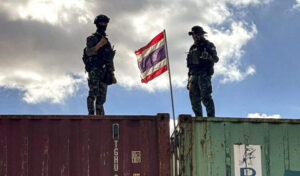
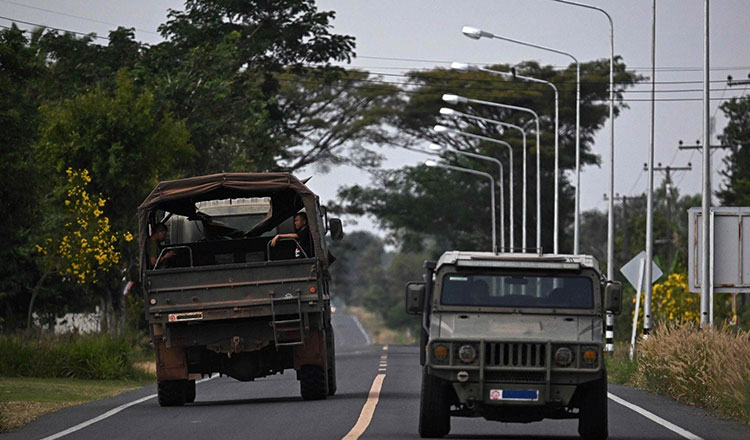 Thai military vehicles are pictured on a road in the Thai border province of Surin on Thursday, amid clashes along the shared border with Cambodia. Renewed fighting raged at the Cambodia-Thailand border on Thursday, with combat heard near centuries-old temples. AFP
#opinion
Border clashes in Southeast Asia rarely expand into major wars. But they recur often enough to unsettle capitals, disrupt border communities, and reveal deeper vulnerabilities within the region.
Thailand and Cambodia’s latest flare-ups illustrate a persistent pattern: violence that is serious enough to shake bilateral relations but not sustained enough to break into whole conventional conflict.
Understanding the difference between these recurring clashes and a full-scale war requires examining the sub-systemic risks embedded within each state.
These are pressures—political, military, social, and even criminal—that accumulate beneath the surface long before any shot is fired.
Persistent border clashes often stem from tactical triggers. Patrols stumble into disputed territory.A landmine detonates. Local commanders respond too quickly or too aggressively.
Such incidents are often unplanned, yet they occur against a backdrop of political sensitivities in both capitals.
Thailand, for example, is managing grave domestic pressures following devastating floods in its southern provinces and the countdown to a general election early next year.
These pressures create conditions in which even minor incidents can be interpreted through the lens of political vulnerability.
When governments face public scrutiny or electoral anxiety, they may see military firmness as a way to project stability.
The danger is that firmness can be misread as preparation for a broader offensive, feeding a cycle of accusations and counter-accusations that keeps the border tense.
A major conventional war, however, requires something much more deliberate.
It involves sustained mobilisation, clear political intent, and a willingness to absorb enormous economic and human costs.
None of these conditions exists between Thailand and Cambodia.
Their economies are too interdependent, their diplomatic ties too deep, and their shared participation in ASEAN too crucial for either side to gamble on a destructive war.
Sub-systemic risks lie between these two realities. They do not automatically trigger conflict, but they create environments in which clashes can escalate faster than expected.
One of these risks is the mismatch between political rhetoric and military capability.
When leaders issue strong statements to reassure domestic audiences, they risk amplifying perceptions of threat in the opposing capital.
As Thailand increases combat readiness and Cambodia reinforces positions along its frontier, both sides begin planning for the worst even if neither wants a sustained conflict.
Another risk comes from non-traditional actors operating in border zones.
The frontier between Thailand and Cambodia is not just a military space; it is also a corridor for smuggling syndicates, cyber-scam networks, and other illicit groups that benefit from ambiguity and instability.
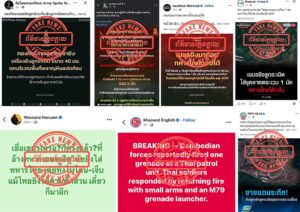
These actors can provoke clashes, sabotage communications, or spread misinformation.
The more persistent the clashes, the more space these groups gain to shape events in ways that national governments struggle to control.
Domestic politics adds yet another layer. As Thailand approaches an election year, every confrontation risks being interpreted as a test of leadership rather than a technical military incident.
Cambodia, in turn, views any Thai escalation as a signal of shifting political winds.
Subsystemic risks accumulate precisely when leaders fear being seen as weak, mainly when natural disasters, economic anxiety, or coalition pressures burden their administrations.
ASEAN cannot eliminate these risks. But it can manage them— primarily through the Kuala Lumpur peace accord, which provides an established, respected framework for de-escalation.
The accord does not prevent the first incident, but it provides a diplomatic lane to avoid additional incidents from spiralling out of control.
Its verification mechanisms require access and time; they cannot deliver instant answers after an explosion or artillery exchange.
Yet the patience required for verification is precisely what prevents emotional reactions from dominating military decision-making.
ASEAN’s strength lies in its ability to prevent local clashes from becoming regional crises.
Strengthening the ASEAN Observatory Team and empowering defence attachés stationed in both capitals can enhance the region’s early-warning capacity.
Fast, quiet, and professional fact-finding prevents misunderstandings from amplifying political anger.
The most significant risk today is not an imminent major war. It is the cumulative effect of persistent clashes that slowly but steadily erodes trust.
Each exchange of fire shortens the distance between tactical missteps and strategic miscalculations.
If domestic pressures grow in Bangkok or Phnom Penh, the line between a border skirmish and unintended escalation can blur.
To maintain regional stability, ASEAN must continue reinforcing its frameworks, supporting its member states, and nurturing mechanisms that keep sub-systemic risks from becoming systemic failures.
Southeast Asia has avoided major war for decades, not by accident but through deliberate, methodical diplomacy. It must stay that course.
The writer is a Professor of ASEAN Studies and the Director of the Institute of International and ASEAN Studies at International Islamic University Malaysia. First published in New Straits Times
-Khmer Times-