When ‘Status Quo’ Becomes a Tool of Occupation
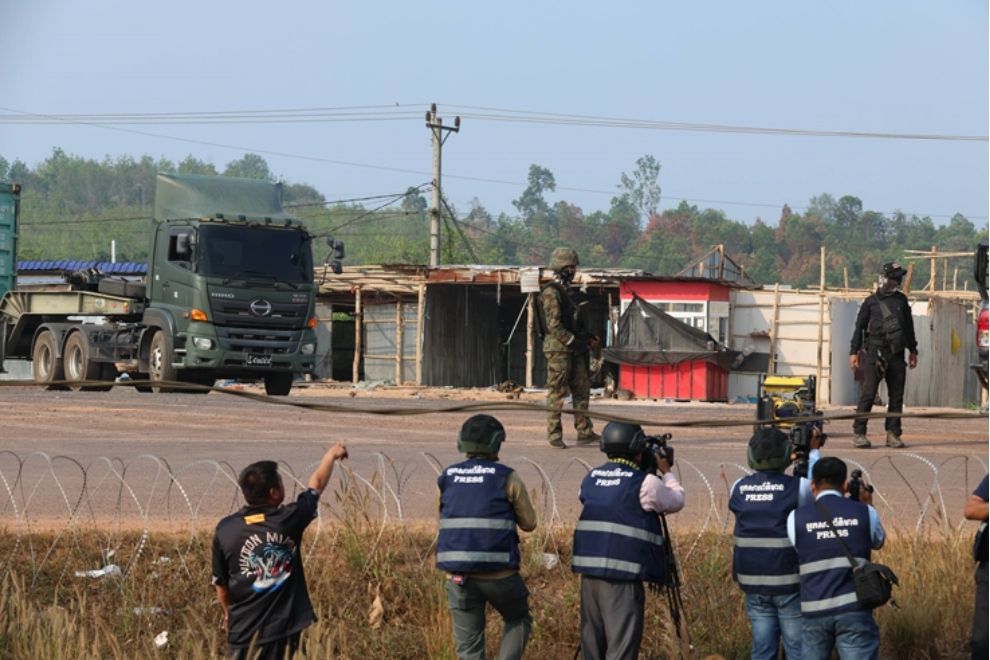 This morning, February 7, Thai forces used shipping containers to block a road in Pursat province. AKP
#opinion
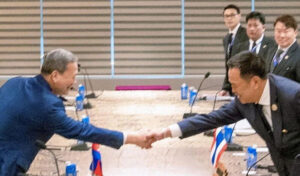
Peace declarations are meant to stop wars — not to reward those who create crises. Yet in Cambodia’s border dispute with Thailand, the Peace Declaration of December 27, 2025 risks becoming exactly that: a diplomatic shield behind which unlawful occupation quietly hardens into permanent control.
The Peace Declaration was intended to serve a clear and constructive purpose. It was meant to reduce tensions, prevent escalation and create the diplomatic space necessary for Cambodia and Thailand to resolve their
boundary dispute peacefully and lawfully. It was not designed to determine sovereignty. It was designed to preserve stability while negotiations and technical demarcation continued.
In principle, such declarations benefit both states. They reduce the risk of armed confrontation, protect civilians living along sensitive border areas, and reassure ASEAN and the international community that dialogue — not force — will guide the relationship forward. They also provide political breathing room for both governments to pursue negotiations without appearing weak at home.
However, peace declarations also carry an inherent risk: when one party already exercises physical control over disputed territory, the language of “status quo” can become strategically imbalanced. What is presented as a confidence-building measure may, in practice, freeze an unjust reality. It can restrain the lawful claimant from responding, while allowing the occupying side time to consolidate control.
This is precisely why Cambodia must treat the “status quo” clause not as a neutral safeguard, but as a potentially dangerous instrument — one that can be exploited quietly and systematically.
The central bargain behind the Peace Declaration is simple: both States are expected to exercise restraint, avoid provocation and ensure that the unresolved boundary dispute is settled through peaceful and lawful means. Such commitments are not meant to produce winners on the ground. They are meant to prevent either party from taking unilateral actions that prejudice negotiations. Under international law, agreements must be performed in good faith. A duty of good faith requires more than avoiding gunfire — it requires refraining from actions that aggravate the dispute or alter the conditions of disputed territory.
In this context, “status quo” cannot reasonably be interpreted as a license for one side to fortify its position. It must be understood as an obligation to maintain neutrality and to avoid creating new “facts on the ground” while the boundary remains unsettled.
Recent developments raise serious concern that Thailand may be violating this principle. Reports of increased military presence, the installation of barbed wire barriers, the movement of logistical containers and restrictions on civilian access are not merely defensive precautions. They represent unilateral measures that strengthen de facto administrative control and reshape realities on the ground. Such conduct contradicts the very purpose of the Peace Declaration, which is to prevent escalation and preserve conditions for meaningful negotiation.
The concept of “status quo” in a border dispute is frequently misunderstood. It is not merely a promise to avoid shooting. It is a commitment to avoid manipulating reality. It means no reinforcement designed to expand control, no fortification, no new construction, no barriers restricting movement and no administrative acts intended to display sovereignty. When one side erects fences, installs barbed wire, expands infrastructure and restricts access, it is no longer maintaining the status quo — it is manufacturing a new one.
Thailand’s conduct demonstrates not restraint, but calculated bad faith. The Thai military appears to be exploiting the “status quo” clause as a strategic loophole — using the language of peace to justify actions that directly contradict peace. Instead of freezing tensions, Thailand is freezing injustice. Instead of preserving neutrality, it is engineering permanence. This is not an accidental misunderstanding of diplomatic language. It is a deliberate manipulation of good faith commitments to create irreversible “facts on the ground” while Cambodia is restrained by its own promise of peace. In effect, the Peace Declaration is being transformed into an occupation strategy: diplomacy on paper, annexation in practice.
Even more troubling is the reported introduction of foreign personnel and the organisation of visits and tours involving foreign individuals and entities in disputed areas. These are not harmless activities. They amount to public displays of authority and political theatre intended to project sovereignty to outside observers. In territorial disputes, the staging of foreign visits is a recognised tactic of legitimisation. It signals control, normalises occupation and creates the impression of undisputed administration.
Over time, it can influence international perception — even when the legal title remains unresolved, international law is clear: sovereignty is not created through occupation, tourism, or unilateral administration. Territory cannot be lawfully acquired by force, coercion or creeping entrenchment. Physical control does not equal legal ownership. Yet in practice, prolonged control combined with silence can gradually reshape political outcomes. That is why these actions cannot be dismissed as routine border management. They are strategic acts that undermine negotiations and prejudice Cambodia’s lawful claim.
Thailand’s approach appears to follow a familiar and troubling pattern: establish control, fortify positions, restrict access, normalise administration and later claim that prolonged occupation is proof of legitimacy. Over time, temporary occupation begins to appear permanent — not because the law has changed, but because the facts have been engineered to appear settled.
This is not good-faith negotiation. It is strategic consolidation.
Cambodia must not allow the Peace Declaration to become a diplomatic trap. Cambodia’s commitment to peace and restraint must never be interpreted as consent, recognition or acquiescence. Yet if Cambodia responds passively — without continuous protest and firm legal positioning — Thailand may succeed in transforming the status quo into a long-term advantage.
This is why Cambodia must act decisively now. Cambodia must insist that “status quo” means genuine neutrality, not unilateral fortification. Cambodia must formally protest any construction, fencing, foreign visits, commercial exploitation or administrative acts in disputed areas. Cambodia must reaffirm consistently — through official notes, ASEAN engagement and international documentation — that all temporary arrangements are strictly without prejudice to Cambodia’s sovereignty and legal rights. Cambodia should also demand credible joint monitoring mechanisms or third-party observation to prevent further unilateral entrenchment.
At the same time, Cambodia must confront a reality at home: public confidence is being tested. Many Cambodians are no longer satisfied with quiet diplomacy while disputed land is fenced, fortified, and treated as if it were already lost. The growing demand for international litigation is not emotional nationalism — it is a rational response to a dangerous pattern. The public understands that prolonged negotiation without enforcement only buys time for de facto occupation to become normalised.
They see that status quo arrangements, when abused, do not preserve peace; they preserve advantage. For Cambodia, international litigation is not merely a legal option—it is increasingly a strategic necessity to prevent Thailand from converting temporary control into permanent entitlement.
But international litigation must be pursued with seriousness and competence, not as political theatre. In the absence of transparent public information, many Cambodians understandably fear that Cambodia is being restrained by diplomacy while Thailand consolidates control on the ground.
If the government is preparing an international legal case — as it should — then it must make one principle unmistakably clear: Cambodia will litigate internationally, but Cambodia will litigate to win, not merely to perform. Every formal protest, every verified map, every satellite image documenting fortifications and every diplomatic note submitted to international bodies is not a substitute for litigation; it is the evidentiary foundation upon which litigation succeeds. Cambodia cannot afford symbolic legal action. It must pursue a disciplined legal strategy capable of prevailing under international law.
International litigation cannot succeed on emotion alone. It requires jurisdiction, evidence and strategy. Cambodia cannot simply “go to court” unless a forum has authority to hear the dispute — whether through Thailand’s consent, an applicable treaty clause or a mutually agreed arbitration mechanism. Filing prematurely, without a strong jurisdictional basis and a complete evidentiary record, risks procedural delay or dismissal, giving Thailand even more time to entrench its de facto control.
For this reason, Cambodia must adopt a litigation-first strategy that is both credible and effective. The government should publicly affirm that international legal action is the destination, while immediately launching a national litigation readiness process: systematic diplomatic protests against every new fortification or foreign visit, formal documentation to the UN, preservation of historical maps and land records, satellite evidence of fencing and construction and verified witness documentation from affected civilians. These steps are not an alternative to litigation — they are the foundation of winning it.
A serious government does not rush into court to satisfy public anger. It prepares to prevail.
Moreover, because the Peace Declaration was initiated through international efforts and witnessed by third parties, its violation cannot reasonably be treated as a purely bilateral matter. When one party exploits the declaration to consolidate control on the ground, it undermines not only Cambodia’s legal position but also the credibility of the peace framework itself.
Cambodia is not asking ASEAN or the witness states to determine sovereignty. Cambodia is asking them to protect the integrity of the Peace Declaration and prevent unilateral acts that undermine negotiations. Silence in the face of systematic status quo violations risks turning a peace initiative into a diplomatic cover for creeping annexation.
If Thailand genuinely respects the Peace Declaration, it must immediately cease actions that alter the disputed territory and undermine confidence-building efforts. A disputed border zone cannot become a stage for foreign tours, a site for infrastructure expansion or a controlled space shaped by unilateral restrictions. Such conduct risks violating the UN Charter’s commitment to peaceful settlement of disputes and the principle that territory cannot be acquired through force.
Peace is not merely the absence of conflict. Peace requires restraint, transparency and good faith.
A peace declaration must not become a cover for creeping annexation. It must remain what it was meant to be: a temporary bridge toward lawful settlement — not a shield behind which disputed land is quietly transformed into irreversible occupation.
Panhavuth Long is founder and attorney-at-law at Pan & Associates Law Firm. The views and opinions expressed are his own.
-Phnom Penh Post-
———————