From Border Noise to Institutional Truth: Cambodia’s Discipline Amid Thailand’s Dual Game
 From Border Noise to Institutional Truth: Cambodia’s Discipline Amid Thailand’s Dual Game
#Opinion
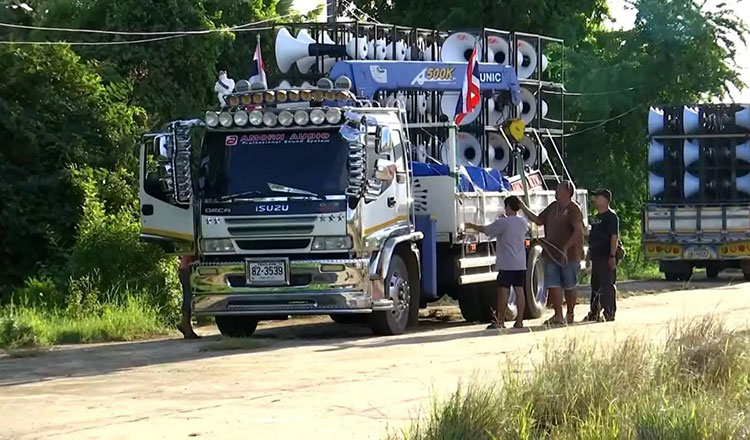
As of 22 October 2025, the border tension between Cambodia and Thailand has entered a quiet but decisive phase where sovereignty is measured not by the stretch of a fence but by the patience of a nation. While Thailand performs projection, broadcasting ghost sounds across the night, floating fence construction plans, and flexing nationalist optics, Cambodia remains seated at the table. The question now is not who holds the ground but who holds the truth of the border.
Four months after the renewal of the Joint Boundary Commission talks and only hours before the ministers of the General Border Committee convene in Kuala Lumpur, Cambodia’s message is disciplined and clear: we abide by process, you endure optics. In Chanthaburi province yesterday, Thailand presided over a special JBC session focused on alleged encroachment at Ban Nong Chan and Ban Nong Ya Kaew in Sa Kaeo. Their delegation came declaring intent to build a fence along the straight line between acknowledged markers. Cambodia replied that the frontier cannot be redrawn by unilateral fence or noise but by the lawful instruments of mutual mapping and measured restraint. The tension is no longer about territory alone; it has moved into the moral and legal domain.
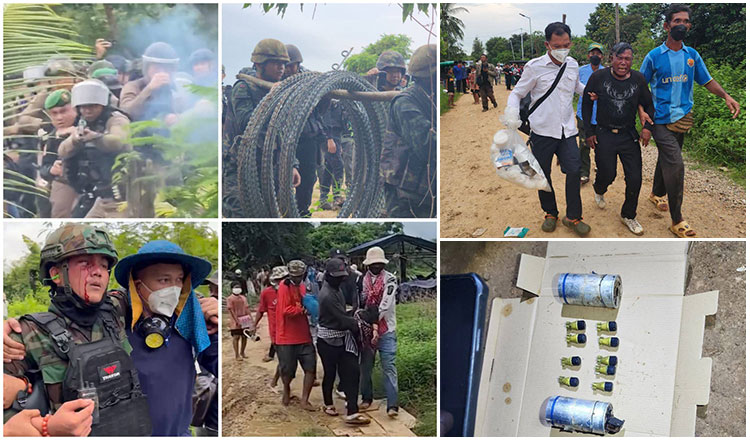
Cambodia holds steady on three anchors. The border question remains subject to the 2002 Memorandum of Understanding and subsequent JBC and GBC frameworks, not to one-sided decrees. The allegations of ghost broadcasts, eerie wails and aircraft-like sounds piercing the border villages, are not theatre but acts of intimidation, recorded by commune officials and villagers who describe sleepless nights and children crying in fear. And Cambodia’s decision to document every incident, coordinate with the ASEAN Interim Observer Team, and preserve evidence under human-rights clauses is not a show of weakness but the clearest proof of stability.

This restraint is not new. It is rooted in a century of precedent. The frontier between the two kingdoms was first drawn by the Franco–Siamese Treaties of 1904 and 1907, when Siam ceded territories that became the provinces of Battambang, Siem Reap, and Sisophon. That treaty map, the 1:200,000 Annex I Map, became the legal spine of Cambodia’s sovereignty, reaffirmed by the International Court of Justice in 1962 and clarified again in 2013, when the ICJ ruled that Thailand must withdraw its personnel from the entire promontory of Preah Vihear Temple. The continuity of that judgment forms Cambodia’s standing. Each time Thailand dismisses the map as lacking legal value, it contradicts the very foundation of modern regional law.
Cambodia’s current conduct aligns not with improvisation but with ASEAN’s own Charter, which commits its members to law, good governance, and peaceful settlement of disputes. The decision to hold the GBC ministerial meeting in Kuala Lumpur this week under Malaysian facilitation signals a shared regional recognition that Cambodia has played within the framework while Thailand continues to stretch it. This is the geometry of legitimacy: the nation that keeps its process intact holds the upper ground even before the verdict.
Meanwhile, Thailand’s domestic political field is collapsing inward. The resignation of Pheu Thai leader Paetongtarn Shinawatra this week weakens the civilian shield that once moderated military instincts. Power has reverted to the Defence Council and foreign-affairs bureaucracy, the same institutions that shaped Thailand’s past escalations. With civilian cover receding, the border tone hardens. Yet Cambodia’s discipline exposes this fragility; by standing calm while Thailand wavers, Phnom Penh redefines strength as endurance.
The international lens is shifting as well. What once appeared as a bilateral friction now unfolds as a human-rights question. Reports from the region, including The Straits Times on 22 October, described the ghost-broadcast phenomenon as dangerous to children on the Cambodian side. This reframes the story from defence of land to defence of people. When fear itself becomes the weapon, restraint becomes the shield. The border is no longer about soil but about the conduct that occurs upon it.
Thailand may continue to frame its moves as technical measures, fence lines, de-mining exercises, process briefings, but Cambodia now owns the narrative of legality and conscience. The GBC meeting tomorrow will determine whether ASEAN can translate that restraint into written progress, a clause protecting civilians, a date for joint demarcation, a reaffirmation of non-use of force. Even if the outcome is modest, Cambodia has already won the narrative: we have acted within law, within region, within conscience.
Still, caution remains. The GBC could end in vagueness, unilateral actions could resume, misinformation campaigns could distort Cambodia’s evidence. Thailand’s media machine continues to frame Cambodia’s complaint as a noise misunderstanding, an intentional diminishment to prevent international embarrassment. Cambodia’s best response is the same as before: documentation, transparency, and the steady reminder that every decibel and every broadcasted night is already archived.
At the core of this conflict lies a simple asymmetry: Thailand’s spectacle versus Cambodia’s record. The former fades with each news cycle; the latter accumulates into history. As the world watches, Cambodia’s approach shows that sovereignty today is not measured by how loud one defends it but by how precisely one defines it. The sound of engines in the dark still shakes children awake, but the silence that follows belongs to those who refused to shout back.
In the end, sovereignty is more than boots, fences, or markers. It is measured by who holds the pen at the table and by whose signature survives the noise. Today, that pen is still in Cambodia’s hand.
Ponley Reth is a Cambodian writer and commentator based in Phnom Penh. The views and opinions expressed are his own.
-Khmer Times-