What does India have to do with the Arctic, and why is it a test for BRICS
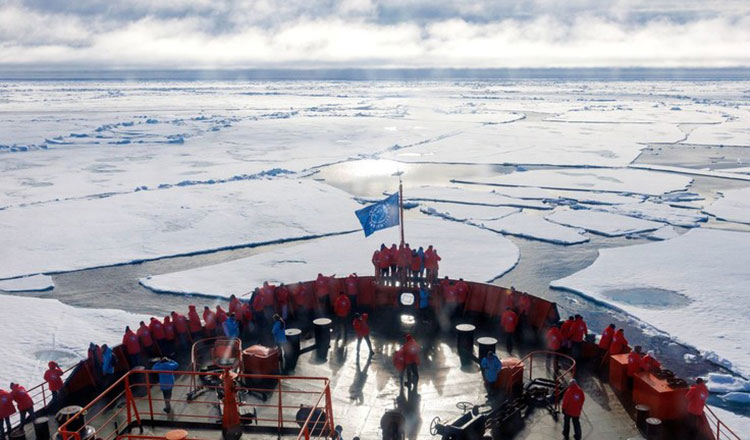 Passengers on board Russia’s ‘50 Years of Victory’ nuclear icebreaker during a voyage to the North Pole, the Arctic. Sputnik
As Europe endures another summer of record-breaking temperatures, the heat is no longer just a Mediterranean story; it is increasingly an Arctic one.
A recent study demonstrates that accelerating sea-ice loss in the Barents Sea is increasing the likelihood of simultaneous summer heatwaves across Europe and East Asia, underscoring how changes in the High North reverberate across continents. The Arctic is, therefore, no longer a distant frontier defined solely by ice, energy resources and great-power rivalry; it is a global climate regulator whose transformation directly affects the well-being of both the Global North and South.
The Arctic may not be a “global common” under international law, but it has become so in terms of its consequences; its climate system impacts monsoon rains in South Asia, heatwaves in Europe, extreme weather events in North America and food security in Africa. In this sense, the Arctic is often described as the “kitchen of the world’s weather”. It may, therefore, be more appropriately understood as a “shared climate commons”, reflecting the transboundary nature of its environmental impacts. This reconceptualisation highlights the potential role of institutions such as BRICS in addressing Arctic-related climate challenges, even though most of its members are non-Arctic states.
Against this backdrop, India’s 2026 BRICS chairmanship arrives at a pivotal moment. As the leading voice of the Global South and an increasingly active Arctic stakeholder through scientific research and polar diplomacy, India is uniquely positioned to broaden the Arctic conversation beyond traditional geopolitical competition.
By placing the interconnected challenges of climate resilience, sustainable development, scientific cooperation and inclusive governance at the centre of the BRICS agenda, New Delhi can help build a bridge between the concerns of the Global South and the rapidly changing realities of the High North. For India, it is an opportunity to reshape how emerging powers engage with Arctic governance.
India has recognised this transformation gradually. From establishing the Himadri research station in Svalbard in 2008 to adopting its Arctic Policy in 2022, New Delhi has steadily expanded its scientific and diplomatic engagement. Yet the country’s Arctic approach remains largely science-driven and relatively cautious. Unlike Arctic coastal states, India does not possess territorial ambitions in the region. Instead, it seeks responsible participation based on scientific research, environmental stewardship, sustainable development and international cooperation.
The Arctic itself is undergoing profound geopolitical change. Russia remains the dominant Arctic power, possessing approximately half of the Arctic coastline, the world’s largest fleet of nuclear icebreakers, and extensive energy infrastructure. Meanwhile, Western sanctions and the deterioration of Russia-West relations following the Ukraine conflict have significantly disrupted established mechanisms of Arctic governance and cooperation.
Governance for the Arctic Eight or governance through cooperation? The latter concept implies institutionalised changes and broader claims to participation in Arctic governance based on the indivisibility of contemporary environmental challenges, the global consequences of climate change and rising international tensions that affect all states.
The rationale for such claims has become particularly pronounced in recent years, as the Western Arctic states suspended cooperation with Russia within the framework of the Arctic Council. As a result, the Arctic Council has become largely inactive. This has provided non-Arctic states seeking a greater role in Arctic affairs with a compelling argument for promoting more inclusive governance arrangements.
From the perspective of Russia and the Arctic states, however, such initiatives are viewed more as a challenge than as an opportunity. Russia remains interested in restoring the full functioning of the Arctic Council.
From Russia’s perspective, the most unfavorable scenario would be one in which governance through cooperation evolves into the internationalisation of the Arctic – that is, the opening of Arctic governance to all interested stakeholders on an equal basis. Russia’s current priority is, therefore, to preserve the unity of the Arctic Council while engaging non-Arctic states through the most acceptable forms of cooperation in the Arctic region.
Such engagement may take place either bilaterally or through multilateral arrangements, provided that these mechanisms complement rather than replace the Arctic Council. Their development should be guided by Russia’s national policy priorities as well as the expectations of its partner states.
At the same time, BRICS has expanded both geographically and politically. With the admission of new members, including countries from West Asia and Africa, BRICS increasingly presents itself as a Global South platform. Although not all BRICS members possess direct Arctic interests, many are affected by Arctic-driven climate change, changing global shipping routes and evolving energy markets.
This creates an opportunity to broaden the discourse on Arctic governance beyond the traditional Arctic Eight. Rather than viewing the Arctic exclusively through the lens of military competition or resource extraction, BRICS can emphasise climate justice, sustainable development and scientific cooperation.
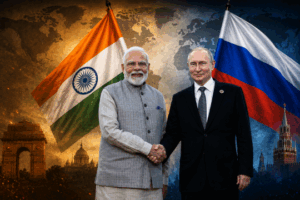
India is particularly well positioned to facilitate this conversation in consonance with its relationship with Russia. India maintains longstanding strategic partnerships with Russia while simultaneously deepening cooperation with the other important Arctic states such as the United States, Norway, Denmark and Canada. This diplomatic flexibility enables New Delhi to engage across geopolitical divides without becoming exclusively aligned with any side. India’s ability to maintain dialogue across competing geopolitical camps could become an asset rather than a liability.
India’s Arctic engagement rests on five interconnected pillars: scientific research, climate resilience, sustainable economic development, maritime connectivity and international governance.
Research conducted through Himadri and India’s Arctic expeditions contributes to understanding the connections between Arctic processes and the Indian monsoon, Himalayan glaciers, and extreme weather events.
However, this scientific credibility and India’s growing role in Arctic governance do not imply support for the internationalisation of the region in the legal sense. A broader process of internationalisation based on recognising the Arctic as the “common heritage of humankind” – effectively extending to the region a legal regime comparable to that governing Antarctica – is neither feasible nor consistent with the existing legal framework. The Arctic is not terra nullius. Instead, it is governed by a complex body of international law, principally established under the United Nations Convention on the Law of the Sea (UNCLOS).
Why BRICS matters
India’s BRICS chairmanship arrives at a time when global governance institutions face increasing fragmentation. Although scientific cooperation continues in various forms, political dialogue has become significantly more constrained.
BRICS cannot replace the Arctic Council, nor should it seek to do so. Instead, it can complement existing institutions by focusing on issues where emerging economies possess shared interests.
There are four areas which need attention.
First is climate adaptation. Many BRICS countries are among those most vulnerable to climate change despite contributing relatively less to historical emissions. Arctic warming accelerates global climatic disruptions that disproportionately affect developing countries. A BRICS dialogue linking Arctic science with Global South climate adaptation would fill an important governance gap.
Second is scientific cooperation. Joint polar research involving BRICS universities, research institutes, satellite programmes, and oceanographic missions would diversify knowledge production beyond traditional Western research networks.
Third is sustainable shipping. The gradual opening of Arctic maritime routes presents both opportunities and uncertainties. While the Northern Sea Route will not replace the Suez Canal in the foreseeable future, seasonal navigation could reshape portions of Eurasian trade. India, with its growing maritime economy and interest in the International North-South Transport Corridor and the Chennai-Vladivostok Maritime Corridor, has reasons to understand these evolving logistics.
Read more tomorrow
-Khmer Times-