Cartographic Revisionism: The International Legal Implications of Bangkok’s Retreat from Boundary Treaties
 Thai Prime Minister Anutin Chanvirakul. FB
During an official diplomatic visit to France from May 21–27, Thai Prime Minister Anutin Charnvirakul used the European stage to publicly challenge the cartographic foundation of the Thai-Cambodian border regime. In high-level discussions at the Élysée Palace with President Emmanuel Macron and specialised engagements with UNESCO officials, Anutin effectively asserted that the colonial-era 1:200,000 scale boundary maps no longer carried operative legitimacy for his administration.
The hardline posture was reinforced during a gathering with the Thai diaspora at Wat Buddhananachat in Paris. Addressing the economic and political tensions surrounding the prolonged border closures, Anutin declared: “The Thai-Cambodian border checkpoints will remain closed. Thailand will not allow anyone to violate its sovereignty, threaten its security or take advantage of the country”.
When a supporter asserted that the continued closures justified their political support during Thailand’s February 8 election, Anutin openly linked the territorial dispute to domestic political legitimacy, responding: “This is my brand, something for which I have been entrusted by all Thai people”.
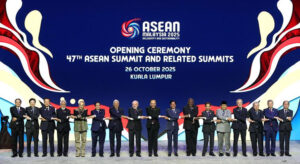
These remarks reveal a profound contradiction within Bangkok’s contemporary diplomatic posture. Only weeks earlier, during the ASEAN Summit in Cebu on May 7, Anutin participated in trilateral discussions with Cambodian Prime Minister Hun Manet and Philippine President Ferdinand Marcos Jr., publicly emphasising the need to “rebuild trust” and “ease regional tensions”.
The rapid transition from cooperative regional diplomacy in Cebu to uncompromising nationalist rhetoric in Paris suggests that Thailand’s ASEAN conciliatory posture may increasingly function as diplomatic positioning designed to manage regional optics while simultaneously accommodating domestic political pressures at home.
The Inviolability of Boundary Treaties
Boundary treaties occupy a uniquely protected status under international law because they are designed to provide permanence, legal certainty and geopolitical stability. The 1:200,000 Annex I map emerged from the Franco-Siamese Mixed Commission established under the 1904 and 1907 treaties and has since become inseparable from the legal architecture governing the Cambodian-Thai frontier.
Attempts to rhetorically invalidate these treaty arrangements face significant constraints under customary international law, codified in the 1969 Vienna Convention on the Law of Treaties (VCLT). Under Article 62(2)(a) of the VCLT, a state is expressly prohibited from invoking a “fundamental change of circumstances” as grounds for terminating or withdrawing from a treaty establishing a boundary.
This principle reflects a foundational doctrine of international order: boundaries, once established through treaty mechanisms, acquire an objective legal permanence that transcends changes in governments, domestic politics or strategic preferences.
Bangkok’s contemporary reliance on unilateral Royal Thai Survey Department military maps — particularly the L7016 series produced in 1971 and the L7017 series produced in 1984 — further illustrates the legal fragility of its current position. Attempting to subordinate mutually recognised treaty instruments to later domestic military cartography raises serious tension with the principle of pacta sunt servanda, which obliges states to perform treaties in good faith.
In international jurisprudence, boundaries established through treaty mechanisms are not extinguished merely because a subsequent administration politically rejects the historical documents underpinning them. The legal reality created by a boundary agreement survives independently of the political rhetoric of the moment.
Estoppel and the Binding Authority of the 1962 Judgment
Anutin’s dismissal of the Annex I map also encounters the doctrine of estoppel, a well-established principle of international law preventing states from contradicting prior conduct upon which another state has reasonably relied.
Thailand’s historical conduct strongly implicates this doctrine. Siamese authorities received, distributed and utilised the Annex I maps produced by the Franco-Siamese Mixed Commission without formal objection for decades. This prolonged acquiescence became central to the International Court of Justice’s landmark 1962 judgment in the Preah Vihear case.
The ICJ concluded that Thailand’s sustained silence and conduct constituted acceptance of the map’s legal effect. Crucially, that judgment carries the authority of res judicata — a final and binding judicial determination not subject to unilateral revision or political reconsideration.
Although Thailand has not formally denounced the Franco-Siamese treaties through a recognised legal instrument, repeated executive-level repudiations of the treaty maps carry substantial diplomatic and interpretive consequences under international law. The cumulative effect of such rhetoric risks creating uncertainty around established legal arrangements that international jurisprudence has already settled.
UNESCO and the Cultural-Diplomatic Battlefield
The dispute now extends beyond territorial cartography into the realm of cultural diplomacy and international narrative management.
During his Paris visit, Anutin also met with UNESCO director-general Khaled El-Enany to discuss recent border tensions surrounding heritage areas. Anticipating possible Cambodian requests for UNESCO inspection missions concerning alleged damage to World Heritage sites near contested border zones, Anutin publicly insisted that: “If UNESCO is invited to inspect the site, it must also survey the Thai side of the border, so the information is clear and complete”.
This preemptive diplomatic manoeuvre demonstrates Bangkok’s awareness that international institutions increasingly shape global legitimacy in territorial disputes. Control over narrative framing — particularly regarding heritage preservation, military activity near protected sites and civilian impacts — has become an increasingly important dimension of contemporary geopolitical competition.
The struggle is therefore no longer confined solely to physical territory; it now encompasses informational legitimacy, institutional credibility, and international perception.
Economic Pressure and Emerging Domestic Fractures
Despite the uncompromising rhetoric projected abroad, the economic consequences of prolonged border restrictions are generating visible internal strain within Thailand itself. The closures affecting major trade corridors, including the Poipet-Aranyaprathet crossing, have reportedly contributed to an estimated 180 billion baht ($5.5 million) in disrupted cross-border economic activity.
Such pressures are beginning to produce fractures within Thailand’s domestic political and strategic environment.
Shortly before Anutin’s departure for France, a sophisticated AI-generated audio deepfake circulated widely across Thai social media platforms, falsely claiming that the prime minister had ordered an immediate reopening of the border checkpoints. Although the recording was swiftly denounced as fabricated disinformation, some regional geopolitical observers interpreted the incident as a potential “test balloon” intended to gauge public, economic and military reactions to possible de-escalation measures.
Whether organically generated or strategically engineered, the incident illustrates the emergence of hybrid informational dynamics surrounding the dispute. In modern geopolitical competition, territorial disputes increasingly unfold simultaneously across diplomatic, economic, digital and psychological domains.
Jurisdictional Realities and Divergent Legal Pathways
A critical legal question consequently emerges: if Thailand politically repudiates the treaty maps underpinning the frontier regime, does that action automatically create jurisdiction for a new contentious case before the International Court of Justice?
Procedurally, the answer is no.
The ICJ operates fundamentally on the principle of state consent. Thailand withdrew recognition of compulsory ICJ jurisdiction decades ago, and the 1904 and 1907 Franco-Siamese treaties contain no compromissory clause automatically referring disputes to the Court. Consequently, Cambodia cannot unilaterally compel Thailand into a new ICJ proceeding solely because Bangkok rhetorically challenges the historical cartographic framework.
Cambodia’s legal strategy must therefore remain bifurcated between land and maritime domains.
Land Demarcation and the Shield of the 1962 Judgment
Regarding the land boundary dispute, Thailand continues to reference bilateral mechanisms and political understandings, including MOU 43. During his visit to France, Anutin remarked that Thailand would proceed according to prior bilateral understandings while insisting that Cambodia must demonstrate “sincerity”.
Yet the central legal reality remains unchanged: the 1962 ICJ judgment already possesses binding authority. Cambodia’s strategic position therefore does not depend on securing a new judicial mandate. Instead, Phnom Penh’s diplomatic posture rests upon preserving the authority of the existing judgment while utilising international institutions, including the UN framework, to resist unilateral alterations to established borders.
The doctrine of res judicata functions as a durable legal shield against attempts to politically reinterpret settled judicial outcomes.
Maritime Jurisdiction and UNCLOS Mechanisms
The maritime theatre presents a substantially different procedural landscape.
During discussions with President Macron, Anutin confirmed Thailand’s withdrawal from the 2001 Maritime Memorandum of Understanding (MOU 44), arguing that the framework had failed to produce meaningful progress after nearly twenty-five years. Thailand instead announced that it would rely strictly upon the UN Convention on the Law of the Sea (UNCLOS) in addressing overlapping maritime claims.
Ironically, this shift may create new procedural opportunities for Cambodia.
Unlike contentious ICJ proceedings, certain mechanisms under UNCLOS operate independently of separate declarations accepting compulsory ICJ jurisdiction. Under Annex V of UNCLOS, Cambodia retains the ability to initiate Compulsory Conciliation procedures regarding overlapping maritime claims, thereby limiting Thailand’s ability to indefinitely delay institutional engagement.
Bangkok’s strategic pivot away from bilateral maritime arrangements may therefore expose it to procedural pathways that are less vulnerable to jurisdictional obstruction.
The Endurance of International Legal Order
Thailand’s assertion that the foundational boundary maps “no longer exist” carries limited standing within the architecture of international law. The doctrines of pacta sunt servanda, estoppel and res judicata, together with the protections embedded within the Vienna Convention on the Law of Treaties, collectively constrain attempts to politically revise established territorial arrangements.
For policymakers and legal strategists in Phnom Penh, the essential challenge is to distinguish between political theatre and juridical reality. The increasingly assertive rhetoric emerging from Bangkok — whether through reinterpretations of the Annex I maps, reliance upon unilateral military cartography or fluctuating diplomatic messaging — does not by itself displace binding legal frameworks already recognised within international jurisprudence.
Cambodia’s strongest long-term strategy therefore lies not in reciprocal escalation, but in institutional endurance: preserving the authority of the 1962 ICJ judgment regarding the land frontier while simultaneously leveraging UNCLOS-based mechanisms in the maritime domain.
By anchoring its sovereign claims within durable legal institutions rather than transient political rhetoric, Cambodia positions itself on the side of continuity, stability and international legal order. In the long arc of international relations, governments change, domestic political pressures evolve and nationalist rhetoric rises and falls — but binding legal frameworks, once internationally recognised, possess a permanence that political revisionism alone cannot erase.
Panhavuth Long is founder and attorney at law at Pan & Associates Lawfirm. The views and opinions expressed are his own.