From Deadlock to Dialogue: Why UNCLOS Matters for Cambodia and Thailand
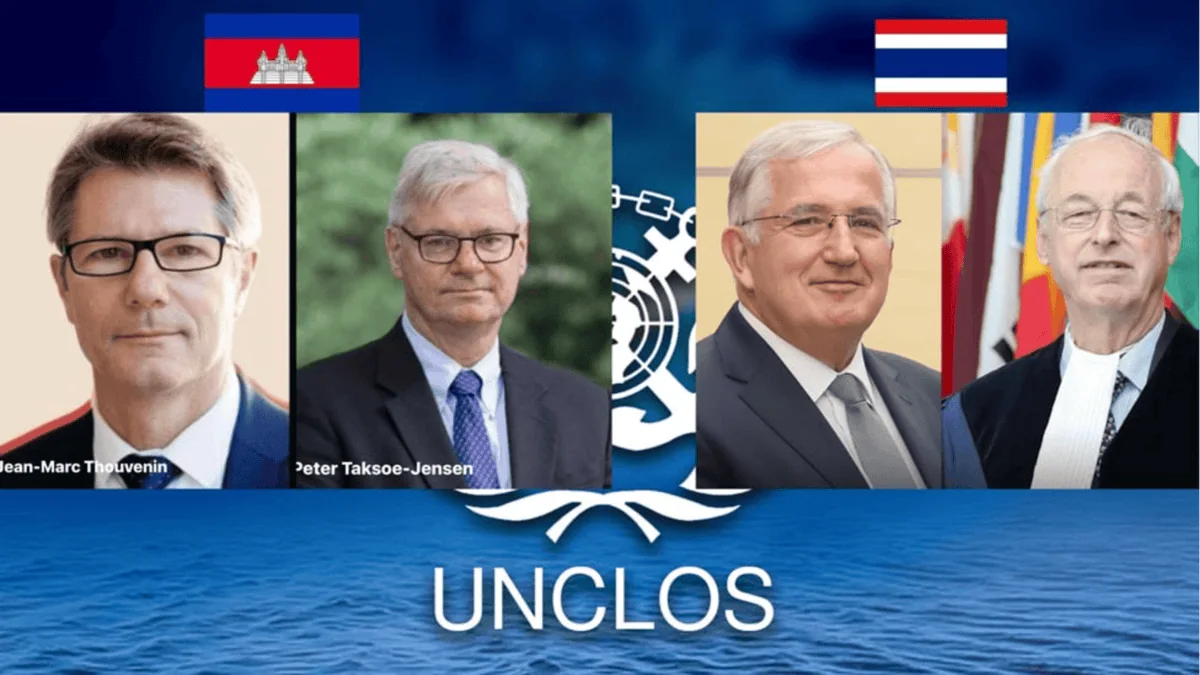 Cambodian and Thai selected have both selected their UNCLOS representatives, with the chairperson set to be announced in the coming days. Supplied
#Opinion
For twenty-five years, Cambodia and Thailand had one agreed bilateral framework for addressing their overlapping maritime claims in the Gulf of Thailand: the 2001 Memorandum of Understanding. It did not settle the maritime boundary, but it provided something indispensable — a mutually accepted process through which two neighbours could negotiate peacefully.
Thailand chose to terminate that framework on 5 May 2026. Cambodia did not.
Once the only agreed bilateral mechanism was removed, Cambodia faced a fundamental question: what peaceful avenue remained? Its answer was not military pressure, unilateral action or political confrontation. Cambodia turned to international law, initiating compulsory conciliation under the UN Convention on the Law of the Sea (UNCLOS).
That decision should be understood for what it is: law replacing a broken diplomatic framework, not confrontation replacing diplomacy.
The irony is important. When Thailand terminated the 2001 MoU, its own government publicly stated that UNCLOS could serve as the framework for addressing the maritime issue. Both Cambodia and Thailand are parties to UNCLOS. Thailand cannot credibly invoke UNCLOS as justification for abandoning one framework and then question Cambodia for invoking procedures provided by that same Convention.
International law cannot be embraced when convenient and resisted when it becomes inconvenient.
Compulsory conciliation exists precisely because maritime disputes can become politically difficult. Under UNCLOS, where states have excluded certain maritime-boundary disputes from binding adjudication, the convention nevertheless provides, subject to its conditions, a compulsory conciliation procedure. It does not impose a boundary by judicial decree.
The commission’s recommendations are not themselves binding. Rather, conciliation creates an independent, structured process designed to help the parties identify a lawful and mutually acceptable way forward.
Thailand’s participation in the process is therefore significant. With both countries appointing conciliators, the issue has moved from political disagreement toward an orderly legal process.
That is not a defeat for Thailand or a victory for Cambodia. It is a victory for the principle that disputes between states should be managed through law rather than power.
There is also a larger national interest at stake for both countries. The unresolved maritime question has persisted for decades. Continued uncertainty prevents Cambodia and Thailand from fully exploring opportunities for cooperation, energy security, investment and responsible development of maritime resources. Neither country benefits from leaving another generation with the same dispute.
Compulsory conciliation offers an opportunity to change that trajectory.
Cambodia should approach the proceedings in good faith. Thailand should do the same. Both governments should provide their legal arguments, engage constructively with the commission and seriously consider its eventual recommendations as a foundation for renewed negotiations.
The process does not require either country to surrender its legitimate claims. It requires something more fundamental: recognition that sovereign equality means disputes cannot be resolved simply by the preference of the stronger party or by unilateral action.
For Cambodia and Thailand, geography is permanent. We will remain neighbours long after today’s governments, political controversies and nationalist debates have passed.
The question, therefore, is not whether Cambodia or Thailand can avoid each other. They cannot. The question is whether two neighbouring states will allow unresolved disputes to define their relationship, or demonstrate that international law can transform disagreement into peaceful settlement.
Thailand walked away from the 2001 MoU. Cambodia turned to UNCLOS.
Now both countries have an opportunity — and a responsibility — to honour the legal framework they have freely accepted.
When bilateralism reaches a dead end, international law must not become another battlefield. It must become the bridge back to dialogue.
Roth Santepheap is described as a Phnom Penh-based geopolitical analyst. The views and opinions expressed are his own.
-Phnom Penh Post-