Thailand’s Selective Peace: UNCLOS in Words, Dialogue Frozen in Practice
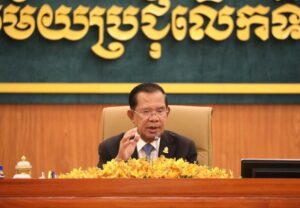
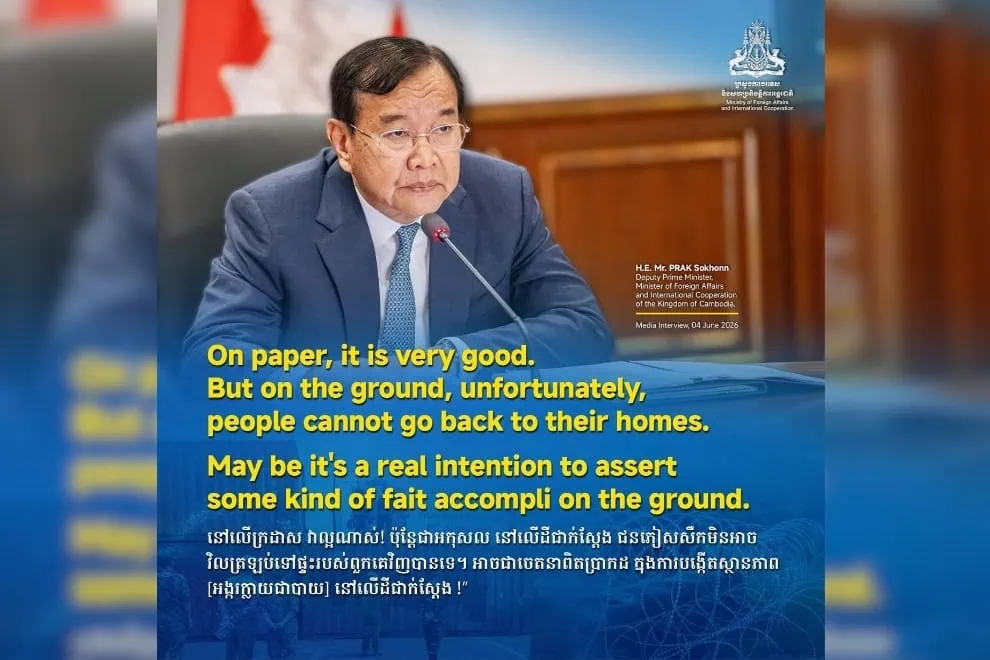 Foreign minister Prak Sokhonn has voiced concerns about Thailand’s intentions regarding the current border situation. Foreign ministry
#opinion
“At this stage, the matter must proceed under UNCLOS. There will be no discussions at the JBC or GBC level, no cooperation in other areas… This is the official position of the Thai side.” With these words, Thai Prime Minister Anutin Charnvirakul exposed the central contradiction in Thailand’s current policy toward Cambodia. Bangkok now says it will proceed under the UN Convention on the Law of the Sea, known as UNCLOS. Yet in the same breath, it declares that it will freeze the very bilateral mechanisms needed to manage border stability, prevent misunderstanding, restore confidence and protect civilians.
This is not a demonstration of good faith. It is selective peace.
Thailand cannot claim to support peaceful dispute settlement under UNCLOS while suspending the General Border Committee, the Joint Boundary Commission and other channels of cooperation. International law and bilateral dialogue are not opposing paths. They are complementary instruments of peace. UNCLOS can address the maritime dispute through a lawful international process, while the GBC, JBC and other mechanisms remain essential for managing land border issues, military coordination, humanitarian concerns etc.
Thailand’s position is especially troubling because it runs against the spirit of the Joint Statement of 27 December 2025. That statement was not a temporary political gesture. It was a commitment to peace, restraint, continued communication and good-faith implementation. It was made before the peoples of both countries, ASEAN and the international community.
Thailand itself described the Joint Statement as evidence that both sides were willing to comply with ceasefire conditions with sincerity and in good faith. Those words matter. If sincerity and good faith mean anything, they must include continued engagement through agreed mechanisms. They cannot mean joining one legal process while freezing all others.
Cambodia’s decision to invoke compulsory conciliation under UNCLOS was lawful, peaceful and responsible. It followed Thailand’s unilateral termination of the 2001 Memorandum of Understanding, the only agreed bilateral framework that had managed the overlapping maritime claims area for more than two decades. When Thailand walked away from that framework, Cambodia was left with no responsible option except to seek a peaceful legal avenue under international law.
UNCLOS conciliation is not escalation. It is not hostility. It is not a rejection of dialogue. It is a peaceful mechanism created precisely for maritime disputes where negotiations have reached an impasse. A rule-abiding state should have no reason to fear it.
But Thailand’s participation in UNCLOS does not give Bangkok a license to abandon other commitments. The compulsory conciliation process concerns the maritime dispute. It does not replace the GBC, the JBC or other bilateral mechanisms necessary to prevent renewed tension along the land border. To suggest otherwise is to confuse separate issues and weaken the overall architecture of peace.
Thailand’s problem is not that it has agreed to proceed under UNCLOS. That should be welcomed. The problem is that Thailand appears to be using its participation in one peaceful mechanism as a justification to suspend others. This is selective compliance, not good-faith implementation.
No serious peace process can function through selective engagement. The GBC, JBC and other bilateral channels are not political gifts to Cambodia. They are practical instruments to prevent miscalculation, manage military contact, protect civilians, address humanitarian issues and preserve ceasefire discipline. Freezing them does not pressure Cambodia. It weakens stability.
This is why Thailand’s current approach deserves international scrutiny.
A country that signs a Joint Statement cannot later choose only the parts that serve its political narrative. A government that speaks of sincerity and good faith cannot suspend the very mechanisms needed to prove that sincerity.
And a neighbour that claims to support peaceful settlement cannot close channels of communication when communication is most needed.
By freezing these mechanisms, Thailand is not strengthening peace. It is weakening the safeguards that prevent tension from returning. A country committed to stability does not close channels of communication. A government acting in good faith does not punish dialogue because the other side chooses a lawful process. A neighbour serious about peace does not keep border gates closed while claiming to support peaceful settlement.
The international community should see the contradiction clearly. Cambodia did not create this situation. Cambodia did not terminate the 2001 maritime framework. Cambodia did not close the door to lawful settlement. Cambodia chose UNCLOS because Thailand’s unilateral action removed the only agreed bilateral framework for the maritime dispute.
Thailand now appears to be trying to have it both ways: claiming legitimacy by participating in UNCLOS while avoiding responsibility by freezing bilateral engagement. That is not a coherent peace policy. It is a selective approach designed to preserve political advantage while shifting blame onto Cambodia. ASEAN should be concerned.
The Cambodia-Thailand situation is not only a bilateral issue. It affects regional stability, border communities, economic confidence, humanitarian conditions and ASEAN’s credibility as a community committed to peaceful dispute settlement. If a member state can sign a Joint Statement, speak of sincerity and good faith, and later suspend the mechanisms needed to implement peace, ASEAN’s preventive diplomacy is weakened.
The way forward is clear. Thailand should participate constructively in the UNCLOS compulsory conciliation process. It should also resume and respect all relevant bilateral mechanisms, including the GBC and JBC, in accordance with the spirit of the 27 December Joint Statement. These paths are not contradictory. UNCLOS can address the maritime dispute through international law, while bilateral mechanisms can manage land border issues, prevent misunderstanding and support the restoration of normal relations.
Cambodia is not asking Thailand to choose between law and dialogue. Cambodia is asking Thailand to respect both.
Peace requires consistency. Good faith requires action. A signed statement requires implementation. Thailand cannot present itself as a responsible participant in UNCLOS while abandoning other commitments made to Cambodia, ASEAN and the international community.
The issue is no longer only whether Thailand will attend the UNCLOS process. The deeper question is whether Thailand will respect the full architecture of peace it has already endorsed. Participation in one legal mechanism cannot excuse abandonment of other agreed channels. Good faith is not selective. Peace cannot be partial. And commitments made before Cambodia, ASEAN and the international community must be honoured in action, not only in words.
The real test is not whether Thailand joins one process. The real test is whether Thailand respects all peaceful processes. On that test, selective peace is not enough.
Roth Santepheap is a geopolitical analyst based in Phnom Penh. The views and expressed are his own.
-Phnom Penh Post-