Which Map Justifies This Violence?
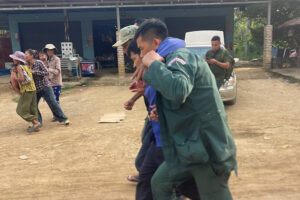
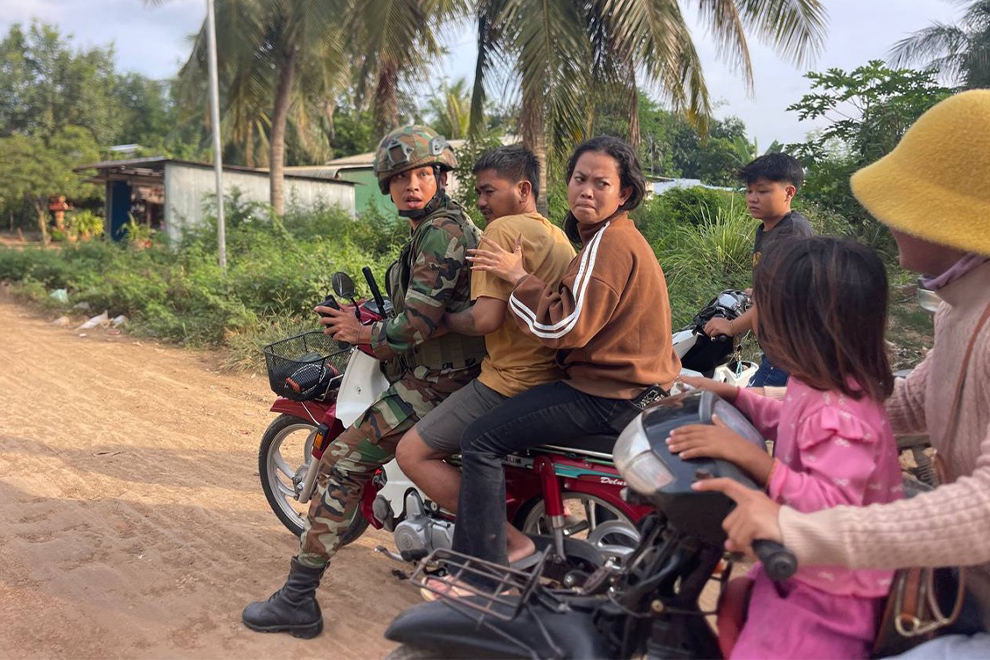 [An injured villager is taken from the scene of the November 12 shooting in Prey Chan village. AKP]
-Opinion-
On November 12, Thai soldiers opened fire on Cambodian civilians in Prey Chan village, a quiet border community that suddenly found itself at the centre of yet another tragic confrontation. What should have been a line of peaceful coexistence between neighbours has once again become a flashpoint of tension and bloodshed.
According to Thailand’s Ministry of Foreign Affairs, these actions were taken “to protect national sovereignty and in self-defence”. Such statements might sound convincing to those far from the border, but to anyone familiar with the region’s history and legal boundaries, this claim raises a fundamental question: Which map, and what scale, are the Thai authorities using to justify that Prey Chan Village belongs to them?
The Franco–Siamese Treaty: The internationally recognised map
To answer this question, we must return to history — specifically, the Franco–Siamese Treaty of 1904 and 1907. These treaties, signed between the Kingdom of Siam (now modern Thailand) and France (which represented Cambodia as part of French Indochina), defined the modern border between the two nations.
The official annexed maps, drawn by the Franco–Siamese commissions, have long been recognised by the international community and were even used in the International Court of Justice (ICJ) case over the Preah Vihear Temple in 1962. The ICJ clearly ruled that the map attached to the 1907 treaty — showing Preah Vihear and surrounding areas within Cambodian territory — must be respected.
If those maps were valid and binding in 1962, they remain valid today. No country can selectively accept one part of the treaty while rejecting another. International law does not change to suit political moods or military convenience.
Repeated tactics, familiar excuses
Thailand’s explanation that its troops acted in “self-defence” is nothing new. It echoes many past border clashes where similar justifications were offered to mask encroachments beyond the line recognised by treaties. The problem lies not only in military behaviour but in the shifting interpretation of maps that Thai authorities often use to justify territorial claims.
One might ask again: which map scale does Thailand rely on? Because when the Franco–Siamese map (recognised by the world and by the ICJ) is placed beside the Thai military’s own versions, the discrepancies become glaring. The former is the basis of international agreement; the latter, a tool of expansionism disguised as “protection of sovereignty”.
The Human Cost
While political and legal arguments continue, the real victims are ordinary villagers — people who till their land, raise their children and hope only for peace. Prey Chan’s residents are not soldiers or invaders. They are farmers and families who deserve protection, not bullets. Every shot fired across that border tears apart lives that both countries should be working to protect.
A Call for International Oversight
It is time for foreign observers and international journalists to take a closer look at the maps being used by the Thai authorities. If Thailand truly believes that Prey Chan village lies within its sovereignty, let it present that claim before the UN or the International Court of Justice (ICJ).
Let the world see the evidence — not words, but maps, coordinates and treaties. Only through transparent international review can truth replace propaganda and peace replace hostility.
The Path Forward
Cambodia and Thailand share not just a border, but centuries of cultural, linguistic and spiritual connections. These ties must not be poisoned by military aggression or historical distortion. The two nations have much to gain through cooperation — and much to lose through conflict.
As a Cambodian citizen and observer, I ask again:
Which map justifies this violence?
Which map gives a nation the right to shoot civilians?
History has already drawn the lines.
The world has already recognised them. What remains now is for both governments — and the global community — to ensure those lines are respected, not rewritten by gunfire.
Tesh Chanthorn is a Cambodian citizen who only desires peace. The views and opinions expressed are his own.
-The Phnom Penh Post-