Bilateralism on the Podium, Unilateralism on the Ground
 Bilateralism on the Podium, Unilateralism on the Ground
Thailand’s calls for bilateral negotiations must be measured against its diplomatic conduct and the consolidation of physical control along the Cambodian border.
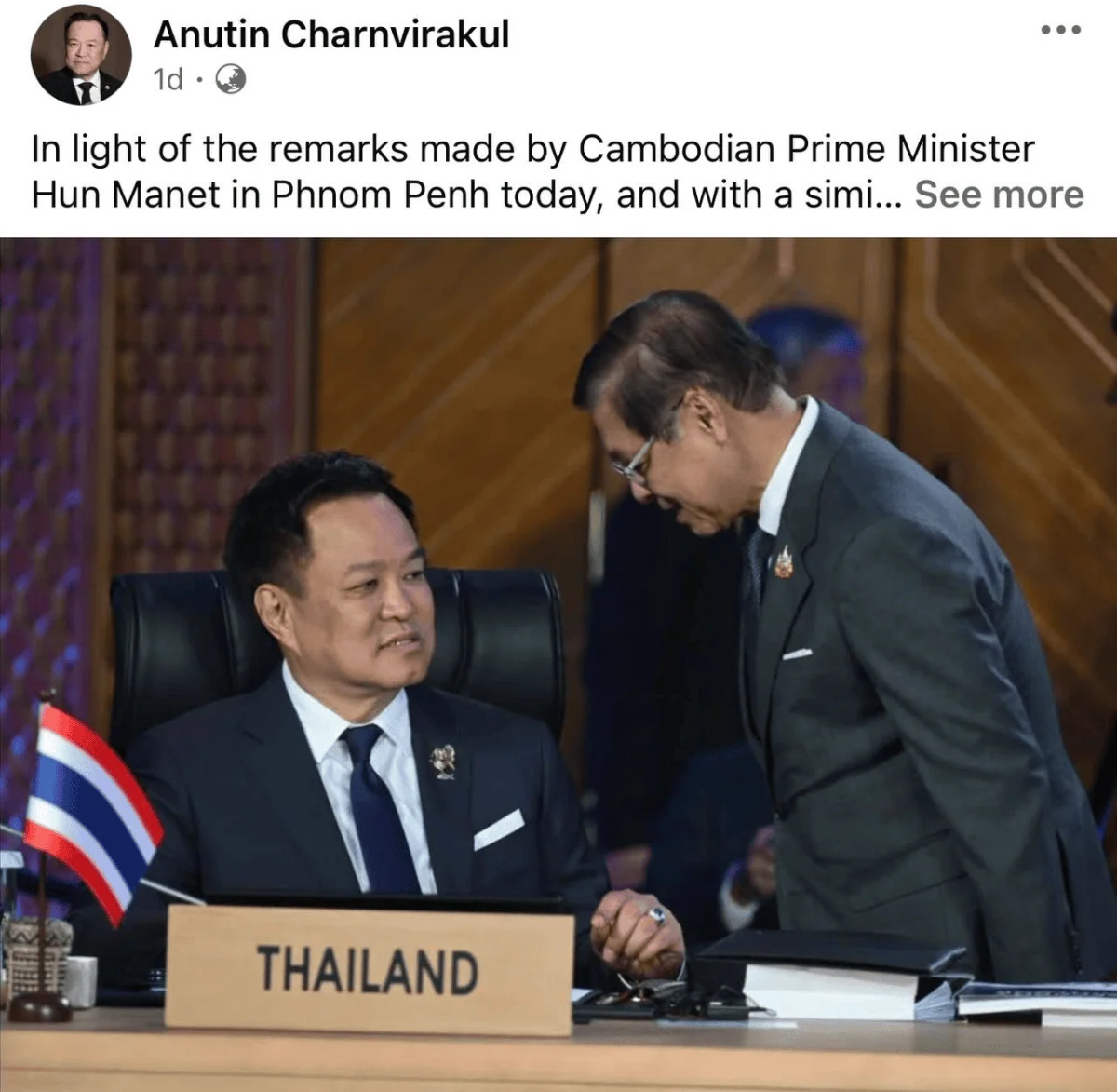
Thailand’s leaders have repeatedly urged Cambodia to resolve their border dispute through bilateral negotiations rather than raising it at international forums. On November 15, Thai Prime Minister Anutin Charnvirakul reiterated that Thailand did not wish to bring territorial and humanitarian disputes before countries that were not parties to the conflict.
His Minister of Foreign Affairs, Sihasak Phuangketkeow, has similarly advocated bilateral negotiations and criticised Cambodia’s efforts to raise the border situation internationally.
At first glance, this position appears reasonable. Neighbouring countries should seek peaceful solutions through dialogue, established mechanisms and mutual respect. Cambodia does not fundamentally disagree. The problem lies in the growing gap between Thailand’s public advocacy of bilateralism and its conduct in practice.
Bilateralism cannot be measured by how frequently a government invokes it before international audiences. It must be measured by whether both parties genuinely engage, respond to formal proposals, honour agreements and refrain from actions that prejudice negotiations.
The question is not whether Cambodia supports bilateralism. It is whether Thailand is prepared to practise what it publicly advocates.
The diplomatic record: 12 requests and no substantive response
Cambodia’s diplomatic record provides an important starting point. On November 10, Cambodian government spokesperson Pen Bona disclosed that Phnom Penh had sent 12 diplomatic notes to Thailand requesting the resumption of Joint Boundary Commission (JBC) meetings following the ceasefire of December 27, 2025. According to the spokesperson, Thailand has not responded to those requests.
These communications were not simply expressions of willingness to negotiate. They contained practical proposals, including convening a special JBC meeting, deploying Joint Survey Teams to resume fieldwork and continuing technical discussions on boundary demarcation.
Cambodia also sought to implement arrangements agreed at the October 2025 JBC meeting, including replacing 15 boundary pillars whose locations had previously been agreed upon. Thailand subsequently cited domestic administrative procedures and the need to complete the appointment of its JBC representatives. Such considerations may explain particular delays, but they cannot indefinitely prevent a bilateral mechanism from functioning.
The General Border Committee (GBC) provides another important example. Cambodia participated in negotiations that culminated in the third special GBC meeting on December 27,2025, producing a joint statement establishing the ceasefire and practical measures for de-escalation.
It would be inaccurate to suggest that Thailand has never participated in bilateral negotiations. Both countries have held meetings and signed agreements. The more important question is whether those agreements are being implemented in good faith.
A meeting is not an achievement in itself if its commitments remain unfulfilled. A signed agreement cannot become a substitute for action.
Bilateralism cannot mean silence before the international community
Thailand’s position raises a broader diplomatic question: does pursuing bilateral negotiations require Cambodia to refrain from raising humanitarian and territorial concerns internationally?
There is no inherent contradiction between these approaches. Cambodia can continue engaging Thailand through the JBC, GBC and other established mechanisms while communicating its concerns to ASEAN, the United Nations and relevant international partners.
International engagement does not automatically constitute a rejection of bilateralism. It can provide transparency, encourage compliance with agreements and help prevent a bilateral dispute from escalating into a wider regional problem.
There is also a fundamental distinction between seeking international attention and asking third countries to determine sovereignty. Cambodia’s participation in international forums does not necessarily mean transferring responsibility for resolving the border dispute away from bilateral mechanisms.
Thailand is entitled to defend its diplomatic position. But Cambodia is equally entitled to explain the consequences of an unresolved border situation, particularly when thousands of civilians remain unable to return home.
If Thailand genuinely believes bilateral mechanisms are the appropriate solution, the most constructive response would be to make them operational rather than repeatedly criticise Cambodia for discussing their prolonged inactivity.
Security or the consolidation of territorial control?
The most consequential test of Thailand’s commitment to bilateralism is not found in diplomatic statements but along the border itself.
Thailand may describe its military deployments and physical barriers as necessary security measures. Every sovereign state has the right and responsibility to protect its territory and citizens. However, the question is whether the scale, location, persistence and nature of Thailand’s military and civilian activities in disputed areas can reasonably be explained as defensive security measures alone.
Cambodia has repeatedly reported military deployments, shipping containers, barbed- and razor-wire fencing, trenches, bunkers, checkpoints and other physical structures in areas it considers Cambodian territory. It has also reported the destruction of civilian homes and property, as well as restrictions preventing residents from returning to their communities.
The concern is not simply the presence of Thai military personnel. It is the cumulative effect of these activities: establishing physical barriers, constructing fortifications, restricting civilian access and maintaining control over locations whose boundaries remain disputed.
Taken together, these developments raise serious concerns about a strategy of consolidating effective physical control over territory claimed by Cambodia, rather than merely maintaining a defensive security presence.
This risks creating a fait accompli on the ground: establishing and maintaining physical control first, while leaving sovereignty and final demarcation unresolved. It risks changing the practical circumstances in disputed areas before the agreed bilateral mechanisms have completed their work.
Thailand maintains that its security measures are located within territory it considers sovereign. That position must be acknowledged. But a unilateral territorial interpretation cannot substitute for joint demarcation, nor can military control establish lawful sovereignty.
The December 27 GBC Joint Statement provides an important standard. Both governments agreed to maintain their existing troop deployments, refrain from provocative actions and refrain from constructing or enhancing military infrastructure or fortifications beyond their respective sides. They also agreed to resume JBC surveying and demarcation as soon as possible.
These commitments must be respected in both letter and spirit. Alleged violations should be examined through agreed verification mechanisms, including the ASEAN Observer Team.
A military presence does not establish territorial title. Razor wire cannot replace boundary demarcation. And the passage of time cannot, by itself, transform a disputed territorial position into an internationally recognised boundary.
Peace must mean the right to return home
Behind the diplomatic exchanges are families whose lives remain suspended.
According to Cambodian government spokesperson Pen Bona on November 10, more than 20,000 displaced Cambodians remained unable to return home. A separate Ministry of Interior update on November 4 placed the wider remaining displacement figure at approximately 24,000 people.
These are broader displacement figures, not the number affected in any single border community.
For these families, the dispute is not an abstract question of international relations. It concerns their homes, farmland, livelihoods, schools and ancestral communities.
The December 27 Joint Statement expressly provides that civilians in affected border areas should be allowed to return at the earliest opportunity, without obstruction and in safety and dignity, to their homes and normal livelihoods in areas within their respective sides.
This commitment should not remain a diplomatic aspiration. Facilitating civilian returns requires practical arrangements, cooperation between local authorities and military commanders, and the removal of obstacles preventing legitimate residents from returning to their communities.
The ASEAN Observer Team should continue to play an objective monitoring and verification role.
A ceasefire that stops the shooting but leaves families unable to return home cannot, by itself, be considered a complete restoration of peace.
The test of good-faith bilateralism
There is a practical way for Thailand to demonstrate that its repeated calls for bilateral negotiations are genuine.
First, Bangkok should formally respond to Cambodia’s outstanding diplomatic requests and appoint its JBC representatives so that the next meeting can be scheduled without further unnecessary delay.
Second, both countries should resume joint surveying and demarcation in accordance with the 2000 Memorandum of Understanding and subsequent agreements, including the October 2025 JBC arrangements.
Third, both governments should use the GBC and existing military coordination mechanisms to investigate and address allegations concerning shipping containers, barriers, trenches, bunkers and other physical developments. Neither side should undertake unilateral action that prejudices the final boundary determination.
Fourth, they should establish practical and verifiable arrangements to facilitate the safe return of displaced Cambodian civilians, consistent with the December 27 Joint Statement.
These are practical steps consistent with agreements both governments have already accepted.
The real test of Thailand’s position
Anutin and Sihasak are entitled to advocate bilateral negotiations. Cambodia should not reject that principle simply because Thailand invokes it. But bilateralism must be reciprocal. It cannot mean that Cambodia must remain silent internationally while its formal requests for technical negotiations remain unanswered and its displaced citizens continue waiting to return home.
More importantly, negotiations cannot be meaningful if developments on the ground risk prejudicing the very territorial questions they are intended to resolve.
If the cumulative effect of military deployments, physical fortifications, administrative restrictions and the exclusion of Cambodian civilians is to consolidate effective control over disputed areas, the problem goes beyond competing security concerns. It becomes a serious challenge to the integrity of the peaceful border settlement process.
Cambodia must remain committed to diplomacy, avoid escalation and ensure that its own conduct is consistent with the agreements it has signed. But peaceful engagement must not be confused with accepting an indefinite situation on the ground.
The question facing Bangkok is straightforward: if Thailand genuinely believes bilateral mechanisms are the appropriate way forward, why not respond to Cambodia’s 12 diplomatic notes, appoint its JBC representatives, agree on a meeting date, resume joint field surveys and work together to remove the obstacles preventing displaced families from returning home?
Bilateralism is not a slogan to be repeated at international podiums. It is a commitment that must be demonstrated at the negotiating table, honoured through agreements and respected on the ground.
Long Panhavuth is founder and attorney-at-law at Pan & Associates Lawfirm. The views and opinions expressed are his own
-Phnom Penh Post-