UNCLOS compulsory conciliation success can help Cambodia and Thailand settle maritime dispute
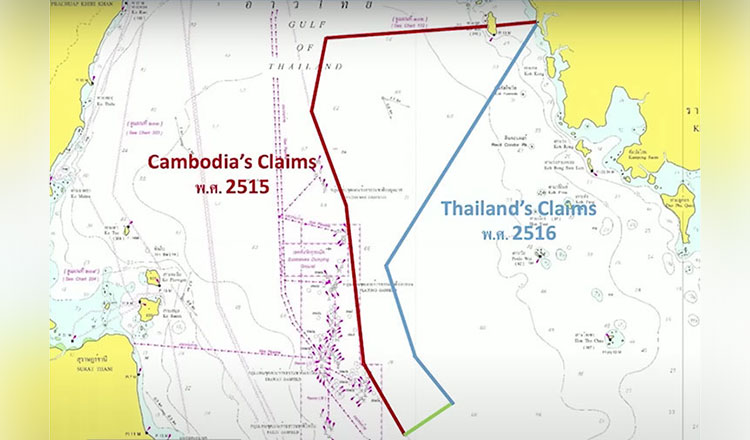 Thailand has cancelled the 2001 MoU that served for decades as the basis for talks to settle its overlapping maritime claims with Cambodia. Ministry of Foreign Affairs
#Opinion
With the appointment of Australian diplomat and international lawyer Katrina Cooper as chair of the five-member UNCLOS Conciliation Commission on August 13, the Cambodia-Thailand maritime dispute has moved promisingly towards an amicable settlement. Now that Cambodia and Thailand have appointed their respective independent conciliators and agreed to terms under the United Nations Convention on the Law of the Sea (UNCLOS) framework, the conciliation commission is set to hold its first formal meeting, anticipated in September.
For the conciliation commission to successfully achieve its mandate in examining the overlapping claims area (OCA) in the Gulf of Thailand and allow both countries to settle their maritime and territorial positions through international law rather than conflict, both governments must do their utmost to ensure the process can reach a peaceful conclusion. This could lead to the establishment of permanent maritime boundaries and settle the fair sharing between the two countries of the vast hydrocarbon deposits trapped beneath the seabed within the OCA.
In addition, international friends and regional partners of both Cambodia and Thailand, such as ASEAN and the UN, must do their part to encourage the two countries to engage in the compulsory conciliation process in good faith and stand ready to provide necessary support to promote a stable environment so that the maritime boundary and overlapping energy resource disputes can be addressed peacefully through legal frameworks, such as UNCLOS.
What should the two governments do to achieve a desirable outcome from compulsory conciliation?
In attempting to peacefully resolve maritime disputes over the 26,000 square kilometers of the OCA, Cambodia and Thailand have engaged in the process of compulsory conciliation under UNCLOS.
Cambodia initiated this process after the Thai Cabinet’s unilateral decision on May 5 to terminate the Memorandum of Understanding (MOU) signed between Thailand and Cambodia in 2001 regarding their overlapping maritime claims to the continental shelf, citing that no progress had been made under that bilateral framework. On June 2, Cambodia notified Thailand and the UN Secretary-General to formally initiate the compulsory conciliation process under UNCLOS. The main reason for Cambodia in choosing this path is that the Cambodian government has no other choice, with the 2001 MOU abandoned, but to seek recognised international legal avenues to protect its sovereign rights with regard to the OCA.
Thailand formally agreed to participate in compulsory conciliation under UNCLOS on June 19 after careful consideration. This decision can be understood as Thailand wanting to avoid default by accepting, rather than ignoring, a valid UNCLOS compulsory conciliation request from Cambodia. Should Thailand default, the UN secretary-general holds the authority to unilaterally select members for the commission on behalf of Thailand. Bangkok has nothing to lose by engaging with Cambodia in this process. On the contrary, by participating, Thailand can demonstrate adherence to peaceful international norms and dispute management while safeguarding its national interests, be it delimitation or joint development of energy resources, or both, in the OCA.
Now that conciliators are expected to kickstart the process in September, the two governments are set to engage in a long negotiation tussle, legally and diplomatically, under the framework of compulsory conciliation while defending their respective key maritime interests. To achieve a desirable outcome from the compulsory conciliation, they should consider the following actionable steps.
The first step would be for Cambodia and Thailand to approach this conciliation process as an opportune setting for both sides to hold talks, building trust and confidence with one another to try to forge amicable and peaceful solutions to resolve their maritime dispute within the framework of UNCLOS, with the legal support of the conciliation commission. By participating in good faith, the two countries should submit all-inclusive documents with supporting legal credentials of their respective competing maritime claims to the independent member commission to study the issues and recommend practical outcomes that are deemed acceptable by both sides beyond purely legal rights in the OCA.
While engaging in this process, both countries should exercise utmost restraint not to provoke tensions at their respective land borders and should maintain good rapport and understanding through the upholding of the security guidelines agreed at the General Border Committee so as not to disrupt the technical work of the conciliators. Both governments should refrain from stirring up domestic nationalism and tone down inflammatory rhetoric in order to create a conducive environment for the conciliation process to proceed unhindered.
Both countries should stand prepared to respect the fundamental nature of the compulsory conciliation by accepting that the conciliation commission’s conclusion will comprise legal expert opinions and non-binding recommendations that are offered to both sides to settle their maritime boundary claims and joint energy development. The outcome of the process should not be treated as a final court verdict.
Cambodia and Thailand would be better off making the best use of the commission’s structured procedure and suggestions as a stepping stone to revisit the spirit of the 2001 OCA Memorandum of Understanding, in order to rebuild a workable functional bilateral framework that can lead to permanent maritime border demarcation and joint development within the OCA.
What should international friends do to help Cambodia and Thailand reap the full benefits of the compulsory conciliation process?
Peaceful coexistence between Cambodia and Thailand is in the best interest of all international friends. As such, the United States, China, Japan, alongside ASEAN and the United Nations, should support the UNCLOS compulsory conciliation process between Cambodia and Thailand. They must encourage both nations to engage in the maritime dispute settlement in good faith by cooperating with the conciliation commission, respecting legal frameworks, and refraining from escalating tensions on the ground. Below are some practical suggestions.
Cambodia and Thailand need good faith encouragement, as they have been entrenched in their border dispute for over a year now. International friends, especially ASEAN and the UN, should avail themselves of the opportunity to offer needed diplomatic support to entice both countries to engage with compulsory conciliation with honesty, transparency, and a genuine intent to settle their maritime dispute through the works of the commission. Without good faith engagement between the two countries, compulsory conciliation could break down, wasting time and forcing parties back into cumbersome and stressful litigation.
Concerned powers should dispatch high-level representatives or entrust their respective ambassadors to urge Phnom Penh and Bangkok to fully cooperate with the conciliation commission chaired by Australian diplomat Katrina Cooper, as well as entice both countries to tone down domestic nationalistic sentiments and inflammatory rhetoric that could undermine the neutral credibility of the commission. They should use their diplomatic soft power influence to persuade both sides to embrace wholeheartedly the structured legal mechanisms under UNCLOS rather than remaining bogged down in perpetual conflict.
In seeking to maintain regional stability, international friends should use diplomatic channels to discourage and de-escalate military activities that provoke tensions at the Cambodian-Thai border. They should lend full support to ASEAN mediation and ensure the existing ceasefire agreements remain intact so that the Gulf of Thailand remains a zone of peace and shared cooperation.
In conclusion, the UNCLOS conciliation between Cambodia and Thailand represents an important opportunity to resolve the long-standing Cambodia-Thailand maritime dispute. The success of the conciliation process hinges on both Cambodia and Thailand engaging with each other in good faith, in the spirit of compromise and understanding with mutual respect, by not only taking into account their respective maritime interests but also the their bilateral relations as permanent neighbours as well as the overall stability of the whole region.
International and regional partners, particularly ASEAN, the US, China, and Japan can play a crucial role in providing the needed support and diplomatic encouragement necessary for both Cambodia and Thailand to pursue this path successfully.
With genuine commitment from both countries to pursue compulsory conciliation with honesty, fairness, and sincere intentions, coupled with appropriate diplomatic support from all international partners, Cambodia and Thailand can look forward to settling their maritime border in the OCA permanently and reaping the equitable resource-sharing of hydrocarbon deposits underneath the seabed amicably.
Pou Sothirak is Distinguished Senior Advisor to the Cambodian Center for Regional Studies. Him Raksmey is Executive Director of the Cambodian Center for Regional Studies.
-Khmer Times-