Destroying World Heritage Is an Attack on Humanity: Remembering Preah Vihear Eighteen Years After UNESCO Recognition
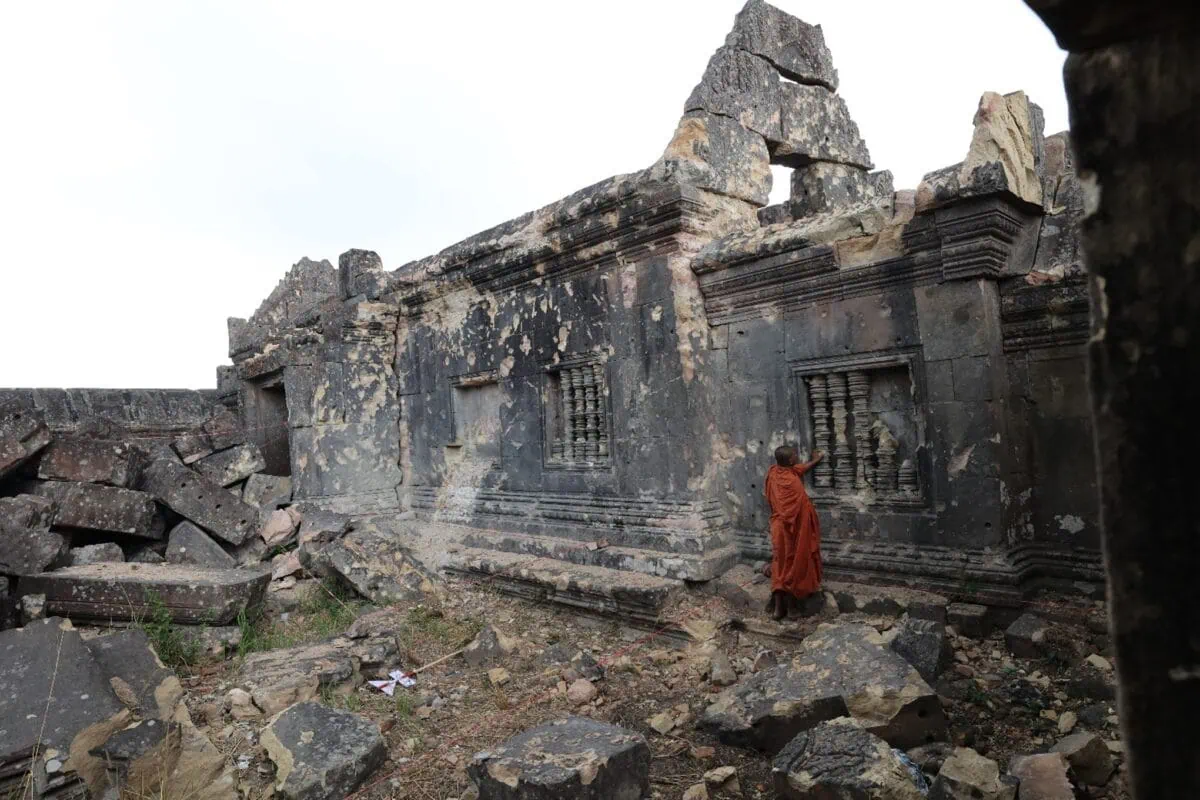 A Buddhist monk examines Preah Vihear Temple, which underwent heavy shelling by the Thai military during the December 2025 fighting. Supplied
#Opinion
On 7 July 2008, the international community celebrated a triumph for humanity. The Temple of Preah Vihear was inscribed on the UNESCO World Heritage List, joining the ranks of the world’s most treasured cultural monuments. The inscription was not merely a Cambodian achievement; it was a global recognition that Preah Vihear possesses outstanding universal value and forms part of the shared heritage of humankind.
Today, eighteen years later, Cambodia proudly commemorates that historic milestone. Yet this anniversary is also a solemn reminder of a painful truth: one of humanity’s irreplaceable cultural treasures became a victim of armed conflict.
The destruction of Preah Vihear was not simply Cambodia’s loss. It was a loss for humanity.
For nearly a thousand years, the temple stood majestically atop the Dangrek Mountains, surviving the rise and fall of kingdoms, the passage of empires and the forces of nature. What centuries could not destroy was damaged during modern military confrontation.
That tragedy should concern every nation that believes cultural heritage deserves the highest level of protection.
Long before UNESCO recognised Preah Vihear, the International Court of Justice had already settled the question of sovereignty. In 1962, the court ruled that the Temple of Preah Vihear is situated in the territory of Cambodia. In 2013, the court unanimously reaffirmed that Cambodia’s sovereignty extends over the entire promontory on which the temple stands and required the withdrawal of foreign military personnel from that area.
These are not political declarations. They are binding judgments of the world’s highest judicial body.
Together with UNESCO’s World Heritage inscription, these decisions imposed upon all States a heightened responsibility to respect and protect one of humanity’s most significant cultural monuments.
Instead, following the temple’s inscription, military confrontation engulfed the surrounding area. Artillery exchanges damaged the temple and nearby structures, leaving scars that remain visible today. Ancient stonework was fractured. Historic architecture suffered damage that no restoration can completely erase.
Cambodia has consistently maintained that this destruction resulted from Thai military heavy weapons during the armed aggression.
Even more troubling, Cambodia has consistently rejected Thailand’s assertion that Cambodian forces had used the temple area for military purposes. Cambodia maintains that those allegations were false and advanced to justify military operations in the vicinity of a monument whose protected status under international law was already beyond dispute.
If a World Heritage Site can be transformed into a military objective merely through unilateral allegations, then no cultural monument anywhere in the world is truly safe.
International humanitarian law was created precisely to prevent such a dangerous precedent.
The 1954 Hague Convention for the Protection of Cultural Property in the Event of Armed Conflict recognises that cultural monuments are not ordinary objects. They embody the identity, history and memory of civilisations. Their destruction diminishes not only one nation but humanity itself.
Accordingly, parties engaged in armed conflict are under a legal obligation to respect cultural property and to take every feasible precaution to avoid damaging it. Those obligations are especially compelling when the site concerned is a UNESCO World Heritage Site of exceptional universal significance.
Cambodia’s position is clear. A state cannot absolve itself of these obligations simply by asserting that a protected cultural monument has become a military objective. Such assertions demand compelling evidence and must withstand the strict scrutiny required by international humanitarian law. Otherwise, the protections painstakingly established after the devastation of the Second World War become little more than empty promises.
The significance of Preah Vihear extends far beyond Cambodia. It is a masterpiece of Khmer architecture. It is a monument of exceptional archaeological and historical importance. It is a symbol of Southeast Asia’s rich cultural legacy. Above all, it belongs to humanity.
When shells damaged Preah Vihear, they did not merely strike Cambodian sandstone. They struck a monument recognised by UNESCO as part of the common heritage of humankind. That is why accountability matters.
Accountability is not about perpetuating hostility. Nor is it about rewriting history to serve political interests. It is about defending the integrity of international law and ensuring that the destruction of protected cultural heritage never becomes acceptable, excusable or forgotten.
Around the world, the international community has condemned attacks against cultural heritage — from Dubrovnik to Timbuktu and Palmyra — because such acts impoverish humanity itself. The same principle must apply consistently everywhere, including Preah Vihear.
Eighteen years after UNESCO recognised its outstanding universal value, the temple still stands proudly above the plains below. It remains a testament to the genius of Khmer civilisation and the enduring spirit of the Cambodian people.
Its survival is remarkable. But survival does not erase the scars of war. The world does not remember only those who built great monuments. It also remembers those whose actions brought destruction to them.
Eighteen years after UNESCO recognised Preah Vihear as part of humanity’s shared heritage, the temple still stands as a masterpiece of Khmer civilisation. Yet its damaged stones tell another story — a story that Cambodia maintains is inseparable from the military actions of the Thai army during the armed invasion. Those scars are more than marks upon ancient sandstone; they are reminders that the protection of World Heritage depends not only upon international recognition, but upon respect for international law.
Civilisations are remembered for what they create. Nations are remembered for how they treat humanity’s shared heritage. History will render its own judgment.
Roth Santepheap is described as a Phnom Penh-based geopolitical analyst. The views and opinions expressed are his own.
-Phnom Penh Post-