The Border Ballot: How a New Policy Challenge Changes Cambodia’s Political Game
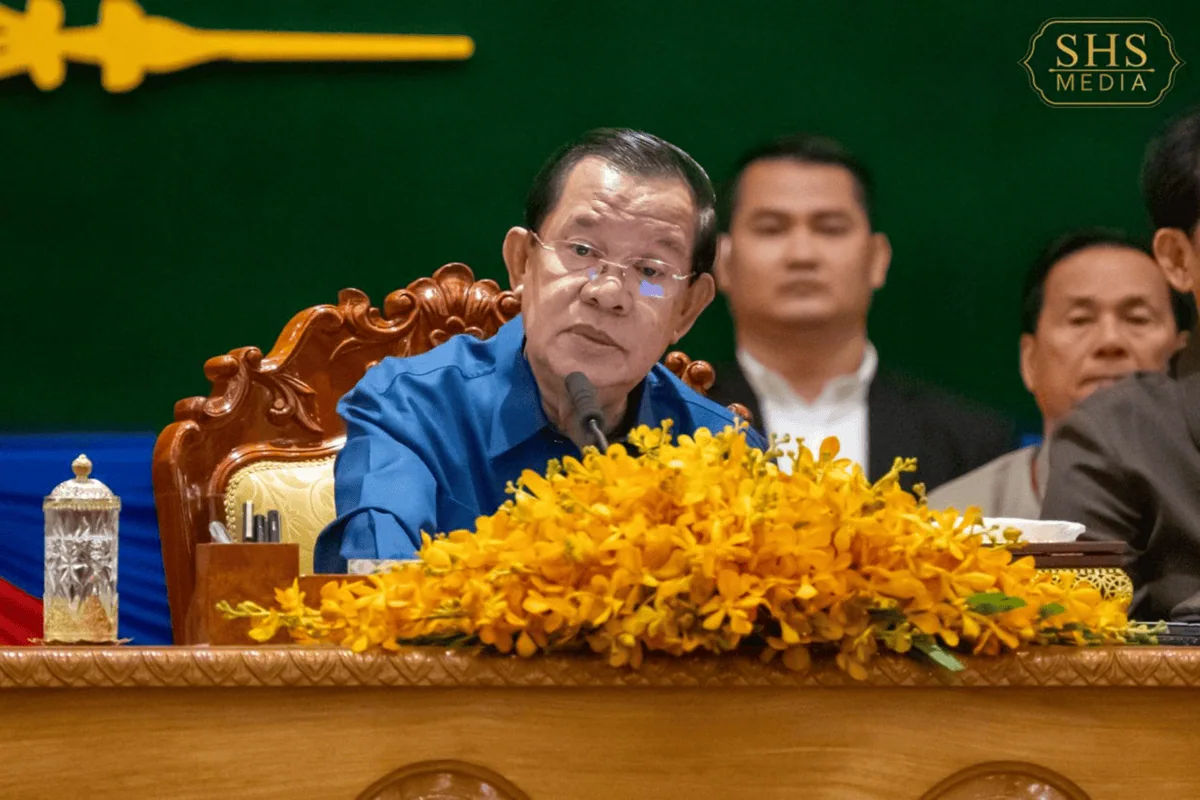 Senate President Hun Sen met with local authorities in Siem Reap on June 10. SHS
#Opinion
Senate president Hun Sen’s recent public challenge — calling on all political alliances and parties to formally present their respective border policies ahead of the 2027 and 2028 elections — marks a profound political development in Cambodia. Beyond the immediate context of territorial disputes, this call signals a pivotal shift in the nation’s political culture.
It indicates a hopeful trajectory where the historical era of zero-sum politics, often defined by personal animosity and purely adversarial opposition, is gradually giving way to a more mature system of competition based on substantive policy and leadership capacity. For a nation navigating complex geopolitical and developmental challenges, this transition from personality-driven friction to institutional policy debate represents a significant beacon of hope for the future of Cambodian statecraft.
Within this evolving political landscape, the ongoing Cambodia–Thailand border issue must be understood not merely as a territorial disagreement between neighbouring states, but as a highly complex matter involving sovereignty, constitutional responsibility, territorial integrity and the strict application of international law.
Particularly in the wake of the severe armed border tensions of late 2025 and the fragile December 27 ceasefire, the issue warrants a structured, institutional policy discussion that goes far beyond political rhetoric and symbolic positioning.
As Cambodia navigates its geopolitical future — and with the 2027 commune and 2028 national elections steadily approaching — border-related issues will naturally feature prominently in public discourse. A key question is whether this discussion will be driven primarily by emotive, nationalistic messaging or by the presentation of concrete, legally grounded policy approaches.
In this context, there is growing relevance in encouraging all political actors to articulate clear and coherent policy positions on exactly how they would address border governance, diplomatic engagement and the effective protection of Cambodia’s national interests without jeopardising regional peace.
Sovereignty as a National, Not Partisan, Responsibility
The protection of Cambodia’s territorial integrity is a constitutional responsibility shared by the state and all political actors. It should not be framed as the exclusive domain of any single institution, nor should it be reduced to short-term political posturing by domestic factions or opposition groups abroad.
Discourse on the border is most constructive when it is based on actionable policy alternatives rather than competing claims of patriotism. Sovereignty issues, by their very nature, require national continuity and institutional consistency that outlasts standard electoral cycles. As international practice suggests, a state’s geopolitical credibility relies heavily on its internal cohesion.
The Constitution of the Kingdom of Cambodia establishes the clear constitutional obligation of all state institutions to safeguard independence, sovereignty, territorial integrity and national unity.
Within this framework, political entities are best positioned to contribute through the development of credible, evidence-based policy proposals. Demanding reactive military solutions without calculating the broader diplomatic and human costs is not governance; it is a failure of statecraft. As acting head of state Hun Sen warned during his June 9 visit to displaced populations, firing the first bullet in violation of a ceasefire represents an immediate political and diplomatic failure. True statecraft requires formulating strategies that protect the nation’s borders while preserving its international standing as a state that respects the rule of law.
The Role of Law and Institutions in Border Resolution
Historical experience demonstrates that territorial disputes are rarely resolved sustainably through military posturing. They are addressed through a combination of strict legal interpretation, diplomatic negotiation, evidentiary documentation and formal international mechanisms.
Cambodia’s historical success in the Preah Vihear case before the International Court of Justice (ICJ) in 1962 illustrates the vital role that legal argumentation — supported by rigorous historical evidence — plays in resolving sensitive territorial questions.
Today, Cambodia’s legal position regarding its land borders remains firmly anchored in the Franco-Siamese Convention of 1904 and the Franco-Siamese Treaty of 1907. These documents are the legal foundation of the modern boundary. Suggesting the revocation or abandonment of these foundational texts, as some populist voices occasionally propose, would be a significant legal risk. It would not only destabilise relations with Thailand but also carry legal implications for borders shared with other neighbours, such as Laos, where these same treaties apply.
From an institutional standpoint, placing greater emphasis on legal research, treaty analysis, archival documentation and structured diplomatic engagement will strengthen Cambodia’s long-term position. Relying strictly on established international law proves to the global community that Cambodia acts as a mature, rule-bound state, insulating its territorial claims from regional political fluctuations.
The Need for a Consistent National Border Policy
Border governance benefits from institutional continuity and long-term policy planning. Too often, border issues are addressed reactively in response to specific localised incidents, media provocations or unilateral border closures rather than through a sustained, proactive national framework.
A more coherent policy framework would benefit from including continuous mapping and verification processes, the preservation of historical and legal records, effective inter-agency coordination and periodic reporting to relevant national institutions. Crucially, a consistent state policy must carefully separate unrelated legal issues to prevent diplomatic deadlock.
For example, the ongoing land border demarcation process, which should be executed strictly through the bilateral Joint Boundary Commission (JBC), must be treated as a distinct and separate legal track from the maritime boundary dispute in the Gulf of Thailand’s Overlapping Claims Area (OCA).
Thailand’s historical attempts to link the two issues have resulted in unnecessary delays. By formally initiating UNCLOS compulsory conciliation over the maritime dispute in June 2026, Cambodia demonstrated how a sophisticated national policy utilises distinct international mechanisms to bypass bilateral gridlock. Ensuring that border management is treated as a technically grounded, institutional governance function prevents external actors from holding land negotiations hostage to maritime economic disputes.
Border Communities and Humanitarian Considerations
Border populations are the first to be directly affected by changes in stability and diplomatic relations. As the nation recently witnessed with the displaced families residing in temporary settlements in Svay Chek district and other areas of Banteay Meanchey province following the 2025 clashes, the human cost of border instability is profound. When tensions escalate, economic activity is paralysed, cross-border mobility is restricted, trade collapses and local safety is deeply compromised.
For this reason, any comprehensive policy discussion on border issues should incorporate robust humanitarian and developmental considerations.
A credible border policy is not just about drawing lines on a map; it is about protecting the citizens who live along those lines.
This includes immediate infrastructure investment for displaced populations, ensuring the continuity of education through mobile libraries and temporary schools, guaranteeing secure land administration and building long-term economic resilience in border provinces to reduce dependency on cross-border micro-economies.
Strengthening local communities in these vulnerable areas contributes not only to national development objectives but also serves as an important element of the broader, physical stability of border governance.
Legal and Diplomatic Strategy
International practice shows that territorial issues are most sustainably managed through legal clarity and diplomatic engagement backed by credible documentation. As state leadership has recently reaffirmed to both the public and the international press, peaceful resolutions based on international law offer far more sustainability than armed conflict.
Initiating military action violates ceasefires and instantly destroys international trust.
In this regard, expanding Cambodia’s legal expertise, historical research capacity and international documentation efforts are relevant policy considerations for any political party. When direct bilateral negotiations stall, a coherent diplomatic strategy must include a willingness to engage international frameworks — whether that means returning to the ICJ for treaty interpretation or utilising UNCLOS tribunals.
A nation’s territorial governance is ultimately shaped by the strength of its evidence, its institutional capacity to present that evidence in international forums and its diplomatic credibility on the world stage.
Policy Articulation and Institutional Statecraft
As noted, the challenge issued to political parties to formally present their respective policy approaches on the border issue represents a major political development for Cambodia.
In many respects, this challenge fundamentally changes the rules of political engagement. Historically, border disputes have sometimes been utilised by various factions as tools for populist critique, relying heavily on emotional appeals rather than substantive solutions. By demanding that all parties present codified border policies, the political arena shifts from grievance-based messaging to a rigorous test of true governance capacity.
What the Senate president is calling for is not merely a theoretical exercise, nor is it an overstep of institutional bounds; it is a highly practical mechanism that reinforces constitutional democracy.
By directing political competition toward the 2027 and 2028 elections, the challenge explicitly validates the ballot box as the sole legitimate venue for resolving national policy disputes. Domestically, it provides voters with clear, actionable alternatives rather than vague promises, fundamentally strengthening the core tenets of a democratic society by ensuring that political competition is grounded in executable policy. Internationally, it signals to allies and adversaries alike that Cambodia’s political institutions are mature enough to respect international law, even if they debate the specific mechanics of diplomatic execution.
Crucially, this challenge presents a profound opportunity for opposition and minority parties to redefine their role within Cambodia’s maturing democracy.
By answering the call to formulate a comprehensive policy, these parties can transcend the stage of purely oppositional positioning and present themselves to the public as a credible “government-in-waiting”. It provides them a platform to demonstrate that they possess the legal expertise, diplomatic sophistication and institutional capacity required to manage complex international law. In a healthy democracy, the role of an opposition party is not merely to point out flaws, but to offer viable, competitive alternatives for statecraft.
By declaring that a peaceful, legally grounded settlement will remain central to the ruling Cambodian People’s Party (CPP) platform, the Senate president has set a new benchmark for political competition. If a political party wishes to challenge the current approach, it must present a legally viable, diplomatically sound alternative to the electorate.
Furthermore, in an era where misinformation and disinformation can rapidly escalate cross-border tensions, requiring political parties to present formal, written policies forces a commitment to verified, factual information over inflammatory rhetoric. Engagement with major national issues through the articulation of coherent policy is a hallmark of mature statecraft.
It demonstrates to the international community that Cambodia handles its sovereignty with institutional seriousness, proving that its political processes are evolving to focus on substantive governance rather than partisan division.
Conclusion
The Cambodia–Thailand border issue represents a long-term governance challenge involving complex legal, diplomatic, institutional and humanitarian dimensions. It must therefore be addressed through coherent policy frameworks rather than episodic political discourse or reactive military demands.
The presentation of clear, legally grounded policy positions by political actors contributes to a more informed public understanding of how Cambodia can best manage its sovereignty, border governance and international engagements.
By demanding these codified policies ahead of the upcoming electoral cycles, the political landscape is transformed. It fundamentally reshapes the terms of political competition, encouraging opposition and minority parties to move beyond critique toward demonstrating genuine governance capacity required to manage complex international law.
Ultimately, the central issue is whether border governance is approached through short-term messaging or through sustained policy development that enables consistent, peaceful and legally grounded institutional responses over time. By prioritising international law, diplomacy and the welfare of border communities — and by demanding that all political parties bring formal, thoroughly researched policy solutions to the ballot box in 2027 and 2028 — Cambodia secures not just its territory, but its enduring credibility as a maturing, sovereign state.
Panhavuth Long is founder and attorney at law at Pan & Associates Lawfirm. The views and opinions expressed are his own.
-Phnom Penh Post-