From Chalkboards to Lab Benches: Cultivating Cambodia’s STEM Future
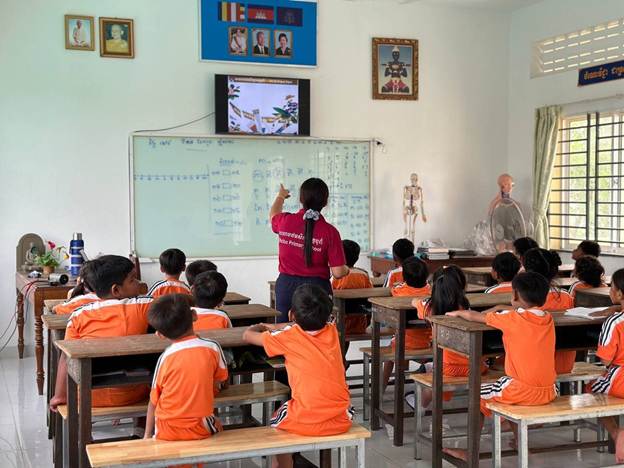 Cambodian students study in a primary school classroom in Siem Reap. Sala/Education ministry
#opinion
Walk into almost any provincial high school classroom across Cambodia, and you will likely witness a deeply entrenched tradition: a teacher writing formulas on a chalkboard, and rows of students quietly copying them into notebooks. For decades, this method of rote memorisation was a functional tool for a rebuilding nation prioritising basic literacy and numeracy.
Today, however, as the global economy accelerates into the Fourth Industrial Revolution (Industry 4.0), copying definitions is no longer enough. To secure its future, Cambodia must urgently transform its youth from passive consumers of information into active, scientifically literate problem solvers.
The Kingdom has set ambitious targets: transitioning into an upper-middle-income country by 2030 and a high-income nation by 2050. Achieving this is not a matter of simply doing what we have always done, just faster or at a larger scale. It requires an entirely different economic model.
For the past twenty years, Cambodia’s remarkable growth has been carried on the backs of low-cost, labour-intensive industries like garment manufacturing, construction and traditional agriculture. But automation, robotic, and artificial intelligence are quickly erasing the competitive advantage of cheap human labour.
If our upcoming generation is not equipped with advanced technical skills, the country risks economic stagnation and technological displacement.
The antidote to this vulnerability is a systemic embrace of Science, Technology, Engineering and Mathematics (STEM) education. The government’s National Science, Technology and Innovation (STI) Roadmap 2030 recognises this, explicitly calling for the cultivation of human capital to achieve “technological sovereignty”.
Multinational firms looking to diversify their high-tech supply chains are eager to invest in Southeast Asia, but they will only establish complex operations where they can source a capable, technically proficient local workforce.
Yet, the importance of scientific literacy extends far beyond industrial output or attracting foreign tech investment. It is an existential tool for solving uniquely Cambodian challenges. Consider our rural landscape.
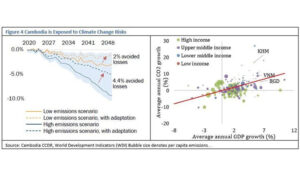
Cambodian agriculture is increasingly exposed to the volatile shocks of climate change — irregular monsoons, unpredictable droughts, and ecological shifts in the Tonle Sap basin. Navigating these crises demands local expertise. We need home-grown agronomists to engineer climate-resilient crops, hydrologists to design smart irrigation networks, and environmental engineers to protect our ecosystems.
When a young student learns the scientific method, they aren’t just memorising facts; they are acquiring a framework to look at a community problem, isolate variables, form a hypothesis and build a tangible solution.
The Ministry of Education, Youth and Sport (MoEYS) has initiated bold steps to address this.
The New Generation Schools (NGS) pilot programme, for instance, has successfully introduced autonomous management, modern ICT infrastructure and hands-on, project-based learning to a selection of public schools. Initiatives like the annual National STI Day have also begun elevating the cultural prestige of scientific careers, showing parents and students alike that engineering and research are highly viable, respected paths.
However, scaling these bright spots into a nationwide reality reveals a stark, deeply concerning structural divide. While urban schools in Phnom Penh or provincial capitals increasingly enjoy digital access, the vast majority of rural classrooms face a profound resource gap.
It is incredibly difficult to foster a deep curiosity for chemistry without test tubes or reagents, or to teach computer science on a chalkboard without a single functioning device. This digital and physical resource divide threatens to leave our rural youth behind, deepening regional inequalities just as the high-tech economy takes off.
Equally critical is our human resource deficit. Upgrading infrastructure is a matter of capital allocation; upgrading pedagogy takes years of intentional investment. Many of our dedicated educators grew up under the very same rote-learning paradigm they are now asked to dismantle.
Teaching science through inquiry and experimentation requires deep content confidence and a cultural shift that tolerates failure. In a traditional classroom, an incorrect answer is often penalized. In a scientific laboratory, a failed experiment is simply data — a necessary step toward a solution. We must provide our teachers with robust, continuous professional development, modern tools and competitive incentives to attract top scientific talent back into the classroom.
Furthermore, we cannot afford to build a tech-driven future while leaving half of our intellectual capital behind. While gender parity has drastically improved in general education, female representation drops off significantly in higher-education engineering and computer science tracks.
Overcoming deep-seated cultural expectations requires us to actively elevate female scientific role models, dismantle classroom biases and show young girls that the laboratory belongs to them just as much as anyone else.
The youth of Cambodia represent a massive, vibrant reservoir of untapped potential. They are inherently creative, highly adaptive and deeply eager to learn. But potential without infrastructure is a missed opportunity. The government cannot carry this massive educational pivot alone. It requires deep, long-term partnerships with private industries, local tech firms and international development organizations to fund provincial school labs, provide digital access and mentor the next generation of educators.
Knowledge is the ultimate currency of the 21st century. By committing to comprehensive, inclusive and inquiry-based scientific education today, Cambodia will ensure its youth are no longer just reacting to global technological updates, but actively driving them.
Investing heavily in STEM is the ultimate act of modern nation-building — one that will secure a prosperous, resilient and truly independent future for the Kingdom.
Jared Wright is a high school teacher in Kampong Chhnang. The views and opinions expressed are his own.
-Phnom Penh Post-