Cambodia’s key word in 2026 is ‘confidence’
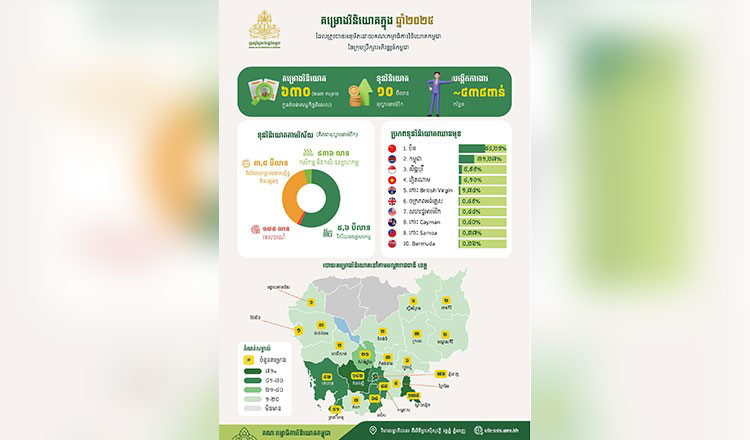 Cambodia approved 630 investment projects worth $10 billion in 2025, data show. CDC
#editorial
Cambodia, like the rest of the world, is facing a global crisis in which superpowers are attempting to redraw their spheres of influence and redefine their instruments of power through brute force and domination.
Cambodia’s neighbouring environment offers a reflection of this global context, albeit on a smaller scale. Countries are witnessing an excessive and boundless arrogance and ambition regarding territory, resources, and technology. These ambitions are such that those in power are prepared to destroy the entire system or architecture if their demands are not met.
In such a brutal regional and global context, in 2025 and until 2026, “confidence” should be the fundamental term to describe Cambodia’s national resilience, its solidarity and its efforts to remain relevant, connected, useful and, above all, to stay on the world map.
One of the most important aspects is public confidence.
If we recall the recent past, marked by the traumas of past wars, Cambodians were accustomed, in times of emergency, war, and conflict, to stockpiling food, seeking refuge abroad, sending money abroad, and withdrawing money from banks. This kind of behaviour was not observed in the face of the 2025 Thai invasion.
On the contrary, Cambodians from all walks of life and of all ages contributed in cash, in kind and in words to express their solidarity with the soldiers on the front lines.
This is a sign of public confidence in the country’s leadership, without which Cambodia would have no chance of resisting Thailand’s overpowering invasion.
As 2026 arrives, Cambodia must continue to question whether it has sufficient confidence in its ability to ensure its survival in the face of external threats that seek to erase it from the world map.
Civil servants, private sector actors, and academics must constantly ask themselves the following question: Do we have enough confidence in our defence, economy, education, healthcare, agriculture, logistics, telecom, aviation, railway, investment climate, etc?
The list is long, but the main point is that the stakeholders must constantly ask themselves whether their actions inspire sufficient public confidence.
Let’s examine a few sectors.
First, investment confidence.
Despite the gloomy outlook for the global economy, Cambodia has performed exceptionally well in attracting foreign direct investment (FDI). In 2024, the Council for the Development of Cambodia set a record by approving US$6.9 billion in FDI. This record was broken in a single year, in 2025, with an impressive investment capital of over US$10 billion, representing a 45% increase.
But investment doesn’t end with approval. It continues with implementation, and Cambodia is not among the easiest countries to do business in by either regional or global standards. There is some good news, however: Cambodia ranks first in the ASEAN region for financial services in the World Bank’s 2025 Business Ready (B-READY) survey.
What about other sectors?
There are some ministries which are fighting each other for business opportunities and to protect their narrow ministerial or even personal interests, at the expense of national interest. Some ministries, or even ministers, are practising obstructionist behaviours requiring every permit to be approved by the ministers. In Khmer, we call these “kampis kor si, bangkong kor si”, meaning people who swallow everything, from small shrimps to big lobsters.
Their rationales? It is the law, it is procedure, it is technical, so complicated that nothing can be approved unless those who need them apply through the so-called ministry’s registered independent consulting companies. Otherwise, approvals are up in the sky. In Khmer, we describe such a process as “doch som pleung yeak”, meaning as tough as asking legendary demonic giants for fire.
To boost investment confidence, the government must strive to remove the technical and regulatory barriers, obstacles, and red tape that hinder investment.
In the meantime, the government needs to continue to push for development of key, strategic, game-changer infrastructure projects to boost the country’s competitiveness, resilience and survival autonomy namely the Funan Techo Canal, expressways, ports and railway.
The government also needs to ensure that mega infrastructure facilities, such as Techo International Airport, is highly competitive in the region so that the public can feel confident that the returns are worth the investment.
Second, trade confidence.
Cambodia’s foreign trade volume reached $65.24 billion in 2025, a year-on-year increase of 17.6%. This is bright news. Maintaining the markets during the scary tariff era was not an easy feat, and Cambodia should be proud of how the country survived the storm.
For the future ahead, diversification is still key for economic survival.
The national momentum for the “Made in Cambodia” and “Buy Cambodia First” campigns should be maintained for economic security without too much reliance on external investment. To that end, Cambodian Okhnas must increase their presence in the manufacturing sector for the good of the national economy and industrialisation.
Lastly, diplomatic confidence.
Every Cambodian saw how difficult it was to shout for help from friends all over the world when Cambodia was invaded by Thailand. Nonetheless, the sincerity of Cambodia’s communications has reached the hearts of international communities. Although many countries, including close friends of Cambodia, could not speak much in support of Cambodia due to the hostile neighbouring and global environment, the international communities still rely on official record-keeping, verified evidence, and international law, when the calamity caused by geopolitical contest subsides.
Cambodia needs to continue to build stronger friendship with every nation, conduct trade with all nations, and build stronger networks with like-minded countries as much as it can.
Cambodia’s name is gaining international recognition, for better or for worse.
It is Cambodia’s duty to forge new memories and positive associations to its name. Some ministers and Okhnas need to behave better with more patriotism, and learn the Buddhist sense of “enough”. they should strive to share their knowledge and resources to help build a stronger Cambodia with strong domestic and international public confidence.
Again, let’s ask ourselves: Are we earning enough public confidence in each of our own sectors?
-Khmer Times-