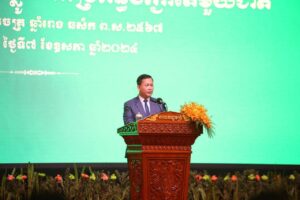
(Video) Selected Comments of Samdech Thipadei Hun Manet at the “Inauguration of School Buildings, Administration Buildings, Teachers’ Residences and Achievements in Kampong Speu Province” [ Unofficial Translations]
[1]
(1) From being a remote and poor province Kampong Speu has interrelated roads, garment, cement, and sugar factories, combined with tourism and agroindustry potential
Building and developing human resources is important […] After 1979, for several mandates, the Royal Government has worked hard to restore the education sector […] Kampong Speu is a province with great potential, but never had the opportunity to develop like it does today […] Kampong Speu is the most remote and poorest province, unable to develop (due to war). Now we have interrelated roads, with the potential to attract factories – not only garment, but many types of factories, including cement and sugar, with some tourism potential, and agroindustry to the province […] The regional Vice President for East Asia and the Pacific of the World Bank, whom I met, praised Cambodia for “having a lot of young human resources”. “Cambodia has young human resources in terms of age, physical fitness, and strong health. But for a person to be more productive, it doesn’t just refer to health and age, but also to ability and knowledge so that we can use or provide opportunities for them or let them seize opportunities in work better” I said […]
(2) Many female teachers at primary school means some were born in the 1990s when schools are already in or closer to their villages and communes already
Over the past several terms, the Royal Government has done a lot of work, especially the Ministry of Education, Youth and Sports, which has been striving to exercise regular reforms. In short, since 1979, it has been a period of rebuilding human resources, building the education system, and building the quality of education, in which parents feel very happy that their children will definitely have good education […] As Prime Minister, I have promoted the construction and expansion of many schools. Like this place, these two buildings were built in the 1990s, or even before the end of the war […] Although they are now old and dilapidated, in the past 30 years, they have served thousands of (students). This achievement was born from the vision of the leader, who said that more school buildings should be built […] We see that there are currently many female teachers, especially primary school teachers […] which means some were born in the 1990s. Those born in the 1990s are over 30 years old. Some teachers are over 20 years old. That means they were born when there are schools in or closer to their villages and communes already […]
(3) The ultimate goal is to provide teaching/studying tools, modernized curriculum, text books to every schools
We continue to expand and strengthen the quality (of education) further. Strengthening quality is talking about infrastructure. Initially, we built schools with thatch roof and wall. Later, we were able to build them in wood. In the 1990s, we have started to build schools with concrete […] As of now, one-story buildings were no longer special, unless they are two-story, three-story, or four-story, and the infrastructure became more modern, including interior equipment […] We have not had the ability to provide all schools with experimental equipment yet […] however, the ultimate goal is that we provide every teaching and studying tools the schools would need […] and modernized curriculum, coupled with the ability to supply books to students […]
(4) Modernize teaching programs enable coping with challenges of emerging trends
Students of this generation’s lessons, compared to the previous generation, are much more modern. For example, they have added STEM programs, science, technology, engineering and mathematics, plus compiled research programs from other countries […] If we do not embark on modernization, adopting programs that have been (learned) for 30 years and not changing them for students to learn, we will not be able to cope with the challenges of emerging trends. We must constantly modernize. The Ministry of Education (Youth and Sports) has implemented programs related to science and innovation […] Many schools, including those in Kampong Speu province, have innovations by the schools themselves, the community, and in some places, parents are mobilized, in addition to what the Ministry of Education (Youth and Sports) has equipped […]
(5) Addressing shortage through contract teachers or some other ways, but with guaranteeing quality and qualifications
The quality of education is related to teachers […] If we don’t have enough teachers or qualified teachers […] students will still not learn properly. Students go to schools to depend on the teachers as a whole. Therefore, the qualifications and teaching ability of teachers are essential. We have worked hard to strengthen qualifications. We increase the quantity and quality of teachers. We have a problem with the quantity of teachers, which needs to be addressed in some way, whether it is (recruiting) contract teachers or some other way, but with guaranteeing quality and qualifications […]
Investing in teachers is a major priority that the Royal Government has been working hard to pay attention to for decades. In this 7th legislative term, we will continue to build qualified teachers. As of present, we have raised (the level of teacher requirements at) the secondary level until to have training of 12 (years of general education) plus 4 (years of pedagogy) or a bachelor’s degree […] Between one teacher with proper training to teach 60 students in a class and, another option, two teachers without proper training and teaching 60 students, I think the teacher with proper training to teach 60 students is a better choice than otherwise, if 30 students in a class (for two classes) go to study with two teachers without proper expertise, we would have created problems for 60 students […]
(6) Door opened for short-term contracts for retired teachers for schools where teachers are needed
In the past, there was a consideration about selecting substitute teachers […] Whatever we do we must ensure (quality) because the future of our children is in the hands of the teachers. We have opened the door to considering short-term contracts for retired teachers. Some people said that if retired teachers were to sign contracts (to continue teaching), it would mean that there would be no opportunities for young teachers. That is not the case. We are only talking about (doing so for places where) there are shortages. Our law stipulates that “officials retire at the age of 60”. That does not mean (contracting them to continue teaching) would not allow them to retire. We are asking them to come back (to teach) as contract teachers […] (In this sense) “We are not doing this to close the opportunities for young teachers. But in schools that cannot find qualified teachers to replace them (we need to consider how to solve the) difficulties.” For kindergarten and primary school teachers, we can take contract teachers of any level, but for teachers (with specialized skills is not easy) […] For example, for grade 11 where they need teachers of chemistry or biology, we cannot go and grab just someone who has a bachelor’s degree, never taught before, and ask them to look at books and teach […]
(7) Selection of contract teachers evaluated by the district authority but final decision still belongs to education department
Strengthening the qualifications, the governance of schools and teachers are the main factors that need to be worked on. The Ministry of Education (Youth and Sports) has a proper set regulation in the selection of directors, training of directors, and school management […] I would urge that the selection of (contract teachers) be evaluated by the district (authority), but the final decision still belongs to the (education) department to be based on those set regulations. We give the right to the lower level to select according to a regulation […] and regarding teachers, (even if they are contract teachers), there must be regulations to (follow through). A teacher educates 30 or 40 students for a few years, which means s/he is responsible for the lives and abilities for hundreds of students […]
(8) Improved scholarship for training phase ensures qualified applicants for teachers entrance exam
Regarding the qualifications and consideration of the living conditions of teachers. We have increased salaries regularly. Compared to other types of civil servants, teachers’ salaries and benefits are high but if one (asks whether that is) enough. It is not enough. We will continue to increase (scholarship for teachers in training). There is no country that has stopped increasing salaries, though it may just postpone doing so in some years, because the cost of other things has gone up. This scholarship improvement must be taken into account since the time we recruited teachers to take pedagogical school […] (whereas addressing and strengthening the attraction to the job) through improved (scholarships) like this ensures qualified applicants for the entrance exam […]
(8) Top graduates of secondary school diploma taking teachers entrance exam help ensure quality education
During Samdech Techo’s era, the Royal Government has worked hard to increase subsidies, arrange good accommodation and schools to attract more candidates to become teachers. Now, 75% of those who have passed the (secondary school diploma) scoring A, B, C mentions have taken teachers entrance exam. This is a great quality for our children in the future. Bringing (these people to be trained as teachers) like this will ensure (quality education) […] The profession of a teacher is not a career of becoming a millionaire […] but a millionaire of honor. Teachers are the one whom, no matter how high in ranks and positions their students may go up, and no matter where they would be, they still greet them as “teachers” always […]
(9) Teachers – the second parents who provide knowledge, behavior, virtues, and ethics to increase abilities to support you, your families, and help nation
Only people with this profession would sit on the platform below and smile when seeing their students succeed and sit up at the podium here […] The first benefactor is the parents who give you a life, feed you, give you clothes, buy you materials and put you in schools. They work hard to earn money. Another benefactor is teachers who may be considered as the second parents who equip you with knowledge, behavior, virtues, and ethics, so that you can use knowledge to increase your abilities, earn income to support yourselves, your families, and help the nation […] Education happens in three places – school, home, and society […] In society, it means engaging in daily life, but at home and in school, parents and teachers help direct and ensure that you get an education […]
(10) Building more secondary and high schools and expanding TVET coverage as current economy relies heavily on human resources
We are investing a lot in further development and construction (of school buildings). We must strive to narrow the gap between primary, secondary and high schools […] so far, we have 7,000 primary schools, 1,300 secondary schools and there are only 600 high schools. This is a big gap. I have asked (Deputy Prime Minister and Minister of Education, Youth and Sports) His Excellency Hang Chuon Naron to discuss with the Ministry of Economy and Finance to increase (fund for the construction of more) secondary and high schools […] and we are expanding TVET coverage further […] The current economy relies heavily on human resources […]
(11) By 2030, 50 to 60 percent of those attending schools continue from primary to secondary, to school, plus taking TVET programs
We must strive, perhaps by 2030 […] 50 to 60 percent of those who attend school will continue from primary school to the secondary school, and to high school, plus studying in other TVET programs […] We must think about number. Some even think that here does need to take an exam when students get to the Baccalaureate. Some countries do not have this Baccalaureate exam. The United States does not have a Baccalaureate exam. They only take semester scores and annual scores. In Cambodia, each exam is a test to determine the rules, evaluation, plus certain selections […] We have no plan to eliminate the Baccalaureate. The exam is to check and motivate students to study hard […]
(12) School shall strive to have parents’ trust, confidence in teachers, and support from the community
The other day, there was this ASEAN-related evaluation of the quality of students through reading ability, learning ability, and how many points they got. The Cambodians got quite high points. We will continue to do that. We must ensure behavior, morality, and virtue, and educate more on skills and soft skills […] and let each school compete, with evaluation from parents. Each school strives to have parents’ trust the school, have confidence in teachers, support teachers, and support from the community. That is the score to be received. Among the tens of thousands of schools in the country, if we take the scores of the Ministry of Education and the Ministry of Public Service each year, only 4 to 10 schools would pass […] The important thing is to score yourself […]
(13) Strengthen education so four or five million young people today will become human resources for the next 60 to 80 years
The goal is competing with yourself. Take scores from parents, students, and the community […] Please continue to encourage parents, communities, philanthropists, former students and those who have the ability, and various working groups here, to continue to participate in helping to strengthen the education sector at the grassroots level. Provincial authorities, district authorities, education departments, and education offices should work hard to promote and strengthen education […] so that the four or five million young people today will become human resources for the next 60 to 80 years. We need to train them to be strong from now on and to have a stronger foundation (for the future) […]
(14) Students leaving school succeed in 10 to 20 years later is the pride for teachers
Education and health are the priority sectors. To strengthen certain tasks, I have personally taken leadership. There are five key rules, and there is a committee under the direct support of the Prime Minister in the fields of education, health, and civil service reform […] It would be our pride that students who leave school have a chance to succeed in 10 to 20 years later, because we have strengthened them from an early age. Children aged 6, 7, or 10 who come to school will have the ability, attitude, and strengthen their learning foundation. In the future, when they go to work, go into business, or do business, they will become those who have a lot of success opportunities. That is the pride for teachers […]
(15) Education is about training human resources for the future – what planted in schools, fruits are in society
It is not different from parents who work hard to raise their children […] This is the pride that comes from the heart […] Education is about training human resources for the future. There is a saying that goes – planted in schools, and the fruits are in society. Learning today will help her/him become a resource for the next decade […] (It is in this context that) Samdech Techo has made it his determination to let no future generations suffer like he did, since he had been separated from his parents at a young age to pursue an education […] Giving Cambodian children everywhere the opportunity to learn is a principle that the Royal Government will continue to build on in this mandate to ensure that Cambodians have more opportunities […]./.