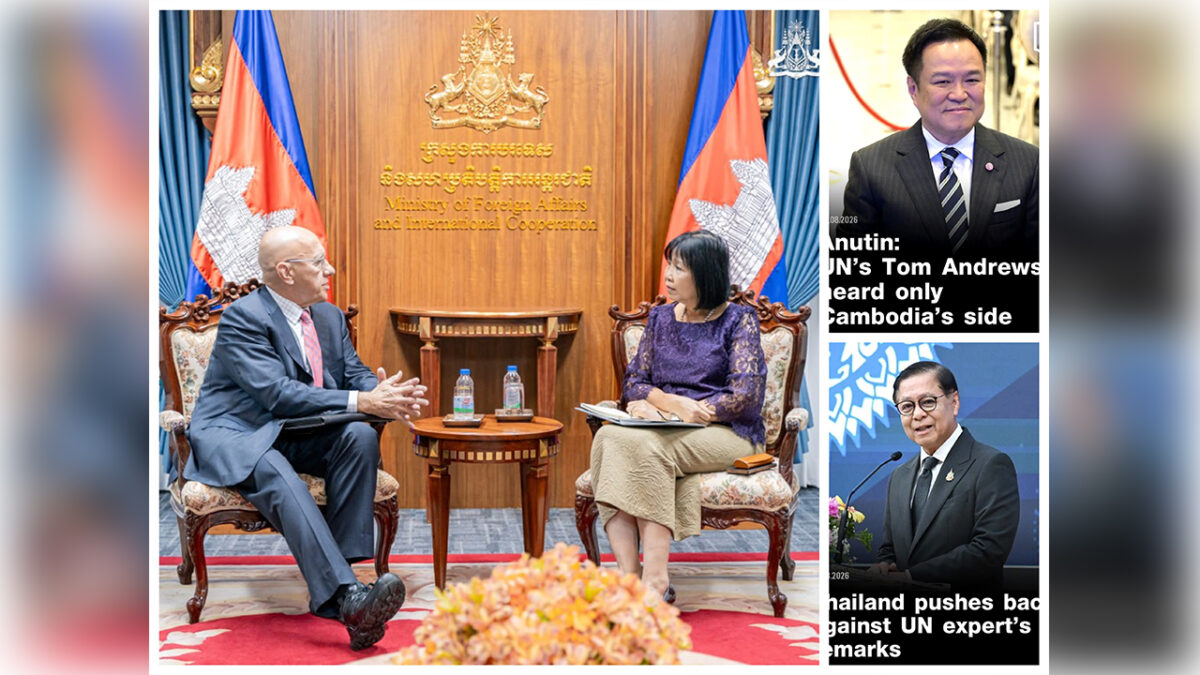
Cambodia has defended the work of UN special rapporteur on the situation of human rights in Cambodia Thomas Andrews following criticism from Thailand, with the Ministry of Foreign Affairs and International Cooperation saying permanent secretary of state Eat Sophea appreciated what she described as the rapporteur’s “comprehensive and balanced approach” to assessing the human rights situation in Cambodia.
The ministry said Sophea met Andrews on July 31 to discuss the outcome of his meetings with Cambodian leaders and relevant stakeholders, as well as his visits to various locations across the country during his first official mission to Cambodia.
According to an August 3 ministry press release, Sophea expressed appreciation for what she described as the special rapporteur’s “balanced assessment” of the human rights situation in Cambodia, including his visit to displaced communities along the Cambodia-Thailand border.
The meeting came shortly after Andrews concluded his mission with a call for Cambodia and Thailand to work together to ensure the safe and dignified return of civilians displaced by last year’s border conflict.
During a July 31 press conference, Andrews said he had visited relocation sites in Banteay Meanchey province, where he met families displaced by the fighting and witnessed the humanitarian consequences of the conflict firsthand.
“I spoke to civilians who told me that they are unable to return to their homes because their villages and towns are now occupied by Thai soldiers,” Andrews said at the time.
He also urged both governments to implement the December 27, 2025 ceasefire agreement and facilitate the return of displaced civilians in accordance with international humanitarian law and international human rights law.
Thailand later rejected Andrews’ assessment, arguing that UN Special Procedures should uphold impartiality, objectivity and “rely on credible and verifiable” sources.
Bangkok also disputed references to some displaced communities, claiming that areas such as Chouk Chey village — which Thailand refers to as Ban Nong Chan — are located within Thai territory.
The foreign ministry’s latest statement did not directly address Thailand’s criticism but reaffirmed its confidence in the UN expert’s work.
The ministry said Sophea recalled Cambodia’s decades-long recovery following civil war and genocide, highlighting the country’s socio-economic transformation since the restoration of full peace in 1998.
She also underscored the Royal Government’s commitment to protecting civil and political rights alongside economic, social and cultural rights, describing them as mutually reinforcing pillars of sustainable development.
The ministry further noted that Cambodia remains the only country in Asia hosting a stand-alone Office of the UN High Commissioner for Human Rights (OHCHR), which has maintained a presence in the Kingdom since 1993.
According to the statement, Cambodia has also worked constructively with eight successive UN special rapporteurs on the situation of human rights in Cambodia, demonstrating what the ministry described as the country’s longstanding commitment to openness, constructive dialogue and meaningful engagement with UN human rights mechanisms.
Beyond the border situation, Sophea and Andrews also exchanged views on a broad range of human rights issues, including freedom of expression, economic and financial inclusion, gender equality, women’s empowerment, prison overcrowding and efforts to improve access to justice.
The ministry said Andrews expressed appreciation to the Cambodian government for facilitating his July 20 to 31 mission, which enabled him to meet senior government leaders, civil society representatives and other stakeholders, undertake field visits in Siem Reap and Banteay Meanchey provinces, and inspect detention centres.
According to the ministry, Andrews observed the situation of displaced border communities and expressed hope for a swift resolution that would enable their safe and dignified return to their homes and livelihoods in accordance with international humanitarian law, international human rights law and the ceasefire agreement between Cambodia and Thailand.
The statement also highlighted Cambodia’s broader cooperation with the international human rights system, noting that the Kingdom has ratified eight of the nine core international human rights treaties and accepted approximately 84% of recommendations made under the Universal Periodic Review (UPR).
The ministry said Andrews reaffirmed the Human Rights Council’s readiness to continue providing technical assistance to support Cambodia’s implementation of those recommendations.
The meeting concluded with both sides reaffirming their shared commitment to maintaining an open and constructive dialogue, strengthening technical cooperation and continuing to work together to advance the promotion and protection of human rights in Cambodia.
-Phnom Penh Post-