Mines minister Rottanak defends legal sand dredging amid public backlash
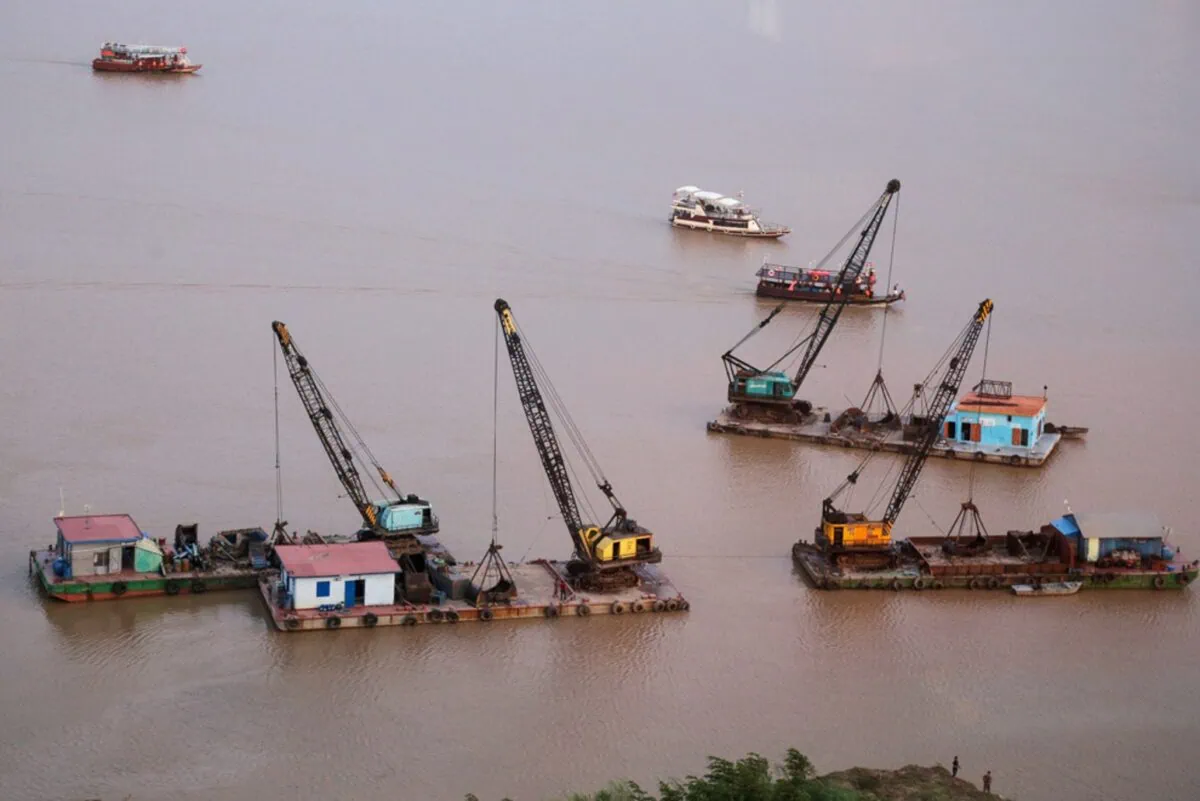 Sand dredges in the Mekong River. Post Staff
Minister of Mines and Energy Keo Rottanak has defended legally authorised sand dredging as essential to Cambodia’s navigation, energy security and infrastructure development, while acknowledging public concern over its potential impact on riverbanks, fisheries and communities.
His intervention followed intense public debate over a recent violent confrontation involving fishermen and a company conducting sand-dredging operations near Phum Thmei village in Peam Ro district, Prey Veng province.
Rottanak said the government was not seeking to dismiss public criticism or determine winners and losers in the dispute, noting that the citizens who raised concerns were motivated by a shared desire to protect the country and ensure development benefited local communities.
“The concerns raised by the public are legitimate concerns that the ministry and relevant institutions must continue to consider,” he said.
However, he stressed that correctly licensed and technically managed dredging should not be equated with illegal or uncontrolled sand extraction.
According to the minister, the government authorises sand dredging for five principal purposes: maintaining navigable waterways, reducing flood and riverbank-collapse risks, supporting new infrastructure and keeping construction materials affordable, removing unexploded wartime ordnance and generating state revenue.
Free navigation
He said the first and most important objective was to open and maintain inland navigation routes along the Mekong, Tonle Sap and other major waterways.
Cambodia had yet to use the full economic potential of water transport, he noted, even though moving large quantities of goods by river was considerably cheaper than relying solely on roads, railways or air freight.
Improved waterways would allow agricultural products and other goods to move more competitively to domestic and international markets, particularly once the Funan Techo Canal becomes operational and connects the Mekong and Bassac river systems with the coast in Kampot province.
Rottanak said the government envisaged vessels carrying between 5,000 and 6,000 tonnes using the waterway during the dry season. Such vessels would require channels of at least eight metres in depth, and at present, many sections of the Mekong currently lack sufficient depth throughout the dry season.
Navigation conditions were even more restricted on the Tonle Sap River, where dry-season vessels could generally carry only between 1,000 and 1,500 tonnes and were required to remain within narrow channels, he added.
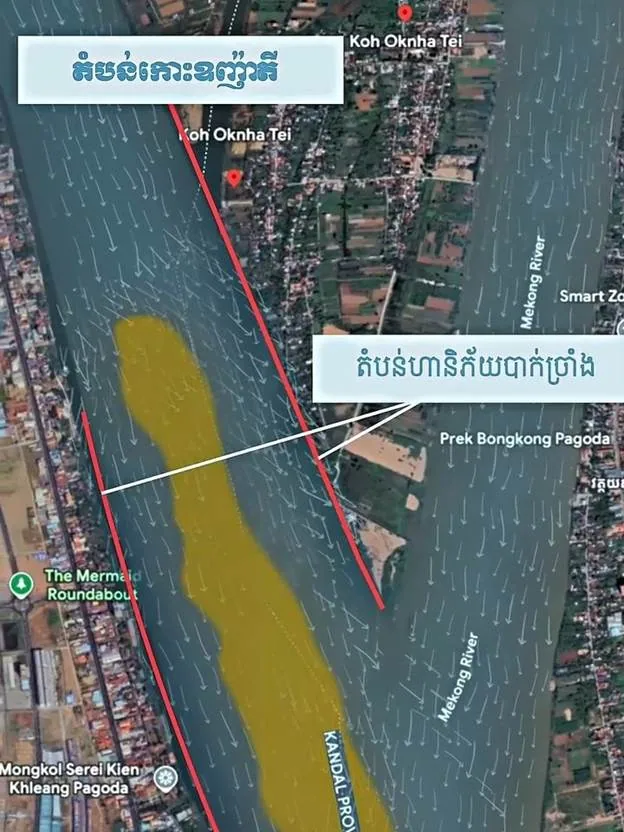
The minister used a licensed dredging zone near the downstream end of Koh Oknha Tei, opposite his own riverside residence near Wat Kean Khleang in Phnom Penh, to illustrate the government’s argument.
He said sediment eroded from the upper part of the island accumulated downstream, gradually extending the island and narrowing the river channel. Without dredging, the sediment could divert the current towards Wat Kean Khleang and nearby homes, increasing the risk of riverbank collapse.
“If the end of the island is not dredged, the land will continue extending into the river,” he said.
He emphasised that licensed dredging should take place in the middle of the river or around sediment deposits, not immediately beside riverbanks.
“Dredging close to the riverbank is absolutely not allowed,” he said.
Preventing erosion, boosting economy, energy
Strategically located dredging could redirect water flow away from vulnerable banks and prevent sediment from obstructing major waterways, he added.
Rottanak also argued that selective dredging could reduce flooding by increasing the capacity of rivers and streams to carry water.
He cited Pursat province, where sediment had made parts of the Pursat River shallow. Dredging the central channel, rather than areas close to the banks, could allow the river to absorb more water flowing from the Cardamom Mountains and reduce the risk of flooding in the provincial capital.
The second major purpose of dredging was to protect existing infrastructure and support new national projects, including ports, roads and energy facilities.
Rottanak said channels had to be dredged to enable fuel and other supplies to reach power plants, including the 400MW facility in Lvea Aem district, Kandal province.
Without the recently restored navigation channel, fuel vessels would be unable to reach the plant, potentially forcing it to suspend operations at a time when Cambodia faced pressure from disruptions to global energy supplies, he warned.
“If the channel is not restored so that ships can enter, we will face an electricity shortage,” he said.
Similar dredging would be needed to provide year-round access for vessels carrying liquefied natural gas to a planned LNG-fired power facility in Koh Kong province, according to the minister.
The access channel would require a depth of at least 14 metres during both high and low tides.
Rottanak said such projects were intended to strengthen Cambodia’s electricity supply and reduce dependence on energy imported from neighbouring countries.
The third objective was to supply construction sand at affordable prices.
A complete ban on dredging around Phnom Penh would force builders to transport sand from distant provinces such as Pursat, sharply increasing transport and construction costs, he argued.
The higher cost would ultimately be borne by families building homes, as well as companies investing in factories and other projects.
“The government wants stone and sand to remain affordable so that people can build homes and investors can construct factories at reasonable cost,” he said.
Disposing of submerged UXOs, supporting tax revenue
Rottanak identified the removal of wartime explosives as the fourth objective.
Decades of conflict had left bombs, ammunition and sunken military vessels in Cambodia’s rivers and lakes, particularly the fighting of the 1970s, he said.
The government had authorised the Cambodian Mine Action Centre to conduct dredging and underwater searches for unexploded ordnance in waterways.
As a sovereign state, Cambodia had a responsibility to ensure that waterways used by cargo ships and international tourists were sufficiently deep and free from explosive hazards, he added.
The final objective was to generate royalties, taxes and customs revenue for the national budget.
Rottanak said income from legally extracted sand was used alongside other state revenue to finance schools, healthcare, medicines, roads and other public infrastructure.
He rejected suggestions that sand extracted during navigation or infrastructure work should be discarded, saying companies carrying out the dredging were permitted to sell it and were required to pay the appropriate revenue to the state.
Bad actors squarely in sights
The minister warned that the government would not tolerate collusion, under-reporting or the diversion of public revenue into private pockets.
“No individual will be allowed to conspire or fraudulently place this revenue into their own pocket in violation of the law,” he said.
The ministry would work with the ministries of Water Resources and Meteorology, Environment, Public Works and Transport, and Economy and Finance, as well as the General Department of Taxation, General Department of Customs and Excise and the Anti-Corruption Unit, to review technical requirements and revenue collection.
Rottanak also promised closer consultation with provincial authorities and communities living near dredging sites, saying licensing and monitoring mechanisms must become more transparent.

Residents would be encouraged to monitor operations, provide feedback and report companies suspected of breaching licence conditions through a ministry hotline operating 24 hours a day.
The minister’s defence comes amid longstanding public mistrust of Cambodia’s sand-extraction industry.
Communities along the Mekong and Bassac rivers have repeatedly blamed dredging for erosion and riverbank collapses, although authorities have often pointed to a combination of natural currents, seasonal water-level changes, construction close to riverbanks and other factors.
In 2024, the government established an inter-ministerial Sand Resource Management Committee to monitor dredging businesses and recommend action against illegal or non-compliant operations. The committee is jointly led by the ministries responsible for mines and water resources, but communities and environmental advocates have called for greater transparency over licences, extraction volumes and state revenue.
Environmental researchers have warned that excessive extraction can lower riverbeds, alter currents and destabilise banks, while officials maintain that controlled dredging based on environmental and technical assessments can improve navigation without causing unacceptable damage.
Earlier this year, the environment ministry temporarily suspended a sand-mining project near the Sre Ambel river system in Koh Kong province pending an environmental impact assessment because of concerns about nearby river ecosystems and a royal turtle habitat.
Rottanak said the government recognised that shortcomings could occur and that technical and enforcement mechanisms should be continually reviewed.
The issue, he argued, was not whether Cambodia should permit any sand dredging, but whether operations were conducted in the right locations, according to scientific standards and under effective public oversight.
He thanked citizens for their comments and urged them to continue reporting suspected violations, saying public participation was necessary to ensure dredging supported development without sacrificing communities or the environment.
-Phnom Penh Post-