Angkor Dialogue: Building the Bridge Across the Mekong
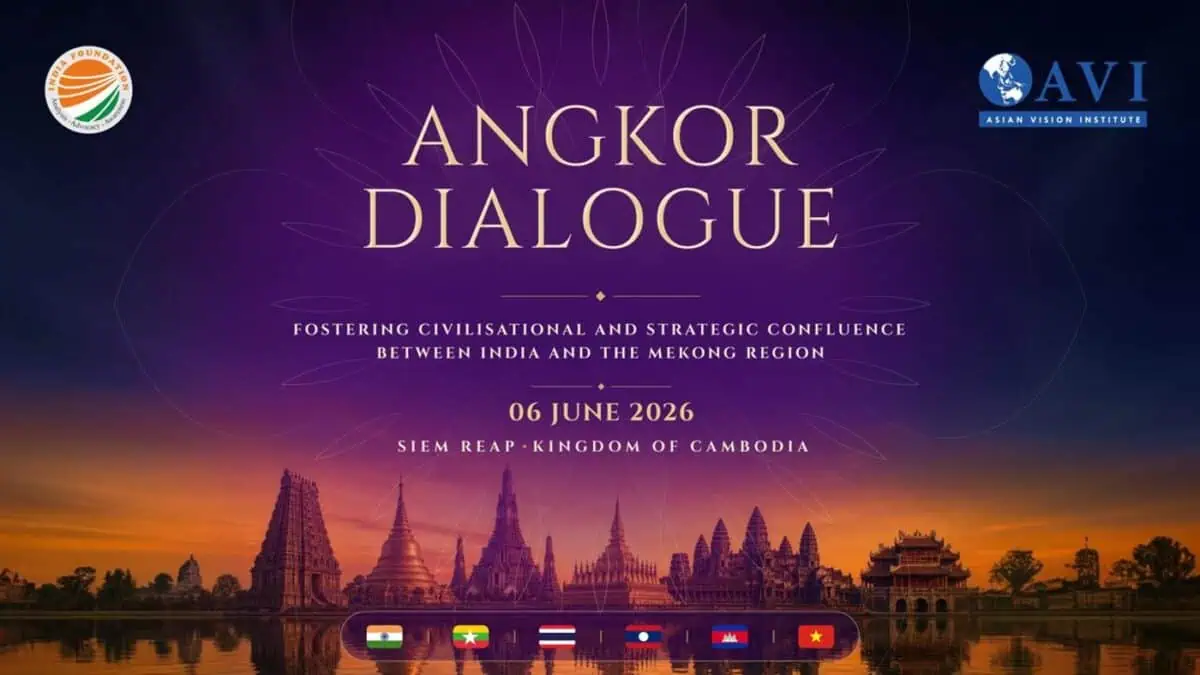 The coming Angkor Dialogue banner. Indian Foundation
#opinion
There is a temple in the forests of northwestern Cambodia that the world knows simply as Angkor Wat. Built in the twelfth century by the Khmer King Suryavarman II, it is a monument of extraordinary ambition, a sandstone cosmos rising from the flat Indochinese plain, its towers modelled on the peaks of Mount Meru, its galleries adorned with episodes from the Ramayana and the Mahabharata. Angkor Wat is not merely a Cambodian heritage site.
It is a symbolic monument to India’s civilisational reach. A Cambodian legend, with a hint of historical reality, says that in the first century AD, an Indian Brahmin named “Kaudinya” travelled through maritime routes and landed on the southern coast of ancient Funan Kingdom of present-day Cambodia and met with a local Khmer princess named “Soma”. Their encounter turned into an inter-cultural marriage, symbolising the birth of the prosperous Khmer civilisation and Indianisation of the then Southeast Asia.
For centuries, the cultural, religious, and artistic genius of the Indian subcontinent flowed eastward along river valleys and sea lanes, shaping the languages, temples, legal codes and cosmologies of the entire Mekong world. That deep, organic connection endures and this is precisely why a new institutional platform anchored in this shared legacy, the Angkor Dialogue, is not merely welcome. It is urgently necessary.
Harnessing the deep and profound connections built over the past two millennia, Cambodia-India civilisational corridor offers promises and hope for regional and inter-regional harmony, integration, peace, stability and prosperity to be advanced by the deepening and expansion of India’s constructive engagement and partnership with the Mekong region.
For India, its Act East Policy (AEP), launched with genuine strategic intent more than a decade ago, recognised that the country’s eastern neighbourhood was not a mere geographic periphery but a civilisational frontier and an economic opportunity.
The Mekong-Ganga Cooperation (MGC) framework, bringing together India, Cambodia, Laos, Myanmar, Thailand and Vietnam, has since provided diplomatic scaffolding for this vision. Yet, for all the bilateral summits, memoranda of understanding and connectivity projects announced under these frameworks, there remains a conspicuous institutional gap.
There is no dedicated, recurring Track 1.5 or Track 2 platform where scholars, policymakers, diplomats, civil society actors and young professionals from India and the Mekong countries can meet as peers, think together, and build the intellectual architecture that durable partnerships require. The Angkor Dialogue, proposed as an India Foundation-led initiative in partnership with Cambodia’s Asian Vision Institute (AVI), is designed to fill precisely that gap.
The case for a common platform rests, first and foremost, on the recognition that civilisational affinity, however real, does not automatically translate into strategic partnership. Shared heritage is a starting point, not a destination.
People of the Mekong region and India are bound by millennia of exchange, be it Sanskrit inscriptions found across Cambodia, the spread of Theravada Buddhism along trade routes that connected Bodh Gaya to Bagan, the Ramayana traditions alive in Thai royal ceremony, the Cham legacy of Hindu temple-building in central Vietnam. These are not museum artefacts.
They are living cultural memories that can serve as a uniquely powerful foundation for contemporary engagement. But to activate that potential, there must be a structured space where these connections are named, celebrated, and also crucially translated into policy vocabulary. The Angkor Dialogue aspires to be that translation chamber.
Yet to frame the Angkor Dialogue solely as a cultural conversation would be to undersell it and to misread the moment. The Mekong sub-region is today one of the most geopolitically contested spaces in Asia. The South China Sea, whose northwestern littoral the Mekong countries share, has become a theatre of competing maritime claims, naval posturing and infrastructure investment that carries strategic strings.
China’s Belt and Road Initiative has poured billions of dollars into Mekong connectivity, reshaping infrastructure landscapes and, with them, political alignments. The Mekong River itself is a lifeline for over seventy million people and is being managed through upstream dams whose downstream consequences are felt acutely in Cambodia, Laos and Vietnam. In this environment, India’s engagement with the Mekong cannot afford to remain confined to temple conservation projects and student exchange programmes. It must acquire strategic depth.
This is where the Angkor Dialogue’s proposed thematic architecture reveals its ambition. Alongside panels on civilisational cartography, shared heritage, trade, connectivity and sustainable development, the Dialogue explicitly places on the agenda the strategic convergences of the Indo-Pacific, maritime security in the Bay of Bengal and the Indian Ocean, the Mekong as a strategic pivot, the policy architecture of AEP and MGC with the architecture of regional institutions such as ASEAN and BIMSTEC, and the collective role of India and Mekong nations in shaping what a free, open, and inclusive Indo-Pacific might actually mean in practice.
These are not abstract formulations. They speak to concrete interests: freedom of navigation through chokepoints that carry a significant share of global trade; the resilience of smaller states against economic coercion; the ability of nations to make sovereign infrastructure choices without surrendering geopolitical autonomy. India’s vision of the Indo-Pacific is one of balance, pluralism, inclusion and rules-based order, values that resonate deeply among Mekong countries navigating the pressures of great-power competition.
The need for a dedicated platform also reflects a structural reality about how trust is built between nations. Formal diplomacy between governments is essential but insufficient. It operates on official calendars, is constrained by protocol and rarely creates the interpersonal density while the networks of scholars, strategists, entrepreneurs and civil society leaders who know each other’s thinking that sustains a partnership through political transitions and policy shifts.
Track 1.5 and Track 2 dialogues perform a different function: they create the intellectual common ground, the shared analytical vocabulary and the personal relationships that allow governments to move faster and with greater confidence when they choose to act. The Mekong, despite its civilisational and strategic significance, has had no equivalent. That absence has been a quiet cost to India’s regional standing, one the Angkor Dialogue can begin to address.
There is also a dimension of timing that cannot be ignored. The first Angkor Dialogue is proposed to be held in Siem Reap, Cambodia in the shadow of Angkor Wat itself in June 2026. The choice of venue is not incidental. Siem Reap is the living heart of Khmer cultural identity. Hosting the inaugural dialogue in Phnom Penh’s backyard sends a signal: that India regards Cambodia not merely as a diplomatic waystation but as a substantive partner, and that the India-Mekong relationship is being conceived beyond a civilisational scale. India’s offer rooted in shared history, free of hegemonic intent and respectful of ASEAN centrality is a genuinely differentiated proposition.
Critics might ask whether another dialogue platform is truly needed in a region already crowded with summits, forums and frameworks. The question is fair, but it misses the point.
The Angkor Dialogue is not proposed as a general-purpose multilateral forum rather it is a focussed, India-Mekong mechanism with a specific mandate: to deepen the relationship across its full spectrum, from the civilisational to the strategic, through sustained intellectual engagement. Its relatively compact format with a single day of plenary sessions is a feature, not a limitation.
It allows for genuine conversation rather than the reading of prepared statements. It creates space for the kind of frank exchange on sensitive issues that larger and more formal bodies cannot accommodate. And by embedding young scholarly voices alongside policymakers, it invests in the long-term human capital of the relationship.
The Angkor Dialogue, in sum, is a bet on the proposition that ideas have consequences that the quality of thinking which surrounds a bilateral relationship shapes its ultimate trajectory. India and the Mekong countries share something rare in international affairs: a bond that predates the state system, that is inscribed in stone and literature and living practice, and that carries genuine emotional resonance on both sides.
That bond deserves more than occasional diplomatic courtesy calls. It deserves a platform worthy of its depth. The Angkor Dialogue is that platform. Its time has come. It serves more than a mere platform of intellectual exchange but a practice of dialogue to calibrate collective outlooks the greater Indo-Pacific region with the Mekong as a springboard to stimulate enduring peace, stability and prosperity.
Shristi Pukhrem is director, Act East Centre, India Foundation. Dr. Kimlong Chheng is president, Asian Vision Institute. The views and opinions expressed are their own.
-Phnom Penh Post-