Navigating a more dangerous world
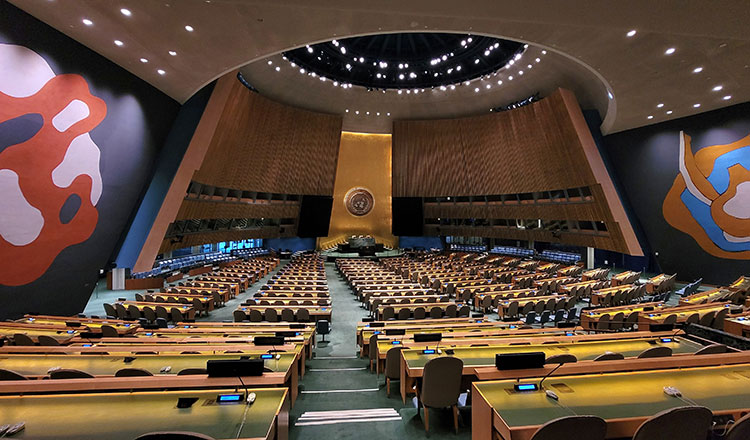 The United Nations General Assembly Hall in UN headquarters, New York City, February 2024. Wikimedia Commons
#editorial
The international system is entering its most consequential turning point since the end of World War II.
The foundations that have underpinned global stability for decades – international law, multilateral institutions and shared norms of state conduct – are under growing strain.
Notably, power politics and geopolitical rivalry are increasingly shaping the rules of international engagement.
Major powers are expanding their spheres of influence, asserting strategic interests across regions and competing to reshape the global order according to their own priorities.
For small states, this transformation causes serious challenges.
Unlike major powers, small states possess limited resources, narrower strategic space and options, and fewer means to absorb external shocks.
Their security, sovereignty, and economic resilience are often more vulnerable to geopolitical turbulence and crises.
As strategic competition intensifies, the margin for error becomes smaller. With just one strategic mistake, small states might risk disappearing from the world map.
In this environment, survival cannot be taken for granted.
Small states must invest in national capacity, strengthen deterrence capabilities and build resilient institutions capable of responding to rapidly changing circumstances. Effective governance and adaptive leadership are no longer desirable qualities; they are strategic necessities.
Equally important is the development of strategic foresight.
Governments must enhance their ability to anticipate risks, identify emerging threats and prepare for multiple scenarios in an increasingly uncertain world.
The countries that succeed will be those that can think beyond immediate crises and position themselves for long-term resilience.
Yet national strength alone is insufficient.
Small states must also strengthen solidarity among themselves. By acting collectively, they can amplify their voices and defend principles that protect all nations regardless of size.
Consistent support for international law – particularly the principles enshrined in the United Nations Charter – remains essential. A world governed by rules offers small states protection; a world governed solely by power leaves them exposed.
A second layer of cooperation is equally important: coalition-building between small states and middle powers. Both face growing pressure as geopolitical competition narrows their strategic space and constrains their freedom of action.
To preserve their agency, they must work together through flexible coalitions grounded in shared interests, common principles, and mutual respect.
Such partnerships are not intended to oppose any particular power. Rather, they seek to preserve a stable international environment in which sovereignty is respected, disputes are resolved peacefully, and economic cooperation remains open and inclusive.
For Cambodia, these global trends carry immediate implications. Security concerns in its neighbourhood, including tensions with Thailand, require a reassessment of diplomatic strategy and national preparedness.
Diplomacy remains the first line of defence, but diplomacy is most effective when supported by credible national capabilities. History repeatedly demonstrates that negotiations carry greater weight when a country possesses the capacity to protect its sovereignty and impose meaningful costs on coercion or aggression.
This does not mean abandoning dialogue. It means recognising that diplomacy and deterrence are complementary rather than contradictory. One reinforces the effectiveness of the other.
Cambodia’s foreign policy orientation remains clear: deepen ties with longstanding partners while expanding friendship and cooperation with new ones.
Upholding international law, promoting open and inclusive multilateralism, and advancing international integration should continue to serve as the cornerstones of Cambodian foreign policy.
To achieve these objectives, Cambodia has developed a four-layer framework for strategic engagement. The first layer focuses on neighbourhood diplomacy, recognising that stability begins with constructive relations among neighbouring countries.
The second emphasises engagement with major powers, whose decisions increasingly shape regional and global dynamics.
The third prioritises active participation in regional and international institutions, particularly ASEAN and the United Nations.
The fourth seeks deeper cooperation with developing countries and the broader Global South, where many nations share common aspirations for development, sovereignty and strategic autonomy.
The framework is sound. The challenge now is the capacity to implement it.
Strategic priorities must be translated into a clear roadmap that strengthens diplomatic engagement, expands practical cooperation projects and improves strategic communication.
Cambodia must consistently project a clear, credible and coherent message to the international community. At the same time, it must enhance its ability to interpret and assess signals from partners, competitors and the broader international environment.
In an era of uncertainty, successful foreign policy depends not only on what a country says but also on how well it listens, understands, and adapts.
The world is entering a period of heightened competition and greater risk. For small states, the answer is neither isolation nor passivity. It is a combination of national resilience, credible deterrence, principle-based diplomacy and strategic partnerships.
In a world where the law of the jungle appears to be gaining ground, small states must work together to ensure that the rule of law does not retreat. Their future may depend on it.
-Khmer Times-
_______________