No Borders by Force: Why Thailand Must Respect International Law
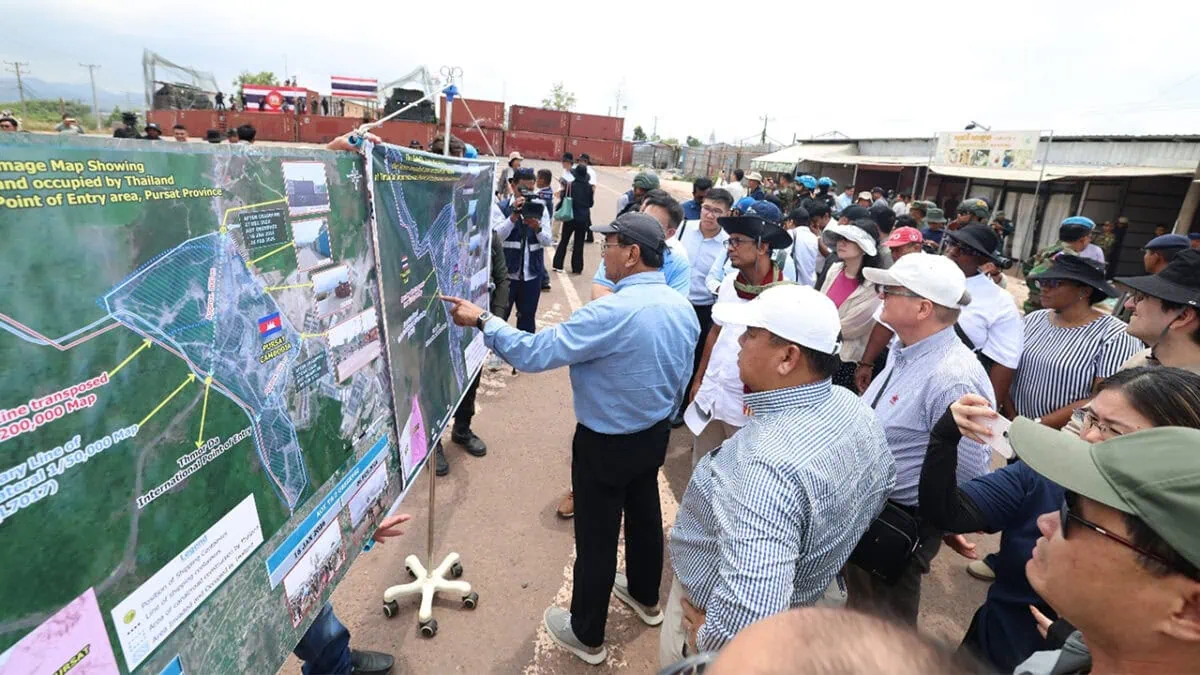 - Foreign minister Prak Sokhonn recently led foreign diplomats on a visit to view Cambodian territory occupied by the Thai military, in the Thma Da area, Pursat province. Supplied
#Opinion
The international order rests on a simple but indispensable principle: no nation may acquire territory through force. That rule was forged from the devastation of two world wars and enshrined in the Charter of the UN to ensure that military power would never again replace law as the basis for international relations.
When that principle is challenged anywhere, it is weakened everywhere.
Cambodia therefore cannot remain silent in the face of military incursions and the continued occupation of parts of its territory. This is not merely a bilateral dispute. It is a test of whether international law, treaty obligations and ASEAN’s own founding principles still matter.
The law is clear. Article 2(4) of the UN Charter prohibits the threat or use of force against the territorial integrity or political independence of any state. This prohibition is universally recognised as one of the most fundamental rules of modern international law. It protects every nation equally, regardless of its size, military capability or political influence.
No exception allows a state to improve its territorial position through armed force.
Military deployments do not create sovereignty. Occupation does not create ownership. Unilateral maps do not replace internationally recognised boundaries. Political declarations cannot override binding treaties.
The Cambodia–Thailand boundary is not without legal foundation. It is governed by the Franco-Siamese Treaties of 1904 and 1907, together with the boundary maps produced under those treaties. Those legal instruments have long been recognised as defining the international frontier between the two countries.
Their legal significance was reinforced by the International Court of Justice, whose 1962 Judgment and 2013 Interpretation Judgment reaffirmed the binding legal framework governing the Temple of Preah Vihear and the surrounding area. Respect for international judgments is not discretionary. It is a cornerstone of a rules-based international order.
Equally important is the principle of pacta sunt servanda — agreements must be honoured. Every state depends upon the certainty that treaties will be respected. If governments are free to disregard legal commitments whenever they become politically inconvenient, no border agreement anywhere in the world remains secure.
Thailand also carries responsibilities as a member of ASEAN.
The ASEAN Charter requires every Member State to respect sovereignty, territorial integrity, political independence, the peaceful settlement of disputes and the renunciation of the threat or use of force. These commitments are not symbolic aspirations. They are solemn obligations undertaken by every ASEAN government as the foundation of regional peace and mutual trust.
A rules-based ASEAN cannot exist if those rules are applied selectively.
Cambodia has consistently chosen the path of law rather than confrontation. It has sought peaceful mechanisms to resolve disputes because lasting peace is built through legal process, not military pressure. That approach reflects confidence in international law rather than confidence in military strength.
The issue today extends far beyond one stretch of border. If territorial occupation is allowed to create legal advantage, the consequences will reach every region where boundaries remain disputed. The principle that has protected international peace for generations would be fundamentally weakened.
This is not simply Cambodia’s concern. It is the concern of every state that relies on international law to safeguard its sovereignty.
The choice before Thailand is therefore straightforward. It can honour the UN Charter, uphold the ASEAN Charter, respect existing treaties and judicial decisions, and resolve differences through peaceful legal means. Or it can continue down a path that undermines the very legal principles upon which regional stability depends.
History has already delivered its verdict: force cannot rewrite borders. International law must prevail.
Roth Santepheap is a Phnom Penh-based geopolitical analyst. The views and opinions expressed are his own.
-Phnom Penh Post-