Why in the world’s most dangerous and fragile contexts, a school meal can be a child’s best hope
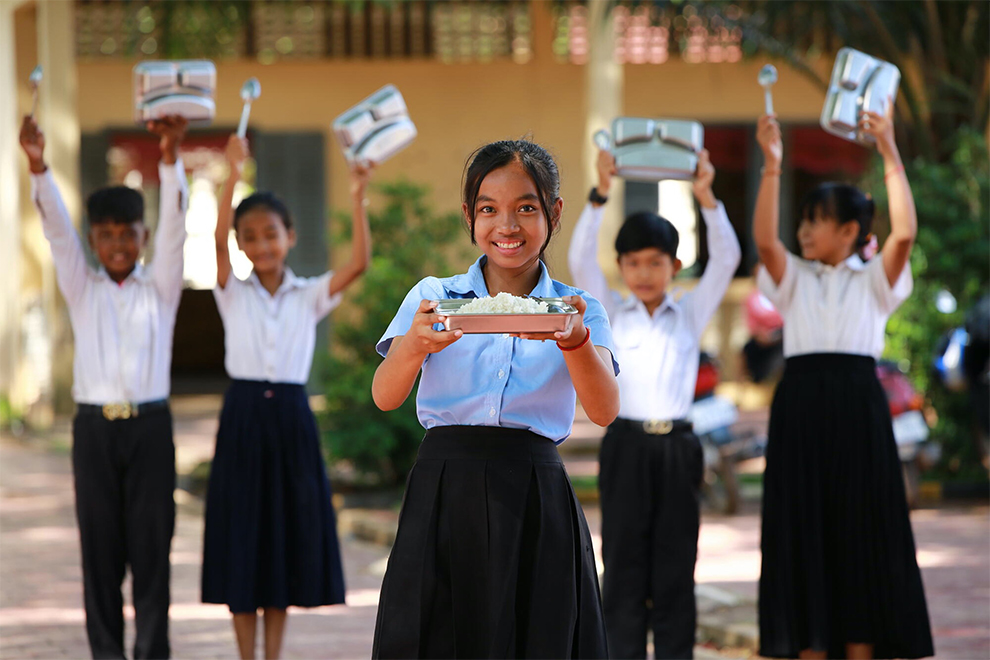 School meals offer more than calories, writes Amanda Rives; they provide stability, dignity, safety and hope. Supplied
-Opinion-
“School meals make me less hungry during learning. I can study hard and get good grades,” says 12-year-old Chandy from Cambodia. Her words highlight a reality that resonates deeply across diverse contexts worldwide: school meals are more than just food. They are a lifeline that enables better learning, unlocks potential and serves as a critical support system for millions of children worldwide.
School meals have been shown to improve educational performance, reduce hunger, boost nutrition, offer protection, and sustain mental health and psychosocial support. They transform lives, one meal at a time, across the globe. But the impact does not stop at the school gate. These programmes also stimulate local economies, create jobs and build environmental resilience. In fact, for every dollar invested, the estimated return, across sectors, is a staggering $30.
A safety net in the midst of multiple challenges
In fragile and crisis-affected settings — where children endure daily threats from prolonged conflict and are acutely vulnerable to shocks such as forced displacement, restricted humanitarian access and deep poverty — school meals often represent the only dependable source of nutritious food. They offer stability and certainty in chaos, ultimately helping children to thrive. They also ease financial pressure on families, create employment and provide safe spaces for children. Planet-friendly school meal programmes, that procure supplies from local smallholder farmers, especially hold the potential to address environmental, health, economic and other societal challenges, thus addressing multiple layers of vulnerability.
As an advisory board member of The State of School Feeding Worldwide, a WFP flagship publication which is the primary reporting mechanism of the School Meals Coalition, I celebrate the surge in domestic investment and the growing reach of school meals programmes. This progress reflects a powerful commitment by governments to nourish their children and strengthen education systems from the ground up.
While school meal programmes have demonstrated significant benefits and achieved notable progress, recent shifts in the global aid landscape — particularly reductions in Official Development Assistance (ODA) — threaten to stall momentum. This is especially concerning for low-income and fragile contexts, where such programmes remain critically dependent on foreign funding.
Even when domestic investment in school meals is growing, low-income countries are still dependent on international donors for 64% of their funding. This dependency makes them vulnerable to shifting donor priorities and funding cuts.
Progress, but not yet equity
The numbers in the WFP report tell a story of both hope and urgency. Government-led school meal programmes now reach 466 million children globally — an increase of 80 million since 2020. While this marks a major milestone in expanding school feeding coverage, it also exposes a deep equity divide: nearly half of primary school-aged children remain beyond reach. Coverage in low-income countries also lags, at just 27%, compared to 80% in high-income nations, underscoring the urgent need for targeted investment and evidence-based initiatives in these contexts.
Moreover, cuts to humanitarian funding are dismantling critical safety nets in fragile settings — hitting displaced communities the hardest and deepening their vulnerability.
When school meals — often the sole source of daily nutrition for children in crisis-affected communities — are disrupted or disappear, children may lose opportunities to transform their lives, dream bigger and break free from the intergenerational cycle of poverty.
While 107 countries now report having a national school meals policy — a promising sign of global momentum — only 18% of these are in lower-income countries (19), despite this group showing the most significant growth since the last reporting cycle. This growing number of low-income governments — demonstrating political will, increasing domestic investment and committing to stronger school meals frameworks, signals a meaningful shift toward sustainable, locally-led solutions that advance both child nutrition and education.
National programmes also typically generate 1,500 jobs for every 100,000 children served — offering an economic boom for countries grappling with instability and offering pathways for wider food system transformation.
World Vision’s commitment to ensuring every child has access to school feeding
Noting the transformational potential of school meals, World Vision is working to create momentum and galvanise global action to scale-up school feeding in partnership with the World food Programme, and hundreds of other global and local actors. As a partner of the School Meals Coalition, we have expanded programmes in fragile contexts like Burundi and South Sudan, and school meals form a cornerstone of the ENOUGH Campaign — our vision and pledge to end child hunger and malnutrition.
World vision’s approach to school feeding is comprehensive: We advocate for increased national investment, support governments in fulfilling coalition commitments and promote locally sourced, planet-friendly meals. We are also piloting innovations like cash for school meals and school gardens initiatives to enhance sustainability and community ownership.
In 2024, World Vision, in collaboration with local partners, provided school meals to nearly 1 million children across 20 countries in seven regions. Of these, more than 70%, approximately 740,000 children, were reached in humanitarian settings, including complex emergencies and natural disasters.
From October 2024 to November 2025, the School Meals program impacted over 28,457 individuals across the East Asia Region, including Vietnam, Myanmar and Cambodia, contributing to improved nutrition, school attendance, and learning outcomes for vulnerable children.
Scaling up school meals in fragile contexts: Building global commitment
As global leaders prepare to chart the next phase of school feeding expansion, at the 2nd Global Summit of the School Meals Coalition, in Fortaleza, Brazil (September 18-19), the urgency to reach every child with a daily school meal should be prioritised, as a key social and economic imperative.
School meals are not a luxury. They remain one of the most effective tools to combat child hunger, boost educational outcomes and strengthen communities. Yet their potential is far from being fully realised. Unlocking it demands more than good intentions — it requires sustained investment, technical expertise, political will and coordinated action. Every child, especially those living through conflict, displacement and poverty, deserves access to nourishment that stimulates learning and growth.
This requires increasing investments in sustainable food systems, with school meals at the centre. Donors and development partners must provide increased technical support and targeted funding for locally led school feeding, particularly in fragile and low-income contexts, in collaboration with local governments, as a means to achieve holistic transformation. National governments must also prioritise school meals programmes within national budgets, and global partners must hold them accountable for fulfilling the commitments made as part of the School Meals Coalition.
Children in crisis settings face unique vulnerabilities. School meals offer more than calories — they provide stability, dignity, safety and hope, reaching far beyond the school grounds. It is now time to position school feeding as a cornerstone of humanitarian and development policy.
Amanda Rives is World Vision senior director, Humanitarian Advocacy, Policy and Partnerships. The views and opinions expressed are her own.
-The Phnom Penh-