Opposition lambasted for fuelling Cambodia-Thailand row
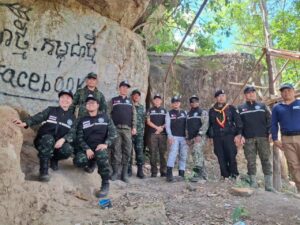
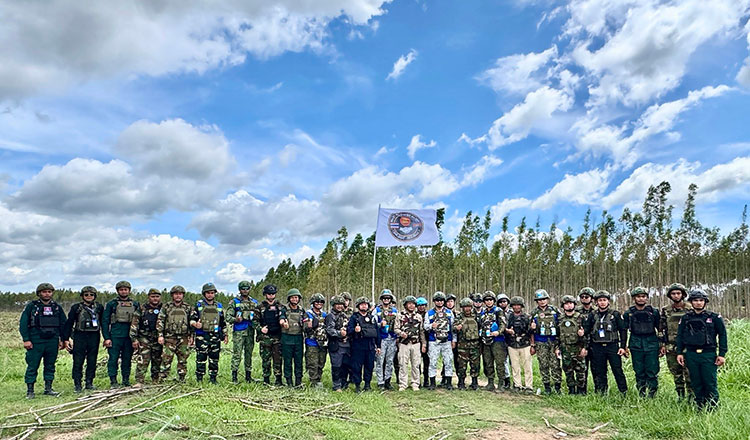 < The ASEAN Observer Team visits Seila Khmer village in Banteay Meanchey province’s O’Chrov district on Sunday to observe and report on the Cambodia-Thailand border situation. Ministry of Defence >
#National
Synopsis: The government says overseas opposition groups are provoking conflict with Thailand for political gain at the risk of prolonging or intensifying the border dispute.
The government has accused overseas opposition groups of attempting to inflame tensions arising from the Cambodia-Thailand border dispute for political gain. Officials claim these groups have encouraged confrontation instead of supporting peaceful negotiations, even as experts warn of a renewed escalation.
In a statement issued Sunday by the Cambodia PR Team, the government alleged that opposition figures based abroad have consistently opposed state policies regardless of whether they serve national interests. The statement claimed these figures seek to intensify tensions without considering the consequences for the country and its people.
“Instead of supporting solutions through negotiations, they attempt to provoke confrontation by force and intensify tensions without considering the consequences that could lead to loss of life and damage to the country,” the statement said.
The Cambodia PR Team accused “extremist opposition groups” of prioritising political attacks over national unity and public safety. It alleged that some activists have reposted Thai content and narratives online to undermine Cambodian leaders and institutions.
According to the statement, such actions benefit Thailand’s position while harming Cambodia’s national interests, territorial integrity and social stability.
The criticism came as the government reaffirmed its commitment to pursuing a peaceful resolution to the border dispute, even if the possibility of success remains small.
“In the Cambodia-Thailand border dispute, the Royal Government chooses a peaceful solution through negotiations, even if the opportunity for a peaceful settlement remains at only 1%,” the statement said.
The government said that peace and the protection of citizens’ lives remain its highest priorities, arguing that even a slim chance for dialogue must be fully utilised to avoid deaths, injuries, property destruction and instability along the border.
Cambodia’s approach should not be interpreted as weakness or a retreat from defending territorial integrity, but rather as a demonstration of diplomatic maturity and responsibility, the statement added.
“The real victory is not creating war,” the statement said. “It is being able to protect the territory, preserve peace and safeguard the lives of the people at the same time.”
The Cambodia-Thailand dispute has expanded beyond border incidents into a wider conflict involving sovereignty, history, and regional influence. Tensions escalated after Thailand withdrew from the 2001 MoU, also known as MoU 44, on overlapping maritime claims in the Gulf of Thailand, while Cambodia signalled plans to pursue international legal mechanisms under the UN Convention on the Law of the Sea (UNCLOS).
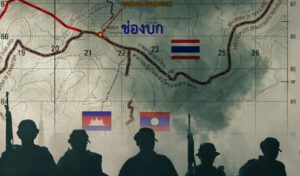
Tensions have also continued to simmer along the land border. Both sides have accused each other of military provocations near O’Smach-Chong Chom and disputed claims over gunfire incidents and illegal border fence construction in contested areas.
Cultural heritage has become another flashpoint. Thailand recently registered the Ta Moan, Ta Krabey and Khnar temple complexes as Thai national monuments. Cambodia condemned the move as an attempt to legitimise claims over ancient Khmer sites tied to its national identity and sovereignty.
Cambodia accused Thailand of using high-level political visits, public ceremonies and infrastructure projects to create a “fait accompli” on the ground, bypassing established bilateral negotiation mechanisms.
The symbolism of cultural heritage appropriation has drawn strong criticism from historian Youk Chhang, director of the Documentation Centre of Cambodia.
In comments issued this week, Youk compared Thailand’s actions to the historical wartime seizures of cultural property during World War II.
“The Thai government dusts off a familiar playbook that has precedence in other wars of aggression of the past,” he said, adding that Thailand’s Fine Arts Department risks betraying the very principles cultural institutions are supposed to uphold.
His remarks reflect growing concern within Cambodia that the dispute is no longer merely territorial but increasingly ideological, involving competing narratives over history, legitimacy and civilisation itself.
Beyond the bilateral dispute, domestic Thai politics may also be contributing to the hardening of Bangkok’s position.
Youk said Thailand’s current administration appears to have embraced a strongly nationalist and militarised approach to consolidate political support among conservative factions. Under such conditions, any withdrawal by Thai forces to pre-2025 positions could be framed domestically as a nationalist retreat.
Meanwhile, with global attention divided among multiple international crises, Cambodia may struggle to secure sustained external pressure to force meaningful negotiations or military disengagement.
Youk warned that without stronger international involvement — particularly from major powers such as the United States—the conflict could settle into a prolonged, frozen standoff lasting years or potentially escalate into a broader confrontation.
“I think this is a conflict that either results in a static border through 2029 or a significant escalation,” he said.
Kevin Nauen, Dean of the Faculty of Social Sciences and International Relations at Paññāsāstra University of Cambodia, agreed that recent heated updates along the border show that tension “definitely has increased again”.
Nauen pointed to another case on May 13, when content creator Kevin Smith was caught in the friction at O’Smach. While filming to “expose hypocrisy,” Smith reported four shots from Thai forces. The Thai army later confirmed those were “warning shots” intended to deter encroachment.
“These aren’t just isolated sparks; they represent a renewed cycle of tit-for-tat activity where diplomatic protests are now being punctuated by ballistics,” Nauen said. “The border hasn’t just warmed up; it’s crackling with renewed volatility.”
-Khmer Times-