Govt builds up military capacity, expands defence partnerships
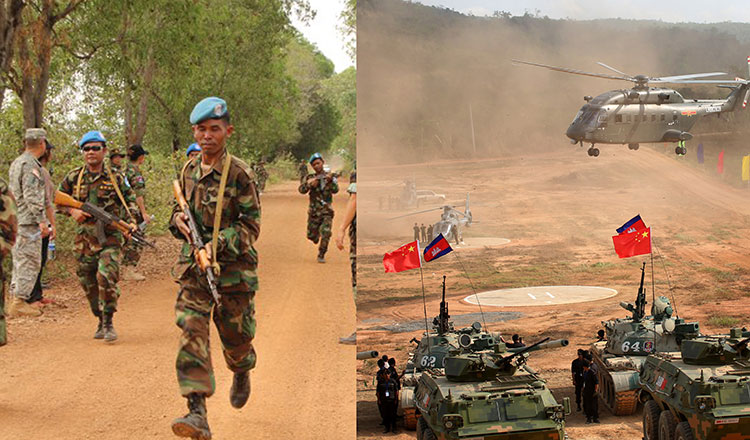 Composite photo of peacekeepers training in the ‘Angkor Sentinel’ exercise in 2012 (L) and the Cambodia-China ‘Golden Dragon’ drill in Kampot province in 2020. US Army & Khmer Times
#National
Synopsis: RCAF launches recruitment drive while looking forward to renewed joint military exercises with major powers and delivery of advanced naval assets.
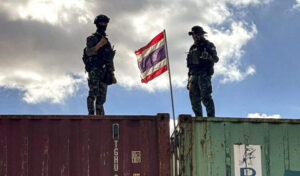
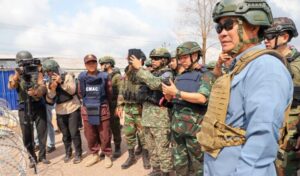
Cambodia is boosting its defence capabilities amid tensions along its 800-kilometre border with Thailand, following two rounds of military clashes last year, which resulted in the illegal occupation of Cambodian territories by Thai forces.
The Kingdom has moved to enhance its military readiness through the resumption and expansion of joint exercises, the acquisition of new naval assets and increased recruitment of personnel.
The Royal Cambodian Armed Forces (RCAF) is recruiting 3,000 more soldiers to bolster ground forces amid evolving security needs. Prime Minister Hun Manet has announced that Cambodia will begin enforcing its long-dormant military conscription law this year, a move aimed at modernising the armed forces, addressing personnel shortages due to retirement, and strengthening national defence.
After nearly a decade of suspension, Cambodia and the United States will resume the “Angkor Sentinel” joint military exercise, marking a revival of bilateral defence cooperation after the US lifted its arms embargo on Cambodia.
The Royal Cambodian Army (RCA) announced last week that the exercise will resume early next year, featuring both Command Post Exercise and Field Training Exercise components under the theme “Together for Relief, Peace and Recovery”, aimed at deepening military cooperation and strengthening bilateral ties.
The announcement followed a visit by Giles Cornelia, Deputy Commanding General of the United States Army Pacific, to Cambodia for talks and preliminary planning meetings on the exercise.
Kin Phea, Director-General of the International Relations Institute of Cambodia (IRIC), said the move reflects a strategy of active neutrality.
“By resuming the Angkor Sentinel exercises with the United States in late 2026, Cambodia is pursuing a strategy of active neutrality to professionalise its forces through Western standards of interoperability while simultaneously diversifying its security dependencies,” he said.
Thong Mengdavid, Deputy Director of the China-ASEAN Studies Centre at the Cambodia University of Technology and Science, said the joint exercise reflects Cambodia’s neutral stance and diversified defence posture.
“The Angkor Sentinel military exercise would further enhance Cambodia’s interoperability, professional training and crisis-response capacity,” he said.
Cambodia will also continue to expand joint drills with China under the “Golden Dragon” exercise on land, sea, and air.
The exercise is a key component of defence cooperation between Cambodia and China under their Comprehensive Strategic Partnership to strengthen ties between the two armed forces and enhance the capabilities, skills and experience of the RCAF. It also supports efforts to safeguard sovereignty, territorial integrity, peace, security and social order, while contributing to UN peacekeeping missions.
This week, Cambodia hosted a detachment of the Russian Navy’s Pacific Fleet calling at the Sihanoukville Autonomous Port in Preah Sihanouk province. Among the fleet were the corvettes Sovershenny and Rezky, which arrived on April 6 and will depart today.
Speaking to the media after visiting the warships on Monday, Russian Ambassador to Cambodia Anatoly Borovik said joint drills could be considered in the future. “In the future, we will schedule some exercises to train together,” he said.
Phea said the growing engagement with multiple partners reflects a broader strategic approach. “Cambodia should continue to open its military exercises to a broad spectrum of international partners to reinforce the official stance that Ream Naval Base is a multinational facility and to maintain a strategic balance among competing global powers,” he said.
Meanwhile, on March 24, Vietnam’s Ambassador to Cambodia Nguyen Minh Vu visited the Royal Cambodian Army General Staff headquarters, where he met General Mao Sophan, Deputy Commander-in-Chief of the RCAF. Both sides agreed to further strengthen joint training and exchanges.
The government has also increased defence spending. Cambodia approved a record draft national budget for 2026 exceeding $10 billion, a 7.8% increase from the 2025 budget of $9.32 billion, with a greater focus on the defence sector. Defence spending in 2025 stood at around $730 million.
Phea said that over the next decade, the multi-aligned exercises are likely to shift Cambodia’s defence posture towards a technologically integrated and partner-diversified model that emphasises strategic signalling.
In April, Cambodia launched the expanded Ream Naval Base, developed with Chinese assistance, which has drawn attention from the United States and other countries over concerns about potential Chinese military presence. Cambodia this week received a new modern warship, a Type 056C corvette, marking a significant step in strengthening the Kingdom’s maritime defence capabilities.
The vessel, provided as a grant by China, is the first of two warships to be handed over. The second is expected to arrive later this year.
The Type 056C is a medium-sized coastal defence corvette to enhance Cambodia’s ability to safeguard its territorial waters. The warship has a displacement of around 1,300 tonnes and is equipped with a 76mm rapid-fire gun, two 30mm guns, dual YJ-83 anti-ship missile launchers, triple 324mm torpedo launchers and an eight-cell HQ-10A air defence missile system. It also features a helicopter deck capable of accommodating a Z-9-sized helicopter.
According to defence sources, the vessel has been adapted for missions including maritime patrol, search and rescue operations and broader naval security tasks.
Vice Admiral Sam Sokha, Deputy Commander of the Royal Cambodian Navy, said the acquisition will further strengthen Cambodia’s naval capabilities.
Phea said the Type 056C corvettes with modern sea control capabilities significantly bolster Cambodia’s maritime deterrence.
Mengdavid said the arrival of the Chinese-made warship reflects strong bilateral relations and Cambodia’s efforts to modernise its navy. “The navy could serve as a deterrent and reassurance of Cambodia’s maritime sovereignty against Thailand plan of encroachment or maritime pressure on Cambodia.”
-Khmer Times-
—————-