Thailand faces scrutiny over cluster munitions use
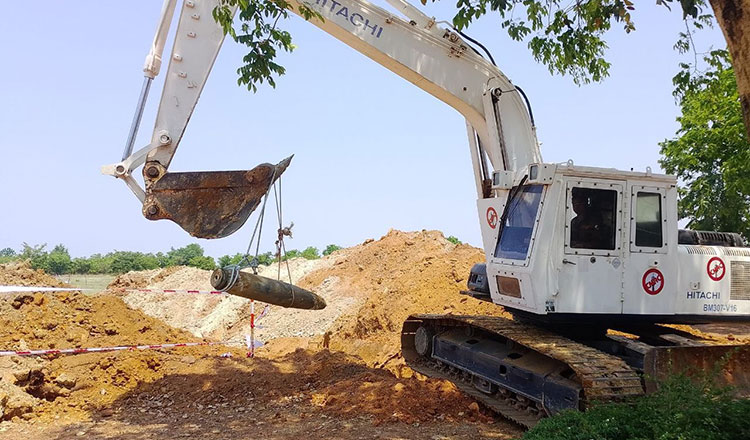 An excavator removes an unexploded aerial bomb from a construction site in Oddar Meanchey province. CMAC
#National
Synopsis: More than 2,300 sq km of land near the border are contaminated, presenting long-terms risks to civilians.
There is clear evidence that Thailand used cluster munitions during last year’s cross-border attacks, Cambodian Mine Action Centre (CMAC) Director-General Heng Ratana said.
He said Cambodia has technical and legal documentation showing Thailand used cluster munitions in the border clashes.
“Although Cambodia and Thailand are not yet state parties to the Convention on Cluster Munitions, international law remains binding. A country cannot avoid responsibility simply by staying outside a treaty,” Ratana said.
“Usually, some states support it, some don’t, but it has become international law. Even if you are not a member state, you must respect international law. Whether you like it or not, you must respect it.”
Thailand carried out military attacks on Cambodian territory twice last year, the first time from July 24 to 28 and again from December 7 to 27. During both periods, heavy weapons struck civilian areas and destroyed homes, schools, and ancient temples. More than 600,000 people were forced to flee to safer locations.
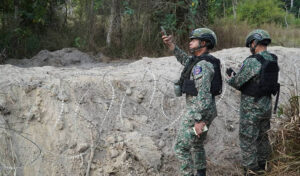
Although active fighting has ceased, large quantities of UXO remain, including cluster munitions, artillery shells, aerial bombs, and other military ammunition, which present risks to civilians, particularly in residential areas, farmland, and school zones.
“We have clear technical evidence and information. We see that what Thailand used against us, our country, is not random, and we do not have only a few pieces of evidence, we have more than 2,300 square kilometres associated with the locations in our database, at which points, and how many families and land area were affected. We have all of that. Therefore, in terms of building sufficient legal evidence, the technical aspects are also clearly demonstrated as evidence in this work,” he said.
About 340 villages and 91,400 families have been affected by landmines, aerial-dropped munitions, cluster submunitions, and chemical devices. Preliminary surveys indicate that roughly 441,000 hectares of land remain at risk, highlighting the challenges for clearance teams and the vulnerability of returning communities, according to Ratana.
The Cambodian Mine Action and Victim Assistance Authority also raised concerns over what it said are credible reports of Thailand using of cluster munitions in or near civilian areas, warning that such weapons are inherently indiscriminate and could cause long-term contamination.
In December, Cambodia called on the Convention on Cluster Munitions to condemn Thailand for using cluster munitions in civilian areas, urging adherence to international humanitarian law.
CMAA First Vice-President Ly Thuch said that cluster munitions are indiscriminate and pose long-term risks to civilian lives and livelihoods.
“While Thailand is not a state party to the convention, the use of these weapons in civilian areas constitutes a clear violation of international humanitarian law,” he said.
“Cambodia calls on the international community to condemn these acts and reinforce the global norm against cluster munitions.”
-Khmer Times-
—————