US-Israel Operations in Iran and Venezuela as a Blueprint to Stifle China’s Rise and Avoid a Second North Korea
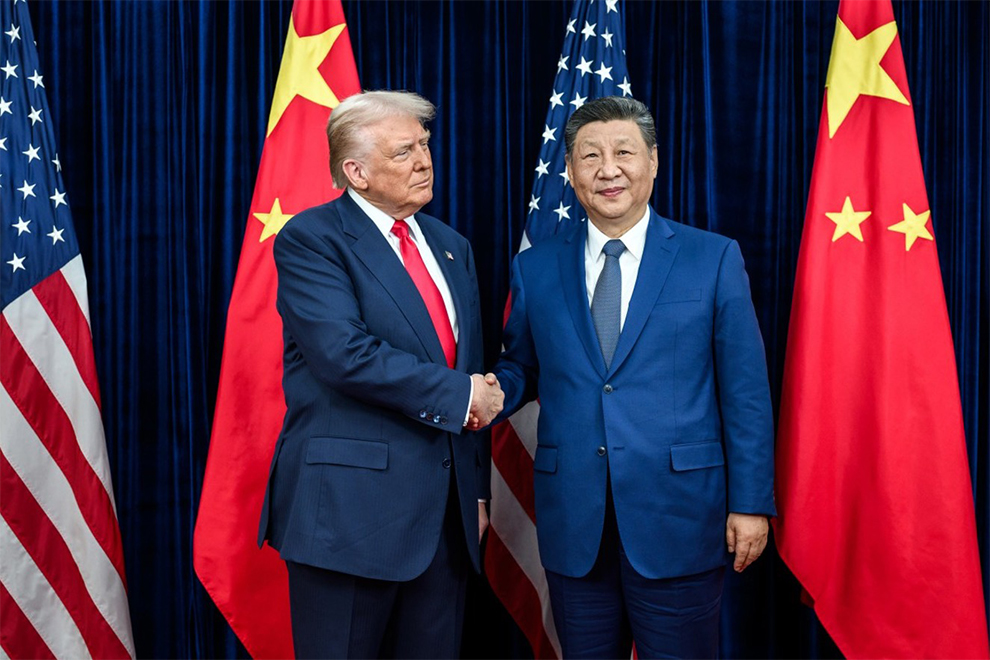 US President Donald Trump shakes hands with Chinese president Xi Jinping in South Korea on October 30, 2025. White House
#OPINION
The geopolitical landscape of March 2026 has been fundamentally reshaped by a series of aggressive US-led maneuverers. By dismantling the “energy lifelines” of the Chinese economy in the Western Hemisphere and the Middle East, the US is executing a strategy of Active Resource Denial. This approach seeks to solve two generational challenges: the preservation of the petrodollar against the rising “Petroyuan” and the prevention of a “North Korean” nuclear stalemate in Iran.
For years, China leveraged a “shadow economy” of sanctioned oil to fuel its industrial growth. Iran and Venezuela were the cornerstones of this strategy, providing Beijing with millions of barrels of oil daily, often settled in yuan to bypass the US. financial system. Following the capture of Nicolás Maduro in January 2026 (Operation Absolute Resolve), the US successfully liquidated China’s $50 billion investment in the Venezuelan regime. By re-anchoring the world’s largest oil reserves to the US dollar, Washington has effectively closed a major non-dollar trade hub.
Since the launch of Operation Epic Fury on February 28, 2026, the US-Israel coalition has physically obstructed Iranian oil exports, which previously accounted for 90% of Iran’s output — nearly all of which went to China. China is now forced to pay market rates in US dollars for alternative energy, draining its foreign exchange reserves and slowing the domestic subsidies required to compete with the West in high-tech sectors like AI and semiconductors.
The primary military objective of the 2026 strikes on Iran is to avoid the “North Korea Trap” — a scenario where a rogue state successfully weaponises nuclear technology, making regime change or military intervention prohibitively dangerous. Analysts at groups like the Chatham House and ISW note that unlike the decades of “strategic patience” shown toward Pyongyang, the US and Israel chose to strike Iran before it could conduct a nuclear test. The target-rich environment of Fordow and Natanz was engaged to physically destroy the programme’s technical foundation.
The strike that killed Supreme Leader Ali Khamenei served as a clinical demonstration for other adversaries. It signalled that the “nuclear insurance policy” only works if the regime survives long enough to use it. The conflict has severed the technological “bridge” between Tehran and Pyongyang. North Korea, now watching its primary partner in missile technology crumble, faces a stark choice: maintain its “irreversible” nuclear status in total isolation or attempt a desperate diplomatic pivot to avoid a similar fate.
As of March 9, 2026, the “Double Squeeze” has placed the US hand firmly on the “valve” of the Chinese economy. By reclaiming Venezuelan oil and preventing a nuclear breakout in Iran, the US has forced Beijing to burn through its cash reserves simply to keep its factories running, effectively “cutting down” China’s momentum toward global hegemony.
Vichana Sar is a researcher of digital governance and geopolitical trends. The views and opinions expressed are his own.
-Phnom Penh Post-
———————