Economic security framework for Cambodia.
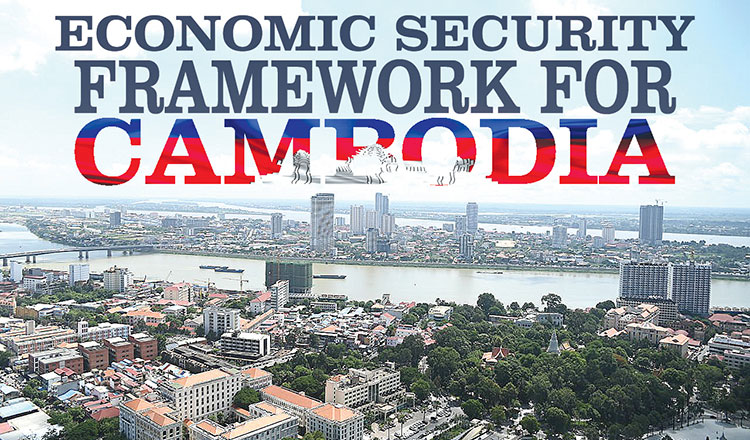 Cambodia’s ability to sustain growth will depend largely on how effectively it continues to manage external risks. KT/Pann Rachana
#opinion
Cambodia needs an economic security framework—not to turn inwards, but to remain open with greater confidence. In a world of geopolitical rivalry, supply-chain shocks, cyber threats, climate stress, and economic coercion, development can no longer be separated from national security.
Economic security is the ability of a country to protect and sustain economic stability, growth and resilience against internal and external threats. It covers strategic industries, critical infrastructure, supply chains, energy, food, technology, investment flows, and cybersecurity.
Cambodia is a small, open, trade-dependent economy. Its growth has relied on traditional economic sector and preferential market access. This model has delivered impressive gains. But it has also exposed Cambodia to external shocks: changing trade rules, market concentration, energy price spikes, supply disruptions, financial volatility, climate risks, cyber insecurity, and geopolitical pressure.
Cambodia’s prosperity depends on connectivity, investment, exports, tourism, regional integration and rules-based international cooperation. The question is how to make openness safer, smarter, and more resilient. Cambodia must move from a growth-only mindset to a resilience-based growth model.
A Cambodian economic security framework should consist five pillars.
First, supply-chain resilience. Cambodia must identify critical imports and exports, map vulnerabilities and diversify suppliers and markets. Food, fuel, medicine, fertilisers, digital equipment, electricity inputs, and essential industrial materials should be treated as strategic goods.
The pandemic and recent global disruptions showed how dependence on a narrow set of suppliers or markets could quickly become a national vulnerability.
Cambodia should build a national supply-chain risk dashboard to monitor critical goods, import dependency, price volatility, logistics bottlenecks, and emergency stock levels.
It should also support diversification through bilateral and multilateral partnerships. For Cambodia, economic security means diversifying, not decoupling.
Second, energy and food security. Energy is the bloodstream of the economy. The global security crisis, intensified by the war in the Middle East, has exposed the vulnerability of energy-importing countries to price shocks, supply disruptions, and spillover effects across the economy.
Cambodia needs immediate measures to protect households and businesses, and long-term reforms to build a more resilient and sustainable energy system.
Energy security should combine diversified imports, domestic renewable energy, grid modernisation, regional power cooperation ,and emergency planning.
Solar, hydropower, biomass, and battery storage require more intensive investments to reduce exposure to fuel price shocks.
This requires reducing regulatory barriers and creating a more favourable environment for clean and renewable energy, especially solar power.
Food security is equally strategic.
Cambodian farmers are increasingly exposed to climate change, water stress, energy shocks, low productivity, weak logistics, and unstable prices. Much more must be done to reduce these risks while raising productivity and rural incomes.
Strengthening food security requires sustainable water management, affordable energy, climate-resilient farming, modern storage, agro-processing, and export diversification.
Third, digital and critical infrastructure protection. Cambodia’s economy is becoming more digital. Banking, public services, logistics, education, health, and commerce increasingly depend on digital systems.
This creates opportunity, but also vulnerability. Cyberattacks, data breaches, online scams, payment disruptions, and attacks on telecommunications infrastructure can damage public trust and economic stability.
Cambodia should classify critical infrastructure, including energy grids, ports, airports, telecom networks, data centres, payment systems, hospitals, and key government platforms.
These assets need minimum cybersecurity standards, incident-response protocols, backup systems and regular stress tests.
Digital sovereignty does not mean cutting Cambodia off from global technology. It means having the capacity to manage risks, protect data and maintain essential services.
Fourth, investment security with openness. Cambodia needs foreign investment. But it also needs better tools to assess risks in sensitive sectors.
It is necessary to develop a transparent review mechanism for critical infrastructure, telecommunications, energy, ports, digital platforms, defence-related industries, and large-scale natural resources.
The principle should be clear: welcome investment, but know what is strategic; protect national interests, but avoid unreasonable restrictions.
Cambodia must remain attractive to investors while ensuring that strategic assets do not become strategic vulnerabilities.
Fifth, institutional coordination and foresight. Economic security cannot be managed by one ministry alone. It requires a whole-of-government and whole-of-society approach.
Cambodia should consider creating a senior-level national coordination mechanism to produce an annual Economic Security Risk Assessment. It should identify vulnerabilities, propose mitigation measures, coordinate crisis response, and advise on long-term competitiveness.
Economic security must also be people-centred. A secure economy protects not only infrastructure and supply chains, but also livelihoods, jobs, skills, small businesses, and household resilience.
Workers need skills for a digital and green economy. SMEs need finance, technology, standards, production capacity, and market access. Farmers need climate adaptation support. Young people need pathways into higher-value industries.
Cambodia should pursue resilient openness by staying connected to the world while reducing excessive dependence; attracting investment while protecting strategic assets; embracing digital transformation while strengthening cybersecurity; joining global value chains while building domestic capabilities; and working with all partners while preserving sovereign decision-making.
The future of Cambodia’s development will depend not only on how fast the economy grows but also how well it withstands shocks. Growth without resilience is fragile. Security without growth is unsustainable. Cambodia needs both.
The author is Chairman of National Assembly Advisory Council. The views expressed here are his own.
-Khmer Times-