Pretexts and Power Plays: Why the World Should Scrutinise Thailand’s Actions on Cambodian Territory
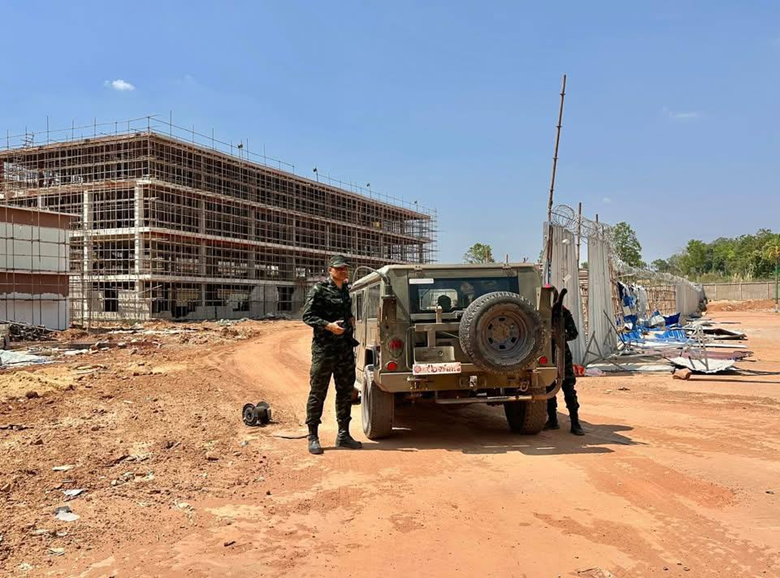 A recent photograph of Thai soldiers and their vehicle on Cambodian territory in the O’Smach area. FB
#opinion
In times of regional tension, narratives matter as much as actions. Today, along the Cambodia–Thailand border, a troubling pattern is emerging — one that risks undermining not only bilateral relations but also the principles of sovereignty and international law that underpin regional stability.
At the heart of the issue is an increasingly visible contradiction: while Thailand publicly emphasises peaceful resolution through bilateral mechanisms, its actions on the ground suggest a different reality. Military presence, infrastructure development and controlled media access in contested or sensitive areas raise legitimate questions about intent. When such activities occur within or near Cambodian territory, they cannot be dismissed as routine security measures.
Cambodia has consistently reiterated its commitment to resolving disputes through peaceful means, including established mechanisms such as the Joint Boundary Commission (JBC) and adherence to international law. This position aligns with ASEAN norms and the broader rules-based international order. However, peaceful intent must be matched by reciprocal restraint.
What is particularly concerning is the growing use of online scam operations as a security pretext. There is no doubt that cybercrime and human trafficking linked to scam networks are real and serious issues affecting the region. Cambodia itself has taken significant steps to dismantle such networks — shutting down operations, arresting perpetrators and cooperating with international partners.
Yet, the instrumentalization of this issue to justify heightened military posture or cross-border pressure sets a dangerous precedent. Security concerns should never become a convenient justification for actions that risk encroaching on another country’s sovereignty. If left unchecked, this logic could be invoked anywhere, by any state, to legitimise unilateral interventions.
History offers sobering lessons about how “temporary” security measures can evolve into long-term strategic positioning. The line between protection and projection of power can become blurred — especially when narratives are carefully curated to shape international perception.
Equally troubling is the apparent effort to create a “fait accompli” reality on the ground. Organised visits for foreign observers or media into sensitive border areas — under military supervision — risk projecting an image of normalcy and control that may not reflect the legal or historical reality. Such actions can gradually shift perceptions, even in the absence of formal agreements.
For ASEAN, this moment is a test. The bloc has long championed non-interference, peaceful dispute resolution and respect for sovereignty. Allowing ambiguous actions to go unaddressed risks weakening these shared principles. Quiet diplomacy may be the preferred path, but silence should not be mistaken for endorsement.
The international community, too, has a role to play. Upholding international law requires consistency. Selective attention or strategic ambiguity only emboldens actions that fall into grey zones.
This is not a call for confrontation. On the contrary, it is a call for clarity, restraint and genuine commitment to peaceful resolution. Cambodia remains open to dialogue, technical cooperation and legal mechanisms to resolve any outstanding issues.
But peace cannot be preserved if narratives are used to justify incremental encroachment.
The question is not only about a stretch of borderland. It is about whether the region will uphold the principles it claims to stand for — or allow them to be quietly redefined through actions on the ground.
Roth Santepheap is a Phnom Penh-based geopolitical analyst. The views and opinions expressed are his own.
-Phnom Penh Post-
———————