Analysts contest Thai plans to maintain troops on Cambodian territory for ‘at least one year’
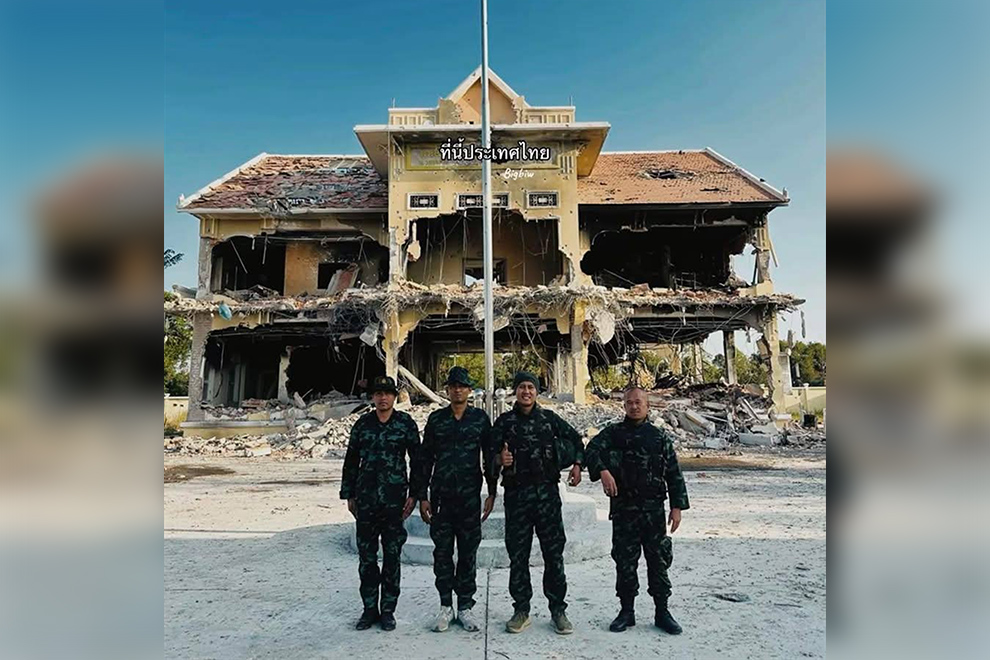 Thai soldiers pose for a photograph in front of the Cambodian customs building in the Boeung Trakuon area of Banteay Meanchey province. Social media
#National
Several leading analysts have urged the Thai Government to immediately halt any measures that may entrench unlawful territorial control and refrain from creating irreversible “faits accomplish” on the ground. They urged Thailand to implement the December 27 Joint Statement in good faith.
Roth Santepheap, a geopolitical analyst based in Phnom Penh, believed that both Thailand and Cambodia should address all outstanding issues through peaceful dialogue and agreed bilateral mechanisms, in strict conformity with international law.
His comments followed the January 9 announcement by Thai defence minister Nattaphon Narkphanit of Thailand’s five-point plan to occupy the Cambodian territory which remained under their control after the December 27 ceasefire.
According to Thai media reports, Narkphanit claimed that Thailand would maintain their positions for at least one year. They intend to install electronic fencing and CCTV in some areas, build permanent fencing in others, open some former restricted areas for veterans to farm and are considering developing some locations as tourist sites.
Santepheap described the plans as unacceptable and believed it signals an intention to retain and normalise territorial control.
“Such conduct constitutes a grave violation of the sovereignty and territorial integrity of Cambodia, arising from the continuing illegal presence and occupation by Thai armed forces of areas situated wholly within Cambodian territory,” he said.
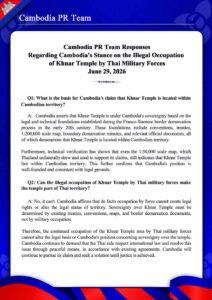
He added that the areas with a Thai military presence must have been clearly delimited by the 1:200,000 scale maps produced by the Franco-Siamese Mixed Commissions pursuant to the 1904 Convention and the 1907 Treaty, which constitute the authoritative legal instruments governing the land boundary between the two states.
He said international law prohibits the acquisition of territory through the use of force, as reflected in Article 2(4) of the UN Charter.
“No claim of security, administrative necessity or factual control can legitimise territorial control obtained through coercive means. Measures of a permanent physical, civilian or economic character undertaken in territory belonging to another State are without legal effect and incapable of conferring sovereignty or lawful title,” he noted.
He explained how such actions would vary from framework for ceasefire, de-escalation, restraint and the preservation of the status quo pending the peaceful resolution of outstanding issues. Actions that entrench permanent control or create irreversible faits accomplis on the ground are inconsistent with the object and purpose of the Joint Statement.
“It is essential to refrain from advancing any narrative implying that Cambodian territory can be ‘taken back’, ‘held’ or ‘maintained’ through force or coercion, as such assertions have no basis in international law and cannot produce legal effects,” he added.
According to a recent statement from the Ministry of Foreign Affairs and International Cooperation, Thai military control areas situated unequivocally within Cambodian territory in four provinces.
In Banteay Meanchey province, they occupy Prey Chan and Chouk Chey villages, as well as the Boeung Trakuon area. In Pursat, the Phluk Domrei area and the Thmor Da International Point of Entry area (Chrok Chey Chomneas). In Preah Vihear, The An Ses area, Ta Thav area, Phnom Trap area. In Oddar Meanchey, the O Smach area, K’nar Temple, Ta Krabei Temple, Ta Mone Thom Temple, Chob Angkunh area and Chok Krous area.
Kin Phea, director of the International Relations Institute at the Royal Academy of Cambodia, said that Thai plans to maintain their troops for one year clearly indicate that they are illegally stationed on Cambodia.
Regarding the installation of CCTV, construction of permanent fences or the giving of land to Thai veterans to farm, Phea said Thailand can only do so in their internationally recognised territory or locations that both Cambodia and Thailand had already agreed to, not in places where they have unilaterally redrawn maps through the use of force.
“It is the same for the location they want to turn into tourism spots. Wherever Thailand want to develop, they can do as long as it is in their territory, internationally recognised, but Cambodia must not allow it to happen on Cambodian territory,” he added.
-The Phnom Penh Post-