‘Angkor Wat stands strong with warm smiles despite border tensions’
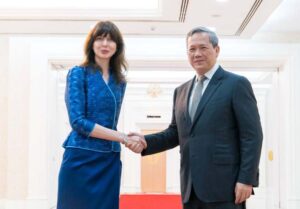
 Chum Sopheak Makara, Deputy Director-General and Spokesperson of the APSARA National Authority. ANA
#business
Synopsis: The Thai invasion has had little impact on Siem Reap, especially the Angkor resort area. In fact, there has been an increase in the number of international tourists purchasing three-day passes instead of one-day tickets. Domestic or international visitors continue to visit temples and other tourist sites as usual.
The recent conflict between Cambodia and Thailand has raised security concerns and forced tens of thousands of families to flee their homes, while key economic sectors, including tourism, have also been dented. Siem Reap, home to the Angkor World Heritage Site, is Cambodia’s most important tourist destination, where issues about tourists’ safety, confidence and the livelihoods of local residents are of particular concern to provincial authorities. Khmer Times caught up with Chum Sopheak Makara, Deputy Director-General and Spokesperson of the APSARA National Authority (ANA), to know the measures being taken to ensure safety, strengthen tourist confidence and work with institutions to instill confidence in the tourism sector.
KT: How much does the Cambodia-Thailand conflict affect tourist visits to Angkor Wat and Siem Reap?
The Thai invasion of Cambodian territory has had a significant impact on the tourism sector in the provinces along the Thai border. However, Siem Reap, especially the Angkor resort area, remains completely safe and has not been affected in terms of tourism. Domestic or international visitors continue to visit temples and other tourist sites in Siem Reap province as usual.
Interestingly, there has been an increase in the number of international visitors purchasing three-day passes instead of one-day tickets. This reflects the effectiveness of the joint efforts of ministries, institutions, authorities and the private sector working together as a unified system to promote national tourism in line with the Open Skies strategy, which allows for more direct flights from key countries such as India and Turkey. These efforts are supported by the Royal Government’s continued commitment to maintaining peace and security.
KT: What measures has the ANA taken to ensure safety and strengthen tourist confidence in the Angkor area?
The ANA has worked closely with the Siem Reap provincial authorities and other competent agencies to implement various security measures in line with the Royal Government’s guidelines during this period of conflict. These include banning drone flights in the Angkor area, strengthening monitoring and reporting mechanisms for suspicious activities, and coordinating with security forces on overall safety. These measures are being implemented in a way that avoids causing fear or concern among domestic and international visitors.
In addition, ANA’s teams carry out daily operations to ensure that tourists enjoy a safe, pleasant and confident visit to the Angkor area. These efforts include providing high-quality visitor services in line with international standards, such as establishing “lost and found” facilities, creating new visitor routes, setting up first-aid and rescue teams, and providing regular hospitality training for tourism officers and ANA staff.
These measures are further strengthened through close cooperation with the private sector and relevant ministries, especially the Ministry of Tourism, as well as by allowing influencers to promote Angkor tourism while highlighting the area’s full safety and readiness for visitors.
KT: Tell us something more about how the ANA cooperated with the Ministry of Tourism and local authorities to strengthen the tourism sector?
With the Royal Government’s Siem Reap Tourism Master Plan 2021-2035 being the cornerstone, the ANA — beyond its core mission of conserving and sustainably developing the Angkor site to support the national economy — has been working closely with the Ministry of Tourism (MoT), national committees, Siem Reap provincial authorities and the private sector to introduce a wide range of key measures.
Relevant working groups hold regular meetings to gather inputs and implement short, medium- and long-term actions aimed at enhancing the competitiveness of the tourism market. These measures include opening Angkor Botanical Garden to visitors free of charge, reforming procedures for photo and video shooting permits, launching an online service application system, introducing the Visit Angkor App, producing and co-producing promotional videos, and providing training for tour guides.
ANA also works with partners to organise and support major national events such as Thanks Angkor Event, Angkor Sankranta, Memorial Night, Angkor Dictation Competition and cycling events, as well as international events such as marathons, Angkor Ultra Trail races (long distance running), international yoga sessions and the Angkor Wat equinox. In addition, it allows Gala Dinners to be held at selected temple sites in the evenings.
Furthermore, ANA continues to cooperate with the MoT and the private sector to develop new tourism products, including modern museum projects and decorative lighting displays at the Angkor Botanical Garden.
KT: What role does tourism in the Angkor area play in supporting livelihoods and increasing income for local communities?
The Angkor area covers 401 square kilometres, spanning 114 villages across four districts and one city. Within this area, Angkor serves as the economic backbone of local communities living inside the site and more broadly of Siem Reap province as a whole. For this reason, the Royal Government of Cambodia (RGC) has introduced a series of key measures to attract more visitors, such as declaring the “Year of Visit Siem Reap” and implementing the Siem Reap Tourism Master Plan.
To further strengthen this role, in addition to its core responsibilities, the ANA has long supported community-based initiatives, such as allowing the establishment of boat communities at Baray Reach Dak Community Tour and cart communities, and cooperating with international partners to boost the local community economy in the Angkor area.
More recently, under the leadership of the Ministry of Land Management, Urban Planning and Construction, the ANA has been working with Siem Reap provincial authorities and the ministry’s technical working group to prepare new regulations on land use, urban planning and construction within the Angkor site. These regulations aim to clearly define areas that must be strictly protected, as well as rural villages, urban zones, business areas and agricultural land across all 114 villages. This will support sustainable management, preserve Angkor’s outstanding universal and original values, promote tourism, and contribute to the economic development of local communities.
KT: What message would you like to send to domestic and international tourists to encourage them to visit Siem Reap and the Angkor area with confidence?
Visitors can be confident that the Angkor area and Siem Reap province are completely safe. Angkor area continues to stand strong with warm smiles, ready to welcome domestic and international tourists to enjoy its unique and unforgettable cultural and historical experiences.
I would also like to call on all Cambodian people and the private sector to continue carrying out their respective roles with a proactive and cooperative spirit, working together to promote the best of our tourism destinations. By continuing to provide high-quality hospitality to visitors, we can help maintain the resilience of Cambodia’s tourism sector as it faces current global challenges and uncertainty.
-Khmer Times-