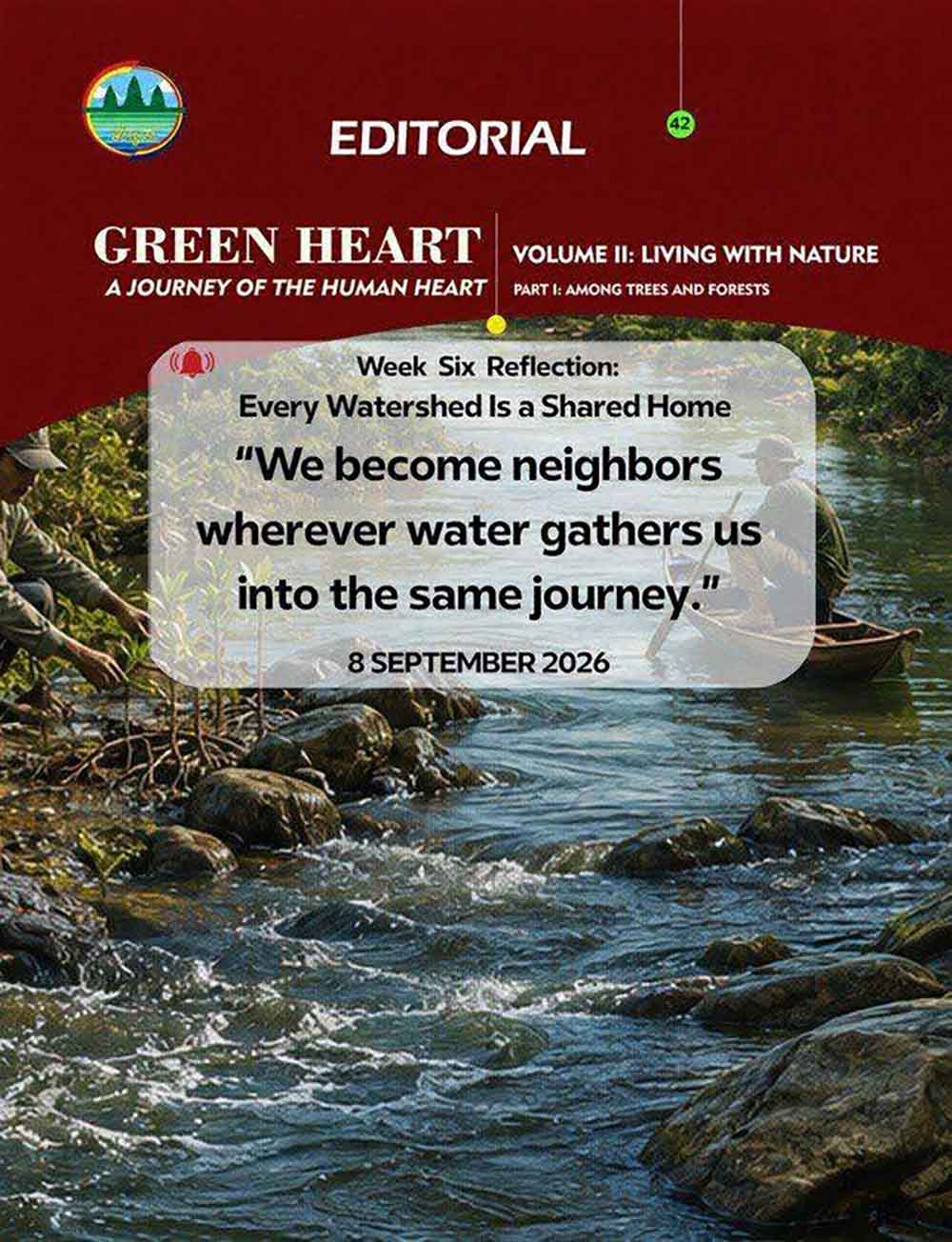
Editorial 42 -Every Watershed Is a Shared Home
 Editorial 42 -Every Watershed Is a Shared Home
Opening Thought
“We become neighbors wherever water gathers us into the same journey.”
Editorial
A watershed is the area of land from which water drains toward a common stream, river, lake, wetland, or other outlet. Hills and ridges often form its boundaries. Everyone living within it shares a water story, whether or not they can see the main river.
Upstream actions can affect downstream communities. Downstream needs can influence upstream decisions. Farmers, towns, forests, industries, roads, fisheries, and wildlife may all depend on the same system in different ways.
Sharing does not mean every user takes the same amount or has the same responsibility. Water needs, rights, geography, and resources differ. Fair management listens to diverse voices, protects essential needs, uses evidence, and considers the health of the whole system.
Watersheds cross administrative borders. A river may pass through districts, provinces, or countries. Water cooperation can therefore build trust. Data, early warnings, pollution prevention, and planning become stronger when people communicate.
Students can understand their watershed by mapping slopes, drains, streams, land uses, and water sources. A map turns an invisible relationship into a visible community. It reveals that the schoolyard and the riverbank may belong to the same system.
Watershed care includes forests and wetlands, farms and cities, groundwater and surface water. It may involve erosion control, sanitation, efficient use, habitat protection, restoration, monitoring, and safe infrastructure. No single action is enough.
This complexity should not discourage us. It gives many people a role. A household prevents waste. A farmer improves land care. An engineer designs safer systems. A teacher builds understanding. A community protects a spring. A government coordinates standards and investment.
During Week Six, we followed water through movement, rain, groundwater, wetlands, ponds, and land. Now those paths gather into one shared home.
Imagine your watershed as a large bowl. Every person lives somewhere inside it, and every drop moves according to the shape of the land. We may never meet all our watershed neighbors, but our choices can still show them respect.
Water connects us before we agree on anything else. Let that connection become a reason for cooperation.
Watershed identity can become a source of pride. Schools, farms, villages, and towns may have different roles, yet all can celebrate improvements in shared water. Cooperation grows stronger when people see themselves not only as separate users, but as caretakers of one flowing home.
Buddhist Reflection
Interdependence becomes practical in a watershed. Our well-being is tied to the actions of others, and theirs to ours. Right speech, fairness, and compassion help transform dependence into cooperation rather than conflict.
Today’s Reflection
Who are my upstream and downstream neighbors, and how might our water choices affect one another?
Today’s Action
Sketch a simple map from your home or school to the nearest known stream, pond, wetland, river, or drainage outlet.
Today’s Pledge
Today I will live as a respectful neighbor within my shared watershed.
When we protect nature, we protect all beings—including ourselves.