ASEAN and UN urged to play stronger role to prevent border conflict escalation
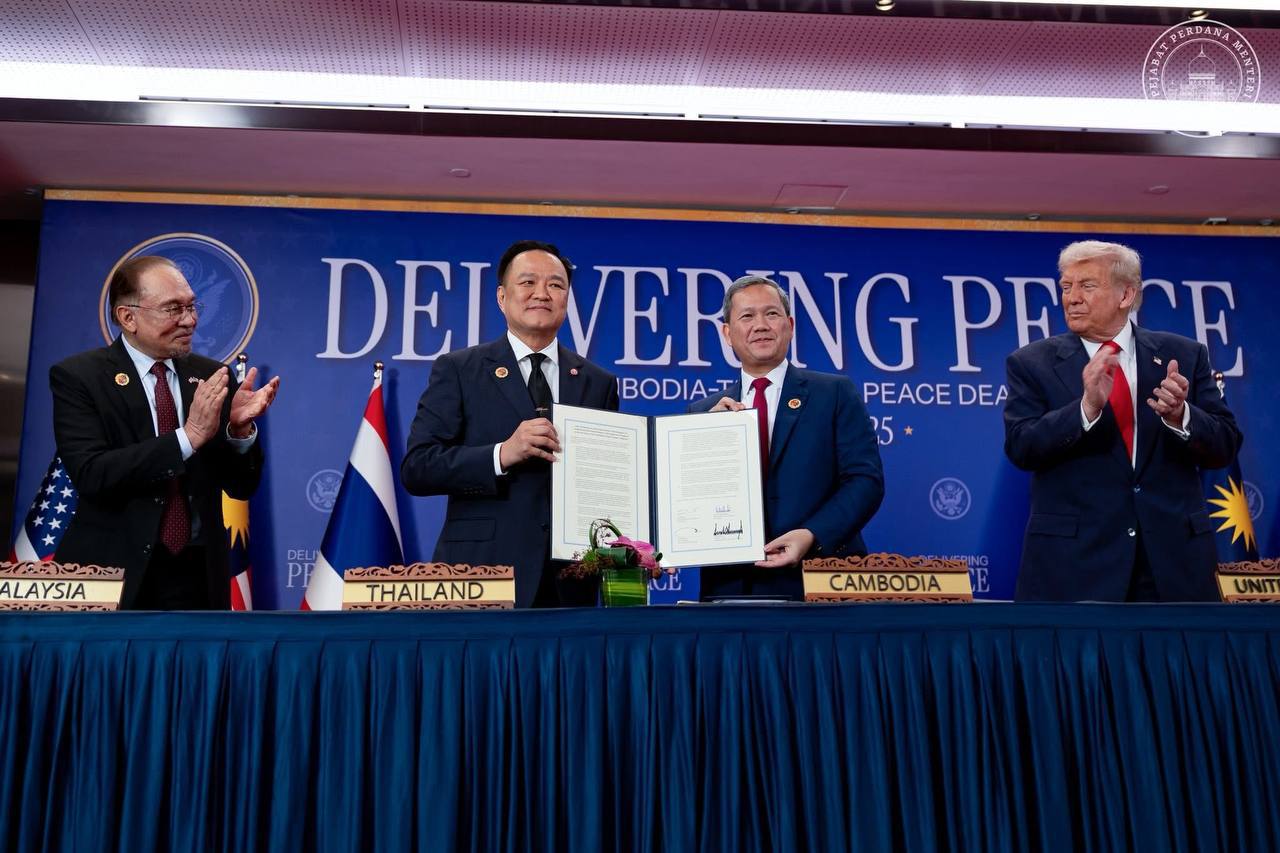 [Cambodian Prime Minister Hun Manet (2-R) and Thai Prime Minister Anutin Charnvirakul (2-L) shake hands after signing a joint declaration for peace, witnessed by Malaysian Prime Minister Anwar Ibrahim (L) and US President Donald Trump, on the sidelines of the 47th ASEAN Summit, in Kuala Lumpur, on October 26. PMO]
Synopsis: A former diplomat and academic calls on ASEAN and the United Nations to take a more proactive role in ensuring that the Kuala Lumpur peace accord between Cambodia and Thailand is upheld, warning the border row remains highly volatile without international intervention.
A prominent academic and former diplomat has called on ASEAN and the United Nations to play a more proactive role in ensuring that the recently brokered peace accord between Cambodia and Thailand is upheld, warning that the situation remains “very crucial” and “very dangerous” if not managed with sustained international engagement.
Speaking in an exclusive interview with Khmer Times, Pou Sothirak, a retired diplomat, academic, and Distinguished Senior Adviser to the Cambodian Center for Regional Studies (CCRS), stressed that maintaining the peace agreement requires more than bilateral goodwill, noting that Phnom Penh and Bangkok have struggled to resolve their differences on their own.
“To uphold the peace accord is not a small matter,” he said. “To start with, you have to understand that it starts with Cambodia and Thailand, starting from there. But if you rely exclusively on them to settle their account peacefully, you may be surprised. As you can see, they cannot reconcile now, and then they try to blame each other all the time.”
Prime Minister Hun Manet and his Thai counterpart Anutin Charnvirakul signed a joint declaration, known as the Kuala Lumpur Peace Accord, on October 26 on the sidelines of the 47th ASEAN Summit, formally committing to end hostilities between the two countries. The signing was witnessed by US President Donald Trump and Malaysian Prime Minister Anwar Ibrahim, the ASEAN Chair.
The accord sought to establish a durable settlement following a sharp escalation of the long-standing border dispute, which in July led to deadly clashes that claimed dozens of lives and displaced tens of thousands of people on both sides of the frontier.
However, Anutin suspended the peace deal on November 10 after a landmine explosion injured Thai soldiers near the border, accusing Cambodia of planting new mines—an allegation Phnom Penh strongly rejected, insisting the blast was caused by remnants from decades of civil war.
Sothirak emphasised that the international community must “be the judge as to who is pro-peace, who is more pro-conflict.”
He said Cambodia should continue to depend on ASEAN’s diplomatic mechanisms and international platforms to help manage the crisis.
“For Cambodia, we should continue to count on ASEAN to help mediate this important, crucial, and very dangerous situation. We should continue to count on ASEAN diplomacy to settle this matter.” he said.
He highlighted the government’s ongoing diplomatic efforts, commending Mr Hun Manet as well as Deputy Prime Minister and Minister of Foreign Affairs and International Cooperation Prak Sokhonn for their work in maintaining peace along the shared border.
However, he added that further engagement with the UN is essential.
“Cambodia needs to let the UN know that peace and stability of the region… can also affect world peace. The UN only reacts if world peace is affected,” he said. “The UN has to do more…for example, I’m thinking about if the UN Security Council has a resolution calling on both Thailand and Cambodia to adhere to ceasefire unconditionally.”
He said such a resolution would “send a very strong message to both countries, and Thailand particularly.”
Sothirak also urged ASEAN to adopt a more assertive approach, rather than defaulting to non-interference.
“ASEAN needs to also go away from their old orthodoxy, the so-called ASEAN comfort zone,” he said. “ASEAN needs to see that this is not an internal affair of Thailand or Cambodia. These conflicts affect the stability and security of the region, affect ASEAN relevance, credibility and image.”
As Malaysian Prime Minister, Anwar helped mediate a ceasefire between Thailand and Cambodia on July 28 by hosting talks in Kuala Lumpur. He secured agreement on an “immediate and unconditional” halt to hostilities, marking a crucial first step toward de-escalation.
Sothirak said ASEAN should consider invoking rarely used mechanisms such as the High Council or dispatching an ASEAN Troika, an ad hoc body, noting that Cambodia would likely “welcome with open arm” such involvement.
He recalled that ASEAN once used this mechanism during Cambodia’s 1997 political crisis, saying it had been “very, very effective” and could provide a model for today.
Sothirak stressed that both Cambodia and Thailand must firmly reject military confrontation.
-Khmer Times-