Editorial 104 – Heritage Places Hold Living Identity
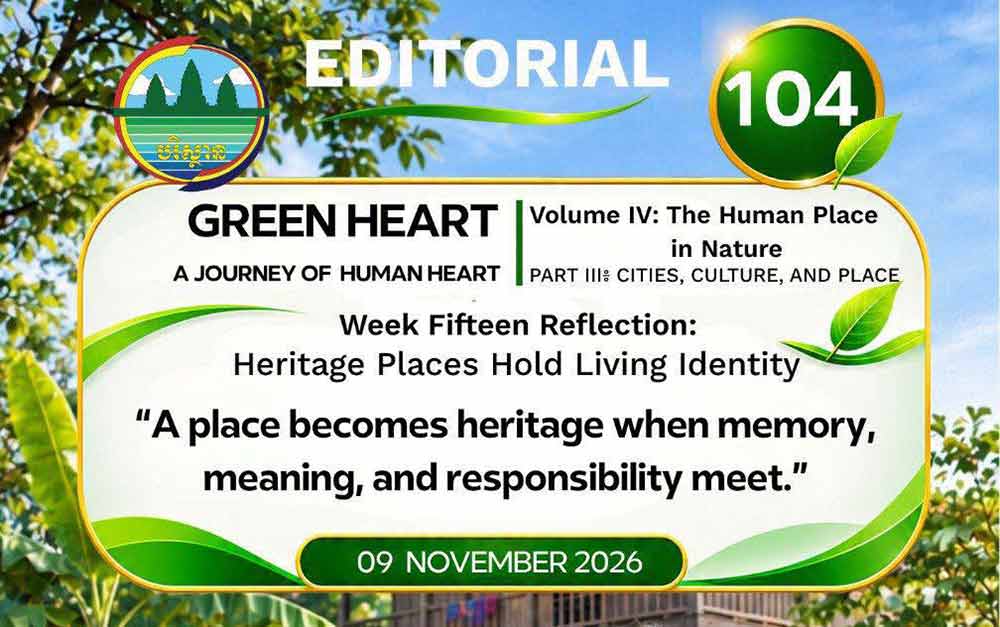 Editorial 104 – Heritage Places Hold Living Identity
Opening Thought
“A place becomes heritage when memory, meaning, and responsibility meet.”
Editorial
A heritage place may be a temple, forest, mountain, river, old neighborhood, farm, wetland, archaeological site, or gathering ground. Its value can be historical, cultural, spiritual, ecological, architectural, or all at once.
People do not experience heritage identically. One place may represent sacred memory to a community, scientific value to researchers, livelihood to residents, beauty to visitors, and development opportunity to others.
Protection therefore requires conversation. Declaring a place important without including the people who live there can create injustice. Ignoring wider public or ecological value can lead to irreversible loss.
Natural and cultural heritage often overlap. Sacred groves protect old trees. Traditional water systems shape ecosystems. Historic buildings reveal climate-responsive design. Cultural landscapes show generations of human interaction with land.
Tourism can provide income and pride, but too many visitors, waste, noise, construction, or disrespectful behavior may damage what people came to experience. Visitor limits, guides, fees, maintenance, local ownership, and education can help.
Climate change threatens heritage through sea-level rise, erosion, storms, fire, heat, changing moisture, and species loss. Adaptation may involve documentation, drainage, protective structures, ecosystem restoration, relocation of movable objects, or difficult choices.
Not every old structure can be preserved unchanged, and living communities need development. Good planning identifies what is essential, what can adapt, and what loss would be irreversible.
Students can contribute by documenting stories, maps, species, photographs, and changes with permission. Information should respect sacred or sensitive knowledge.
Heritage is not nostalgia alone. It offers continuity—evidence that people belonged before us and a question about what we will pass onward.
Visit a meaningful place and ask: What makes this place itself, rather than any other location? Which relationships would be lost if it changed beyond recognition?
Protecting heritage is not freezing time. It is guiding change so identity, memory, ecology, and human dignity can continue their conversation.
Emergency documentation is valuable before disaster. Accurate maps, photographs, oral histories, material records, and species lists can guide repair or remembrance after loss. Documentation cannot replace a place, but it prevents some knowledge from disappearing with it.
Copies should be stored safely in more than one location, with access rules decided by the community. Sacred or sensitive information may require protection rather than publication.
Buddhist Reflection
Impermanence does not remove the value of memory. Because places change, mindful stewardship becomes urgent. We care without pretending we can possess or preserve every form forever.
Today’s Reflection
Which relationship gives one local heritage place its meaning?
Today’s Action
Create a one-page heritage profile including place, people, ecology, memory, current use, threat, and respectful protection.
Today’s Pledge
Today I will protect heritage as a living relationship among place, memory, nature, and community.
When we protect nature, we protect all beings—including ourselves.