THE HUIONE FIASCO
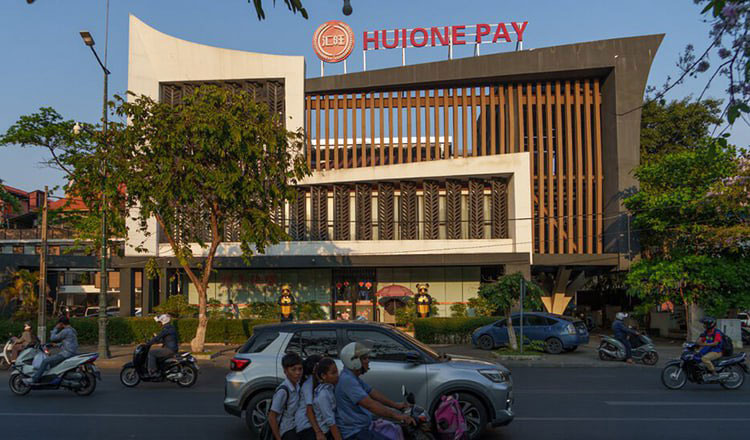 (File photo): Huione Pay Plc’s office on Preah Monivong Boulevard (Street 93) in Phnom Penh, where customers recently rushed to withdraw funds. Khmer Times
#opinion
Based on the facts reported in the article, it would be difficult to conclude that NBC legally “failed” a specific statutory duty without reviewing the full supervisory record, inspection reports, correspondence and enforcement actions. However, if the article’s allegations are accurate, there are several provisions of Cambodia’s banking and financial regulatory framework where questions can legitimately be raised regarding supervisory effectiveness.
What the article alleges
The article states that:
• HuiOne Pay held only a payment service licence.
• It allegedly conducted activities beyond that licence, including:
o accepting deposits
o offering fixed-return savings products
o facilitating lending
o cryptocurrency-related remittances
o money-changing operations.
The article further alleges that:
• NBC revoked HuiOne Pay’s licence in September 2024.
• The company was supposedly liquidated thereafter.
• Yet customers claimed the app and related operations continued well into 2025 and even 2026 through HuiOne Pay and H-Pay.
If those allegations are true, the legal questions become less about licensing and more about supervision, enforcement, unauthorised banking business, consumer protection and liquidation control.
1. Possible issue under the Law on Banking and Financial Institutions (LBFI)
Unauthorised banking activities
The most obvious issue concerns provisions restricting deposit-taking and banking activities to properly licensed institutions.
Under the LBFI:
• No person may conduct banking business without authorisation from NBC.
• Deposit-taking from the public is a regulated banking activity.
• Institutions must operate only within the scope of their license.
If HuiOne Pay was operating as a payment service provider but offering fixed deposit products, savings accounts and lending activities, the the primary violation would have been committed by HuiOne Pay. The question then becomes whether NBC detected and stopped it promptly enough.
2. Possible issue under NBC’s supervisory powers
The LBFI gives NBC broad authority to:
• inspect institutions
• require information
• issue corrective orders
• suspend activities
• revoke licences
• appoint administrators or liquidators
The article indicates NBC inspected HuiOne Pay in July 2024 and revoked its licence in September 2024.
A critic could therefore argue:
If unauthorised deposit-taking and lending had already become widespread before July 2024, why was intervention not done earlier?
That is a question of supervisory effectiveness rather than necessarily a breach of law.
3. Potential concern regarding liquidation oversight
The article is particularly damaging on one point: NBC stated HuiOne Pay was liquidated, yet customers reported continued operations under similar branding and through H-Pay.
If proven, questions arise regarding:
• adequacy of liquidation controls,
• monitoring of successor entities,
• prevention of continuation of business under another vehicle,
The law grants NBC authority to ensure cessation of unauthorised activities after licence revocation.
Therefore critics may argue NBC did not adequately enforce post-revocation controls.
That is probably the strongest legal criticism emerging from the article.
4. AML/CFT obligations
The article notes:
• international concerns
• allegations relating to shadow-market activities
• links to cryptocurrency flows
• later actions by US authorities
If suspicious transactions were occurring through licensed channels, then questions could arise regarding:
• customer due diligence,
• suspicious transaction reporting,
• risk-based supervision.
However, AML supervision in Cambodia is shared among multiple authorities, not NBC alone.
Therefore it would be incorrect to place all responsibility solely on NBC.
5. Consumer protection concerns
The article notes:
• 1,297 claimants allegedly reported losses of approximately $31 million plus $20 million in crypto assets.
Critics could argue NBC should have:
• issued stronger public warnings,
• acted faster against misleading representations,
• clarified that customer funds were not protected deposits.
Again, this is more a policy and supervisory criticism than a clear statutory violation.
Which articles would lawyers likely scrutinise?
Assuming the English 1999 Law on Banking and Financial Institutions is the governing statute, investigators would likely focus on provisions dealing with:
1- Exclusive authorisation to conduct banking business
2- Deposit-taking from the public
3- NBC inspection powers
4- NBC corrective and enforcement powers
5- Licence suspension and revocation
6- Conservatorship and liquidation procedures
7- Protection of creditors and depositors
The legal exposure would not necessarily be that NBC violated these articles, but whether NBC exercised the powers granted by these articles adequately and in a timely manner.
A balanced legal assessment
From the facts presented in the article alone, the strongest criticism is probably not “NBC violated the Banking Law.”
Rather, it is “NBC may have acted too late, and may not have effectively enforced its revocation and liquidation decisions, allowing customers to believe the business remained legitimate after regulatory intervention.”
That distinction is important because regulatory negligence, supervisory weakness, and delayed enforcement are very different legal concepts from an outright breach of a statutory duty.
After reviewing the allegations in the Nikkei article and cross-referencing them against the structure of Cambodia’s LBFI 1999, the issue should be framed as follows:
Conclusion
If the facts reported by Nikkei are substantially accurate, the greatest legal vulnerability is not that NBC directly violated a specific article of the LBFI, but that NBC may face criticism for failing to exercise its statutory supervisory and enforcement powers in a sufficiently timely and effective manner.
The provisions most likely to come under scrutiny would be those governing:
• unauthorised banking activities
• prudential supervision and inspection
• corrective measures
• licence revocation;
• liquidation and winding-up oversight.
The case becomes especially problematic because NBC itself reportedly acknowledged that HuiOne Pay held only a payment service licence while customers were allegedly using it for activities resembling deposit-taking, lending, remittance, and crypto-related financial intermediation.
I. Potential breach area no 1
Unauthorised deposit-taking relevant legal principle
Under the LBFI, only licensed banking institutions may:
• receive deposits from the public
• conduct banking business
• hold themselves out as carrying on banking activities
The article reports that HuiOne Pay customers were able to:
• maintain fixed-deposit style accounts
• place savings
• obtain loans
• conduct crypto remittances.
If true, those activities are far beyond a normal payment-service licence.
Legal question
When did NBC first know?
If NBC knew before July 2024 and took no meaningful action, critics could argue NBC failed to properly enforce the provisions prohibiting unauthorised banking activities.
If NBC only discovered the conduct during its 2024 inspection and then revoked the licence shortly thereafter, NBC would have a stronger defence.
II. Potential breach area no 2
Failure of ongoing supervision
The LBFI gives NBC authority to:
• inspect institutions
• demand records
• order corrective actions
• sanction institutions
The article states NBC conducted an onsite inspection in July 2024 and revoked the license in September 2024.
The supervisory question becomes:
How did a payment company allegedly conduct quasi-banking activities for years before decisive intervention?
A parliamentary inquiry or independent review would likely focus on:
• inspection frequency
• risk assessments
• examination reports
• off-site monitoring.
This is probably the strongest area of regulatory criticism.
III. Potential breach area no 3
Post-revocation enforcement failure
This is where NBC appears most vulnerable.
he article reports:
• HuiOne Pay licence revoked September 2024;
• liquidation initiated;
• customers still reported access to services months later;
H-Pay emerged using similar branding, locations and customer base.
If true, a key question arises:
Why were operations apparently able to continue after revocation?
The LBFI gives NBC authority to ensure the cessation of unauthorised financial activities.
herefore critics could argue:
NBC exercised the power to revoke but failed to fully enforce the consequences of revocation.
This may not be a breach of a specific article but could be viewed as deficient execution of statutory responsibilities.
IV. Potential breach area no 4
Liquidation oversight
The article contains perhaps the most troubling allegation:
NBC stated HuiOne Pay had been liquidated, yet customers reportedly continued transacting through associated channels.
Under liquidation principles:
• assets should be identified
• liabilities verified
• operations terminated
• creditors informed
Questions likely to be asked include:
1- Was the liquidation genuinely completed?
2- Were all customer liabilities captured?
3- Were affiliated entities examined?
4- Were digital assets traced?
5- Were crypto wallets included?
These issues could expose weaknesses in liquidation administration.
V. Potential breach area no 5
Fit-and-proper oversight
The article notes links between HuiOne entities and persons later associated with serious international allegations.
The LBFI gives NBC authority to assess:
• shareholders;
• directors;
• senior management;
• beneficial ownership.
Investigators would likely ask:
1- Were ownership structures fully disclosed?
2- Were related-party entities examined?
3- Were beneficial owners properly vetted?
This is particularly important given the apparent interconnectedness of the HuiOne ecosystem.
VI. Potential AML/CFT regulatory weakness
This issue extends beyond the Banking Law.
The article references:
• shadow-market allegations
• cryptocurrency activities
• subsequent US Treasury action
Reviewers would likely examine:
• suspicious transaction reports (STRs)
• enhanced due diligence
• transaction monitoring
• cross-border transfers
However, responsibility here would be shared among:
• NBC
• Cambodia Financial Intelligence Unit (CAFIU)
• law enforcement
• prosecutors.
Which specific articles would be investigated?
Although article numbering varies by publication version, investigators would likely focus on sections dealing with:
Area Likely Legal Focus
Licensing Unauthorised banking activities
Supervision NBC inspection obligations
Enforcement Corrective orders and sanctions
Revocation Termination of licensed activities
Liquidation Protection of creditors and customers
Governance Fit-and-proper requirements
AML/CFT Monitoring suspicious activities
The most damaging legal question
The question most likely to be asked by foreign regulators, correspondent banks, FATF reviewers, or international investigators is not “Why did HuiOne violate the law?” but rather “Why was HuiOne apparently able to continue operating after NBC had already inspected it, revoked its licence, and announced liquidation?”
That is the point where regulatory credibility becomes exposed.
If a future inquiry were conducted by international financial regulators, that issue—not the original licensing violation—would probably receive the greatest scrutiny.
Based solely on the facts reported in the article, post-revocation enforcement and liquidation oversight appear to be the areas where NBC would face the strongest criticism.
-Khmer Times-