From MOU to UNCLOS: Cambodia Chooses Law, Not Confrontation
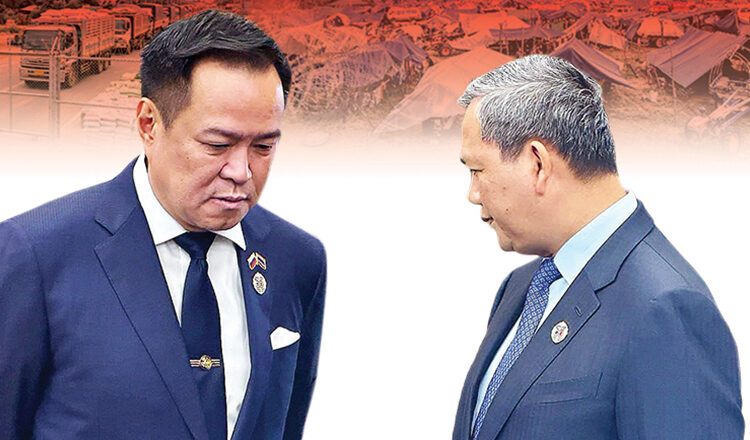 From MOU to UNCLOS: Cambodia Chooses Law, Not Confrontation
#Opinion
When Thailand unilaterally terminated the 2001 Memorandum of Understanding with Cambodia, it did more than abandon an agreement that had existed for a quarter of a century. It dismantled the only mutually agreed bilateral framework specifically established to address the two countries’ overlapping maritime claims in the Gulf of Thailand.
Cambodia did not respond with confrontation. It responded with law.
Following Thailand’s decision, Cambodia initiated compulsory conciliation under the United Nations Convention on the Law of the Sea (UNCLOS)—a peaceful dispute-settlement mechanism established precisely for circumstances in which negotiations have failed to produce agreement and the applicable conditions under the Convention are met.
The process is now underway. Cambodia and Thailand have appointed their respective conciliators, and the four members are working through the process for selecting the fifth member, who will serve as Chair of the Conciliation Commission.
This is not escalation. It is the rule of law in action.
Thailand Closed One Door
For 25 years, the MOU signed on 18 June 2001 provided Cambodia and Thailand with an agreed framework for dealing with their overlapping maritime claims to the continental shelf. The agreement is registered with the United Nations. It established a bilateral process through which the parties could pursue maritime delimitation and arrangements concerning hydrocarbon resources in the overlapping claims area.
Whatever frustrations existed over the pace of negotiations, the essential point is straightforward: there was an agreed framework. Thailand chose to terminate it.
On 5 May 2026, the Thai Cabinet approved termination of the MOU. Significantly, Thailand itself stated that it intended to move toward a framework based on UNCLOS and international law. Cambodia took Thailand at its word.
If the bilateral framework was no longer acceptable to Thailand, Cambodia could not reasonably be expected to leave its maritime rights indefinitely unresolved while waiting for Bangkok to design a replacement framework on its own terms.
Cambodia therefore turned to the framework both countries have accepted: UNCLOS. That was not an unfriendly act. It was the responsible act of a State seeking a peaceful legal solution.
Compulsory Conciliation Is Part of UNCLOS
There is sometimes a misleading suggestion that Cambodia has somehow “internationalized” a matter that should remain exclusively bilateral. That argument ignores the Convention itself.
UNCLOS is not an outside actor imposed upon Thailand. Thailand is a State Party to the Convention. Cambodia is also a State Party.
Article 298 of UNCLOS expressly provides, under specified circumstances, for compulsory conciliation concerning disputes relating to maritime boundary delimitation. Where the Convention’s requirements are satisfied, a party may request submission of the matter to conciliation under Section 2 of Annex V.
This mechanism was deliberately incorporated into UNCLOS as a bridge between unsuccessful negotiations and peaceful settlement.
Conciliation is not litigation. The Conciliation Commission is not a court imposing a judgment on either country. Its role is to hear the parties, examine their positions, facilitate negotiations and propose a basis upon which a fair settlement might be achieved.
That makes the process particularly appropriate for Cambodia and Thailand. It preserves diplomacy while anchoring diplomacy in international law.
Thailand Cannot Invoke UNCLOS Selectively
There is an even more fundamental issue. When Thailand terminated the MOU 2001, its own government publicly said that UNCLOS could provide the framework for future engagement.
That position carries consequences. A State cannot credibly say that UNCLOS is the appropriate framework when terminating a bilateral agreement, but then object when another State invokes a procedure contained in UNCLOS.
International law cannot operate à la carte.
States cannot embrace the provisions they find politically convenient while rejecting the procedures that become inconvenient.
If UNCLOS is to replace the MOU 2001 as the governing legal framework—as Thailand itself suggested—then UNCLOS must be respected as a whole, including its mechanisms for peaceful dispute settlement. Cambodia is doing exactly that.
Compulsory Does Not Mean Confrontational
The word “compulsory” can easily be politicized. But compulsory conciliation should not be portrayed as coercion or hostility.
It is a peaceful mechanism agreed in advance by States when they became parties to UNCLOS. There are no warships involved. No threats. No unilateral attempt to impose a maritime boundary by force. There are lawyers, diplomats, international experts and conciliators sitting around a table. That is precisely how disputes between neighboring States should be handled.
The process also protects both countries. Cambodia will have the opportunity to present its legal position. Thailand will have exactly the same opportunity. Independent conciliators can examine the competing arguments and help identify possible areas of convergence.
Neither side needs to surrender its position merely by participating. Participation demonstrates confidence in international law.
The Gulf of Thailand Should Be a Sea of Cooperation
The maritime question is not merely about lines on a map. Behind the overlapping claims lie potentially significant energy resources and broader opportunities for economic cooperation. A prolonged dispute leaves those opportunities unrealized and creates uncertainty for future generations.
Cambodia and Thailand are neighbors. Geography cannot be changed, and neither can the necessity of eventually finding a mutually acceptable solution. The question is therefore not whether the two countries should negotiate. They must.
The real question is whether those negotiations will take place within a predictable, rules-based framework capable of helping the parties overcome decades of deadlock.
Compulsory conciliation offers precisely such an opportunity. It should not be viewed as Cambodia versus Thailand. It should be viewed as law replacing uncertainty, dialogue replacing deadlock, and peaceful procedure replacing unilateral action.
Honor the Law Both Countries Accepted
Cambodia did not terminate the MOU 2001. Thailand did. Cambodia did not abandon peaceful settlement. It moved from a bilateral framework that Thailand terminated to a multilateral legal framework accepted by both countries.
And Cambodia did not invent compulsory conciliation. It is embedded in UNCLOS.
The Conciliation Commission is now taking shape. Four conciliators have been appointed, and the process toward selecting the Chair is underway. That institutional progress should be welcomed rather than politicized.
Thailand now has an opportunity to demonstrate something larger than its position on a particular maritime boundary: its commitment to the international legal order it has repeatedly invoked.
Participating constructively does not weaken Thailand’s sovereignty. Nor does it predetermine the final maritime boundary. It demonstrates that disagreements between sovereign States can be addressed through law rather than power.
Cambodia has chosen that path. Thailand should walk it too. The principle at stake is simple but important: no State should invoke international law only when international law is convenient.
Thailand terminated the bilateral framework and pointed to UNCLOS.
Cambodia turned to UNCLOS. Now both countries should honor it. Because in the Gulf of Thailand, as everywhere else, lasting solutions will not come from unilateral claims or political pressure.
They will come from dialogue anchored in international law.
Roth Santepheap is a geopolitical analyst based in Phnom Penh. The views expressed are his own.
-Phnom Penh Post-