Four cities, one strategy
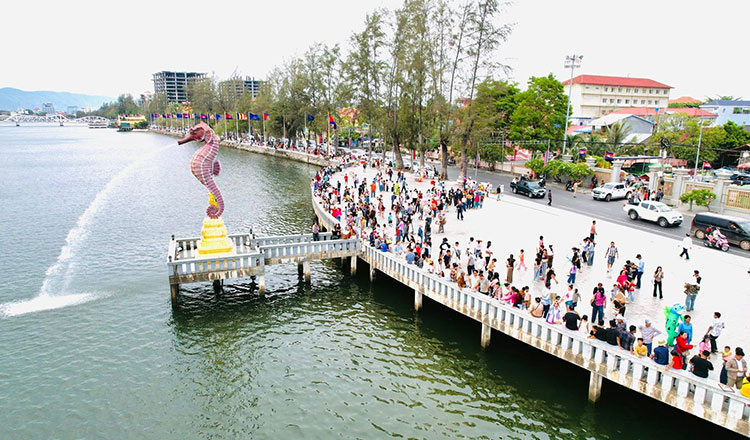 Kampot province, with its natural beauty and pristine environment, has the potential to become a longevity and wellness haven. Department of Kampot Tourism, Cambodia
#Opinion
Concentrating all growth in Phnom Penh is a national risk. Distributing four distinct roles across four cities is the answer.
If you want to understand the structural limits of Cambodia’s current economic model, look at the traffic on Russian Federation Boulevard in Phnom Penh. The capital is overheating. It attracts most of the foreign direct investment, the country’s best talent, and its primary infrastructure spending. Meanwhile, the rest of the country remains predominantly agrarian and economically sidelined.
In investment, putting all your capital into a single asset is considered a fatal risk. (Some investors have built fortunes on concentrated bets, but the foundational principle remains diversification.)
For a nation, monocentric growth carries the same danger. It inflates urban land prices, creates infrastructure bottlenecks, and leaves the national economy vulnerable to localised shocks.
Cambodia’s path to a $4,000 GDP per capita does not run through Phnom Penh alone. It requires what this column calls “spatial asset allocation”: treating the country’s geography as a diversified portfolio of specialised economic engines.
The framework
Over the past four columns, this series identified four underused strategic assets: a manufacturing window, a dollarised economy, the Mekong’s freshwater endowment, and a premium climate for the longevity economy. These assets cannot co-exist effectively in a single city. They require physical separation to achieve maximum efficiency. Each must be assigned to the city where it works best.
The Hun Manet government’s Pentagonal Strategy recognises regional development as one of its objectives. But in the current framework, spatial distribution remains a secondary theme, nested within a broader set of priorities. Given the complexity of today’s global environment, where supply chains are fragmenting, climate shocks are intensifying, and low-income countries must compete for every dollar of investment, spatial asset allocation deserves to be elevated from a supporting objective to a central organising principle. It is not one of many things Cambodia should do. It is the structure within which everything else works.
The four-city portfolio
Phnom Penh: the financial and digital nerve centre. The capital must pivot from a low-value real estate hub to the offshore financial gateway for the lower Mekong. As Part 6 argued, Cambodia’s dollar economy can attract regional startups and capital owners who cannot access proper markets at home. Phnom Penh should host the reformed CSX, the proposed Startup Board, cross-border fintech, and the policy bank discussed in Part 10. It is the brain of the economy: capital formation, corporate headquarters, high-value services.
Sihanoukville: the manufacturing and logistics engine. Cambodia’s physical gateway to the world. The deep-water port and the Funan Techo Canal make it the location where export-oriented manufacturing can operate on a scale. As Part 5 argued, this is where the anchor SEZ must be designated, concentrating stable power, logistics, and co-located Tier-1 suppliers.
Battambang: the premium agriculture processing hub. Agriculture cannot lift Cambodia to the middle class if the country continues exporting raw commodities. Battambang, backed by the Mekong’s water advantage and water infrastructure investments, must become the national food-processing centre. The focus is certified premium: halal, organic, clean-label, linking local production directly to high-margin global markets.
Siem Reap and Kampot: the longevity and wellness havens. As Part 8 argued, these must be repurposed from mass tourism to the high-value longevity economy. Siem Reap serves as the cultural and spiritual wellness axis, Kampot as the nature-oriented slow-life retreat. Senior residences, wellness clinics and healthcare REIT-backed communities turn short-term visitors into long-term, wealthy residents.
This is not urban planning. It is a structural fix.
The spatial concentration of growth in Phnom Penh is not merely an inconvenience. It is the root of one of Cambodia’s deepest economic problems. Young people leave their provinces because there are no jobs at home. In the capital, they take on debt, often secured against inflated property. When property values fall, as they have over the past two years, those loans turn sour and the bank and microfinance sector absorbs the damage. They are spatial problems.
When manufacturing jobs exist in Sihanoukville, food processing jobs in Battambang, and wellness careers in Siem Reap, the pressure on Phnom Penh eases and the debt cycle weakens at its source. Four cities with four roles do not just diversify the economy. They structurally reduce the urban-rural divide that feeds the asset price plunge and debt crisis.
Each city will need a tailored regulatory environment: streamlined licensing for the financial zone, fast-track permits for the anchor SEZ, simplified certification for the agriculture processing hub, relaxed foreign practitioner rules for the wellness zone. The details belong to implementation. The principle is simple: one national strategy, four specialised engines.
Conclusion
Distributing economic roles across four cities mitigates national risk, creates realistic career paths for rural youth in their home provinces, and maximises the efficiency of national infrastructure spending. But building four world-class hubs requires significant, long-term capital. Private equity and commercial banks alone cannot fund the heavy upfront infrastructure that Sihanoukville’s factories or Battambang’s cold chains demand. To fund this transition, Cambodia needs a new kind of financial institution.
Next (Part 10): ‘The policy bank Cambodia needs’: Commercial lending built Cambodia’s garment factories. It cannot build the next economy. Why Cambodia needs a development finance institution, and how to design one that learns from Korea’s successes and avoids its failures.
[Author bio: Heemin Shin is a founding partner of Plateaux Capital, a private equity house based in New York, with prior roles as CFO of a Cambodian microfinance institution, managing director at Siguler Guff Company & LP, and founder of a fintech company he took to a successful exit. He writes in a personal capacity. Email: david@plateauxnewyork.com]
-Khmer Times-