An Open Letter to the Prime Minister of Thailand
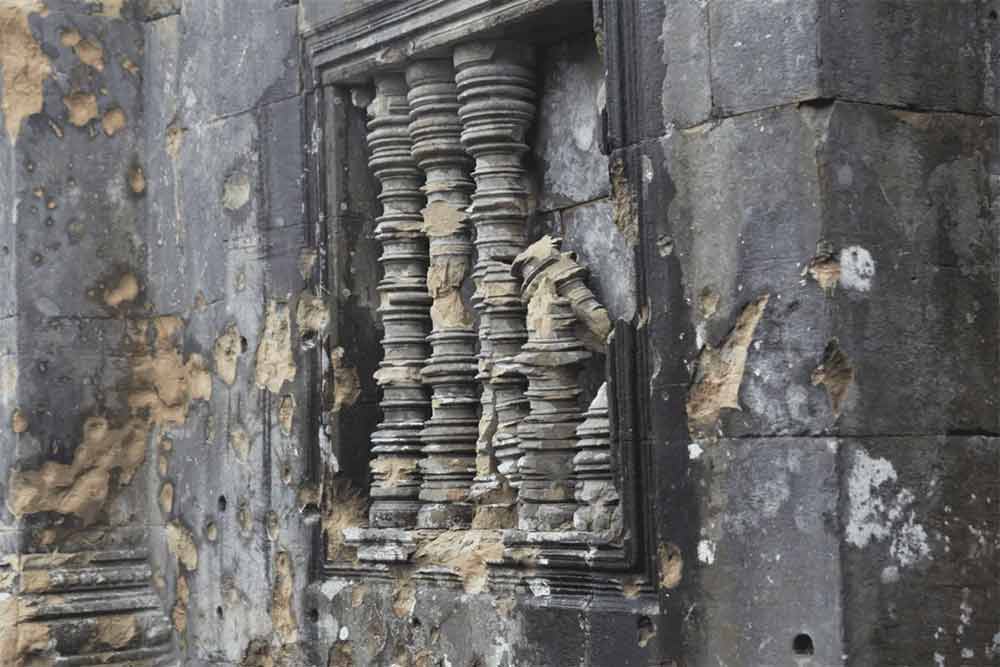 Preah Vihear Temple suffered extensive damage at the hands of Thai artillery and airstrikes. Post Staff
A response to Thailand’s statement at the 81st United Nations General Assembly
“Thailand has never sought conflict. But peace can only be built when we work together in earnest.”
— Prime Minister Anutin Charnvirakul at UNGA81, 24 September 2026
Your Excellency,
I listened carefully to your address before the United Nations. Your words about peace were well chosen, and I agree that Cambodia and Thailand must find a way to live beside one another without further bloodshed. But I was troubled by the distance between the speech delivered in New York and what Cambodian families have lived through along the border.
Thailand has acknowledged carrying out airstrikes inside Cambodia. Civilians were killed and injured, large communities were displaced, and homes and public infrastructure were damaged. The Temple of Preah Vihear still bears artillery craters, broken stonework and serious structural wounds. These facts cannot simply be set aside while Cambodia is told that it must make a more “genuine effort” for peace.
Cambodia should answer honestly for any action taken by its own forces. Thailand must do the same. Peace begins when each government is willing to face the consequences of its conduct, especially when that conduct crosses an international border.
The record cannot be rewritten from the UN podium
The record is already substantial. On December 8, 2025, Reuters reported that Thai fighter jets struck targets inside Cambodia. Thailand said the aircraft were attacking military assets; Cambodia called the strikes unprovoked aggression. Four Cambodian civilians were reported killed that day.
Reuters also quoted Thailand’s army chief of staff saying that the objective was to cripple Cambodia’s military capability for the long term. The two governments disagreed over who restarted the fighting, but there is no serious dispute that Thai air power was used across the border.
Associated Press later reported further strikes, including one near Poipet that Thailand acknowledged. Cambodia said bombs fell in a residential area and injured civilians. Thailand answered that the intended target was a rocket warehouse on the outskirts and that precautions had been taken. That difference matters and deserves an independent investigation. It does not change the basic fact that Thai aircraft dropped weapons on Cambodian soil.
The cost grew quickly. Reuters reported in January that the two rounds of fighting had caused 101 deaths and displaced more than half a million people. By May, the reported combined death toll was close to 150. The totals varied as official records were updated, but the scale was unmistakable. This was a serious armed conflict, not a small misunderstanding between border patrols.
The question of invasion and victimhood
Cambodia describes the entry of Thai aircraft, artillery fire and troops into Cambodian territory as invasion. Thailand rejects that word and says it acted in self-defence. Some stretches of the frontier remain undemarcated, and responsibility for individual clashes is contested. Those questions must be settled by evidence and law. They cannot be settled by allowing the militarily stronger side to define every disputed location and every use of force on its own terms.
This is why your presentation at the UN was so difficult for many Cambodians to accept. Thailand acknowledged the airstrikes, yet your speech placed the moral burden on Cambodia. Families who buried relatives, fled their homes or saw sacred and public places damaged will naturally ask how the country that sent fighter aircraft across the border can now speak as though it were only the victim.
I ask that question directly, but not disrespectfully. It is a question about the responsibility of a government and its armed forces. It deserves a clear answer supported by records, access for observers and an investigation trusted by both sides.
Preah Vihear is evidence carved into stone
The Temple of Preah Vihear is not an ordinary battlefield structure. It is an eleventh-century masterpiece of Khmer architecture, inscribed by UNESCO as a World Heritage Site. The International Court of Justice ruled in 1962 that the Temple is situated in territory under Cambodian sovereignty. In 2013, the Court clarified that Cambodia has sovereignty over the whole territory of the promontory of Preah Vihear.
When Associated Press journalists visited in March 2026, they saw stone debris, artillery craters, burned vegetation and serious damage across the complex. Cambodia’s Ministry of Culture and Fine Arts identified 142 damaged locations from the July fighting and another 420 from December.
It reported that all five principal gateway pavilions were damaged, three of them severely. The Associated Press also made an important qualification: an independent outside assessment had not yet confirmed the full Cambodian inventory. The honest response to that gap is not to dismiss the damage. It is to invite UNESCO and ICOMOS to examine it without restriction.
Thailand says Cambodian forces used the site for military purposes. Cambodia says Thailand deliberately attacked it. I do not ask readers to decide that dispute from political statements. I ask for an impartial examination. Whatever the final finding, a Cambodian monument of exceptional importance to the world was left badly wounded, and no responsible government should be comfortable with that outcome.
Cambodia has repeatedly chosen diplomatic and legal channels
Cambodia joined the ceasefire arrangements reached in July and December 2025, worked through ASEAN and continued to seek dialogue. The UN Secretary-General called on both governments to protect civilians, return to the ceasefire and use peaceful mechanisms. In September 2026, the two countries also entered a UN-backed conciliation process over their maritime boundary. Cambodia’s willingness to use that process is practical evidence that it is prepared to rely on law when bilateral talks reach an impasse.
Thailand has every right to submit its evidence and to protect Thai civilians. Cambodia has the same right. I do not excuse harm to Thai families, and I do not believe nationalism should be used by either government to hide uncomfortable facts. At the same time, fairness does not require us to ignore the difference in military capacity, the use of fighter aircraft or the location where bombs landed. Those details are central to accountability.
The commitments Thailand must make now
If the commitment expressed in your UN speech is genuine, Thailand should be willing to take practical steps that both countries and the international community can verify:
1. Independent investigation. Invite an impartial international fact-finding process to examine the initiation and conduct of hostilities, cross-border airstrikes, artillery use, civilian casualties and damage to civilian and cultural property.
2. Full ASEAN observer access. Permit observers to enter every sensitive location relevant to the ceasefire, including areas where troop positions, barriers, roads or military works are disputed.
3. No unilateral change on the ground. Freeze new fortifications, barriers, excavation, roadbuilding and troop expansion in disputed or undemarcated areas pending verified agreement.
4. Safe civilian return. Guarantee that displaced Cambodian families can return voluntarily, safely and with dignity, with access to their homes, farms, schools, pagodas and community property.
5. Heritage protection and restoration. Support a joint UNESCO and ICOMOS assessment of Preah Vihear and every affected heritage site, publish the findings and contribute to restoration wherever responsibility is established.
6. Accountability and reparation. Create a credible process for compensation, reconstruction and individual accountability where independent evidence establishes unlawful civilian harm or destruction.
7. Lawful border settlement. Resume effective demarcation work and accept adjudication, conciliation or other peaceful legal mechanisms where bilateral negotiations cannot resolve the dispute.
8. Transparent military communication. Publish verified incident reports, preserve operational records, maintain hotlines and prohibit provocative conduct that could manufacture a pretext for a third round of war.
A message to the Thai people
I want to be equally clear about the Thai people. This letter is not an attack on them. Cambodians and Thais share religion, culture, commerce, family connections and a long human history. Thai civilians also lost loved ones, left their homes and lived in fear. Their suffering deserves the same honesty and compassion as Cambodian suffering.
My criticism is directed at decisions of government and military command. Asking a government to explain those decisions is not hostility toward its citizens. Thailand’s dignity is not harmed by difficult questions. It is strengthened when its leaders are prepared to answer them openly. As people shaped by Buddhist traditions, both our nations should know that peace is not achieved by hiding suffering behind national pride. It begins with seeing suffering as it is and accepting responsibility where responsibility is due.
Your Excellency, the burden of proof now belongs to Thailand
You told the UN that Thailand never sought conflict. The most convincing way to support that statement is through action: welcome an investigation, give ASEAN observers access to contested areas, help displaced families return, stop unilateral changes on the ground and place unresolved claims before lawful mechanisms.
Cambodia’s calls for peace should not be interpreted as weakness. Our country knows the cost of war too well to romanticise it. Choosing restraint and international law is not surrender. It is how a smaller state protects its people and its sovereignty without condemning another generation to violence.
A speech, however accomplished, cannot by itself change the order of events. Thailand used fighter aircraft across the border; civilians suffered; communities remain displaced; and the damage to Preah Vihear is visible. Whether each action was lawful must be judged from evidence, but Thailand cannot declare itself the victim and consider the matter closed.
Cambodia is ready for peace, but it cannot be a peace built on silence. Cambodian families cannot be asked to deny what they experienced or to abandon claims to their homes and land. A durable settlement will require truth, monitored military positions, accountability where violations are established, and respect for the sovereignty of both kingdoms.
Respectfully,
Dr. Thourn Sinan
Tourism and Spiritual Professional
The views and opinions expressed are the author’s own.
-Phnom Penh Post-