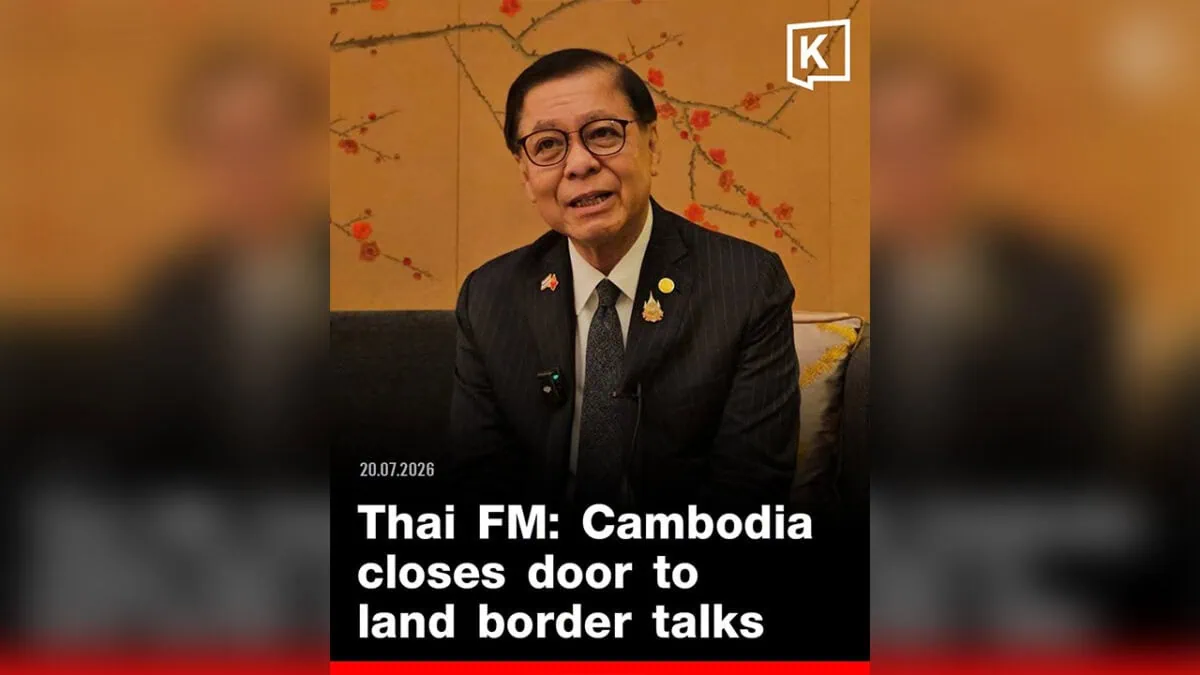
The accusation by Thai Deputy Prime Minister and Foreign Minister Sihasak Phuangketkeow that Cambodia has “closed the door to negotiations” by initiating compulsory conciliation under the United Nations Convention on the Law of the Sea, or UNCLOS, is an inversion of the facts and an attempt to shift Thailand’s own responsibility onto Cambodia. A Cambodian proverb describes this tactic perfectly: “The monkey eats the rice and smears it on the goat’s mouth.”
The official sequence of events makes clear that Cambodia was not the party that dismantled the bilateral framework for maritime negotiations. Thailand itself unilaterally terminated the 2001 Memorandum of Understanding, the agreed framework for negotiations on maritime delimitation and the management of overlapping claims.
Cambodia expressed regret over that unilateral decision and reaffirmed its commitment to resolving maritime differences peacefully and in accordance with international law.
The Party That Burned the Bridge Cannot Accuse the Other Side of Refusing to Cross It
Mr Sihasak now claims that Thailand repeatedly proposed maritime negotiations under the 2001 MOU, while Cambodia supposedly rejected bilateral dialogue. The obvious question is this: how could Cambodia continue negotiating under a framework that Thailand itself had terminated?
A state cannot tear up an agreed negotiating framework and then accuse the other party of refusing to negotiate under that same framework. The party that burned the bridge cannot stand on the opposite bank and blame the other side for failing to cross it.
The contradiction becomes even clearer because, when Thailand terminated the 2001 MOU, Thai authorities themselves stated that future maritime discussions could proceed with UNCLOS as the governing legal framework, describing it as clear, comprehensive and systematic.
Yet when Cambodia acted through that very framework, Thailand suddenly accused Cambodia of closing the door to negotiations. That is not consistency in foreign policy. It is an effort to change the narrative after the facts have become inconvenient.
UNCLOS Does Not Close the Door—It Creates a Law-Governed Path to Negotiation
Cambodia initiated compulsory conciliation under UNCLOS only after Thailand had dismantled the existing bilateral maritime framework.
Thailand subsequently accepted the notification and joined the process. Thailand has also acknowledged that UNCLOS conciliation is non-binding and is intended to assist the parties in reaching a mutually acceptable solution.
How, then, can Thailand participate in the process while simultaneously claiming that the same process represents a rejection of dialogue?
Compulsory conciliation under UNCLOS is not a judicial proceeding that imposes a binding judgment on either party. The conciliation commission hears both sides, examines the legal and factual issues and proposes possible terms for a peaceful settlement. Its recommendations are not binding unless the parties agree to them.
The term “compulsory” refers to participation in the procedure, not compulsory acceptance of its outcome. In practical terms, UNCLOS conciliation is negotiation supported by neutral conciliators, governed by agreed procedures and grounded in international law. It gives both parties an orderly, credible and time-bound diplomatic process.
Using international law is not a rejection of diplomacy. It is a means of ensuring that diplomacy is conducted with discipline, fairness and accountability rather than being delayed indefinitely or controlled unilaterally by one party.
The JBC Governs the Land Boundary; UNCLOS Governs the Maritime Boundary
Mr Sihasak also claimed that Cambodia was being contradictory by calling for meetings of the Joint Boundary Commission, or JBC, on land demarcation while pursuing UNCLOS conciliation on maritime delimitation. There is no contradiction whatsoever.
The JBC deals with the survey and demarcation of the land boundary under the 2000 Memorandum of Understanding. UNCLOS, by contrast, governs questions relating to maritime delimitation. These are two distinct disputes, governed by different legal instruments and addressed through different mechanisms.
Continuing the JBC process for the land boundary while pursuing UNCLOS conciliation for the maritime boundary is entirely logical, lawful and consistent. Both are peaceful mechanisms intended to prevent confrontation and produce negotiated solutions. The real contradiction lies in Thailand’s position.
Thailand says it has not closed the door to negotiations, yet in the same breath it says that formal talks cannot resume, that technical discussions will be difficult and that progress must wait until Thailand’s broader political and security conditions are satisfied.
That is not an open door. It is a door that Thailand claims is open while continuing to hold the key and refusing to unlock it.
The appointment of a new Thai JBC chair and members is merely an internal administrative step. It has no practical meaning unless Thailand agrees to convene meetings, deploy joint technical teams and resume the agreed work of boundary survey and demarcation. An appointment without a meeting date is not negotiation.
Confidence-Building Cannot Be Used as an Excuse for Indefinite Delay
Landmine clearance, transnational scam networks and other security concerns are serious matters. They should be addressed through their appropriate technical, law-enforcement and security mechanisms.
But they cannot legitimately be turned into preconditions for suspending land-boundary negotiations. In fact, the resumption of JBC meetings and joint technical work would help reduce uncertainty, prevent misunderstandings and lower the risk of further incidents. Boundary negotiations are not a reward to be granted only after complete trust has been restored. They are one of the principal means through which trust is restored.
If Thailand insists that full confidence must exist before technical negotiations can resume, then talks can be postponed indefinitely. Vague accusations of “provocation” or “lack of trust” would effectively give Thailand a unilateral veto over bilateral obligations.
Cambodia has repeatedly called for the resumption of JBC meetings and the deployment of joint survey teams. If Thailand truly has not closed the door, it should set a date, send its technical representatives and begin the work already agreed by both countries. Instead, Thailand says negotiations remain “difficult” while attempting to place responsibility for that difficulty on Cambodia.
Who Actually Closed the Door?
The sequence of events is straightforward. Thailand terminated the 2001 maritime MOU. Thailand stated that UNCLOS could serve as the applicable legal framework. Cambodia initiated a peaceful conciliation process under UNCLOS. Thailand accepted the process and agreed to participate. Cambodia continued calling for the JBC to resume work on the land boundary.
Thailand then declared that JBC talks could not meaningfully proceed until a range of additional political and security conditions had been met. These facts do not show Cambodia closing the door. They show Cambodia refusing to remain dependent on a door that Thailand can open, close or lock whenever it chooses.
Cambodia has chosen a process governed by law, supported by neutral conciliators and directed towards a peaceful settlement. That is not a rejection of dialogue. It is responsible diplomacy. If Thailand genuinely wishes to prove that negotiations remain open, it should take three concrete steps.
First, it should participate in the UNCLOS conciliation process in good faith. Second, it should convene the JBC without attaching unrelated political preconditions. Third, it should stop linking progress on the land boundary to separate maritime, criminal or security questions that already have their own mechanisms. Negotiations without rules can become a tool for delay.
Negotiations grounded in law create accountability and a realistic path towards resolution.
Public statements cannot rewrite the record. The party that terminated the maritime framework, delayed the land-boundary process and imposed new conditions cannot credibly accuse Cambodia of closing the door. That is precisely why the Cambodian proverb is so appropriate:
The monkey eats the rice—and then smears it on the goat’s mouth.
Roth Santepheap is a geopolitical analyst based in Phnom Penh. The views expressed are his own.
-Khmer Times-