Regarding the Thai Side’s Claims Concerning the Use of the Compulsory Conciliation Mechanism under the United Nations Convention on the Law of the Sea (UNCLOS) July 21, 2026
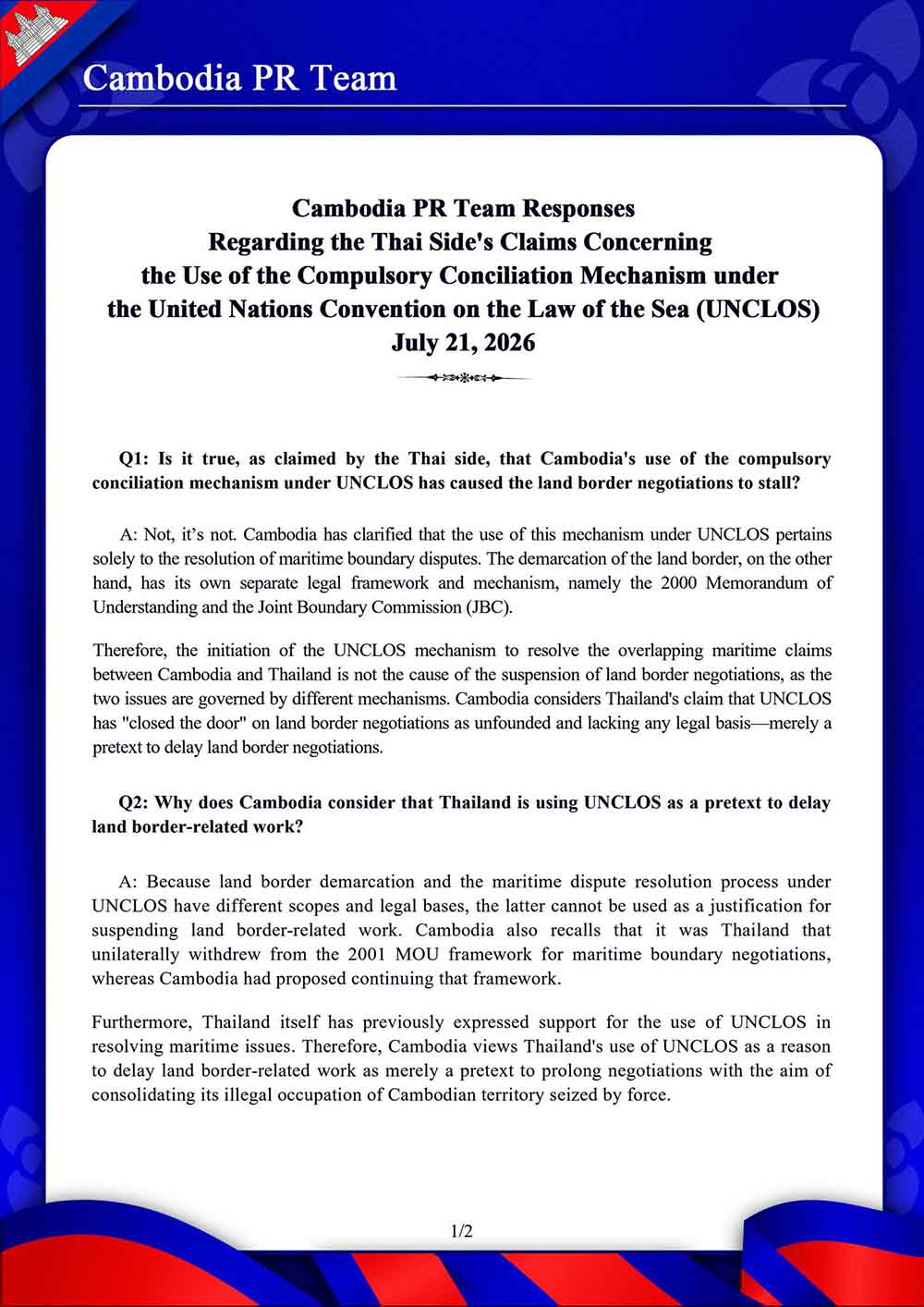
Cambodia PR Team Responses
Regarding the Thai Side’s Claims Concerning the Use of the Compulsory Conciliation Mechanism under the United Nations Convention on the Law of the Sea (UNCLOS)
July 21, 2026
Q1: Is it true, as claimed by the Thai side, that Cambodia’s use of the compulsory conciliation mechanism under UNCLOS has caused the land border negotiations to stall?
A: Not, it’s not. Cambodia has clarified that the use of this mechanism under UNCLOS pertains solely to the resolution of maritime boundary disputes. The demarcation of the land border, on the other hand, has its own separate legal framework and mechanism, namely the 2000 Memorandum of Understanding and the Joint Boundary Commission (JBC).
Therefore, the initiation of the UNCLOS mechanism to resolve the overlapping maritime claims between Cambodia and Thailand is not the cause of the suspension of land border negotiations, as the two issues are governed by different mechanisms. Cambodia considers Thailand’s claim that UNCLOS has “closed the door” on land border negotiations as unfounded and lacking any legal basis—merely a pretext to delay land border negotiations.
Q2: Why does Cambodia consider that Thailand is using UNCLOS as a pretext to delay land border-related work?
A: Because land border demarcation and the maritime dispute resolution process under UNCLOS have different scopes and legal bases, the latter cannot be used as a justification for suspending land border-related work. Cambodia also recalls that it was Thailand that unilaterally withdrew from the 2001 MOU framework for maritime boundary negotiations, whereas Cambodia had proposed continuing that framework.
Furthermore, Thailand itself has previously expressed support for the use of UNCLOS in resolving maritime issues. Therefore, Cambodia views Thailand’s use of UNCLOS as a reason to delay land border-related work as merely a pretext to prolong negotiations with the aim of consolidating its illegal occupation of Cambodian territory seized by force.
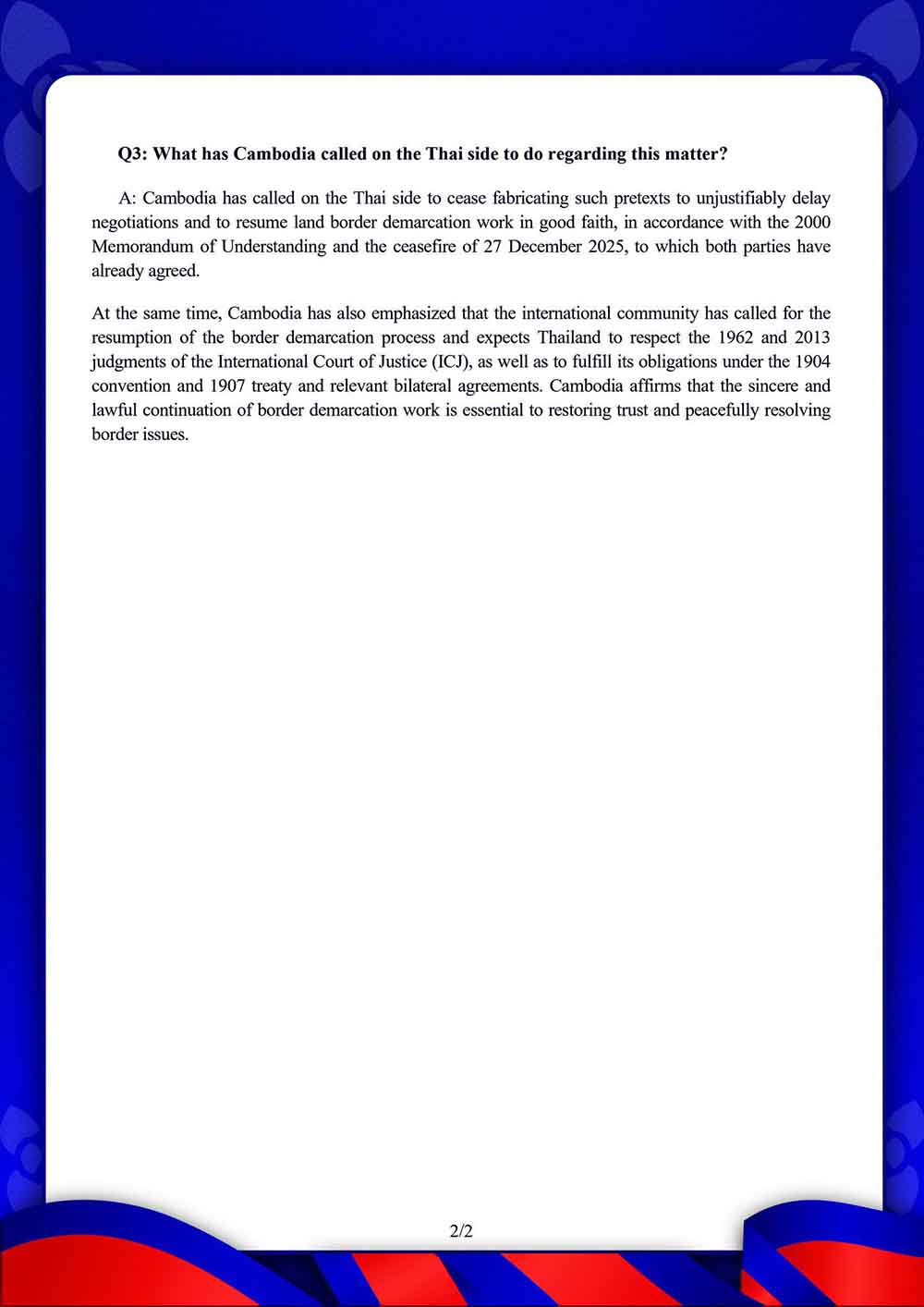
Q3: What has Cambodia called on the Thai side to do regarding this matter?
A: Cambodia has called on the Thai side to cease fabricating such pretexts to unjustifiably delay negotiations and to resume land border demarcation work in good faith, in accordance with the 2000 Memorandum of Understanding and the ceasefire of 27 December 2025, to which both parties have already agreed.
At the same time, Cambodia has also emphasized that the international community has called for the resumption of the border demarcation process and expects Thailand to respect the 1962 and 2013 judgments of the International Court of Justice (ICJ), as well as to fulfill its obligations under the 1904 convention and 1907 treaty and relevant bilateral agreements. Cambodia affirms that the sincere and lawful continuation of border demarcation work is essential to restoring trust and peacefully resolving border issues.