Thai reaction to UNCLOS seen as negotiating tactic as maritime conciliation process is extended
 Thai reaction to UNCLOS seen as negotiating tactic as maritime conciliation process is extended
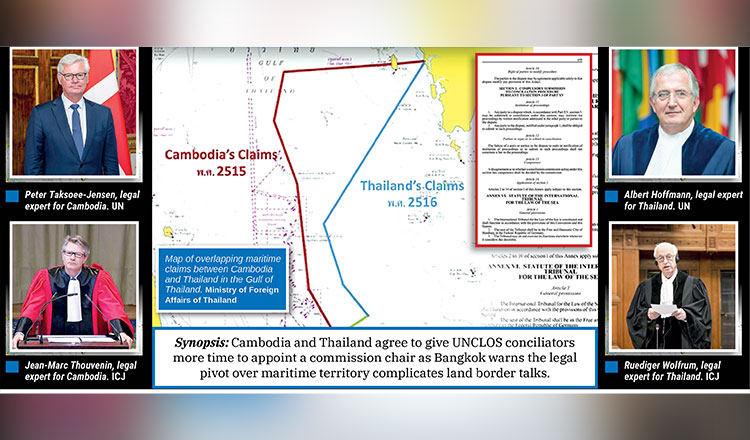
Synopsis: Cambodia and Thailand agree to give UNCLOS conciliators more time to appoint a commission chair as Bangkok warns the legal pivot over maritime territory complicates land border talks.
Cambodia and Thailand have agreed to allow more time for four independent conciliators appointed under the United Nations Convention on the Law of the Sea (UNCLOS) to choose the chair of the Conciliation Commission.
At the same time, Thailand has warned that Phnom Penh’s push to resolve overlapping maritime claims through the legal process has complicated land border negotiations.
Cambodia’s Ministry of Foreign Affairs and International Cooperation on July 19 said the conciliators had asked for more time to carefully consider the appointment, with both governments agreeing to the proposal.
“The four independent conciliators have proposed spending additional time to carefully consider who should be appointed Chairperson of the Conciliation Commission. Cambodia and Thailand have both agreed to this course,” the ministry spokesperson said.
Cambodia and Thailand have each appointed two internationally recognised legal experts to serve as conciliators under the UNCLOS framework.
The four appointed experts – Professor Jean-Marc Thouvenin and Peter Taksoee-Jensen for Cambodia, and Judges Ruediger Wolfrum and Albert Hoffmann for Thailand – act as independent, neutral arbiters rather than government advocates. Their immediate task under Article 3 of UNCLOS Annex V is to jointly choose a fifth expert to serve as the chairperson.
Cambodia initiated compulsory conciliation proceedings under UNCLOS on June 2 after the Thai cabinet unilaterally terminated the 2001 Memorandum of Understanding (MoU 2001) on May 5, which governed the two countries’ overlapping maritime claims.
The ministry stressed that the extension will not affect the timeline for the proceedings.
“The additional time requested by the conciliators to consider the chairperson’s appointment is modest and entirely appropriate given the significance of the appointment and the proceedings as a whole,” the spokesperson said. “It will have no effect on any prescribed timeline or procedural step.”
Speaking in Beijing yesterday, Thailand’s Foreign Minister Sihasak Phuangketkeow said Cambodia’s decision to pursue compulsory conciliation undermined bilateral trust and made negotiations over the land border more difficult.
“At this point, it has effectively closed the door to discussions on the land border. That makes things much more difficult,” Sihasak said.
He said Cambodia should not have pursued compulsory conciliation before bilateral negotiations were exhausted, maintaining that border issues should ultimately be resolved directly between the two neighbouring countries.
“We appreciate China’s goodwill, but this is a matter that Thailand and Cambodia must discuss directly,” Sihasak added.
Pou Sothirak, a retired diplomat and senior adviser to the Cambodian Centre for Regional Studies, said Thailand’s reaction should be viewed as a negotiating tactic rather than a rejection of dialogue.
“I think it’s more of a tactic,” Sothirak said. “I think Thailand also wants peace. Thailand wants to have a solution to the border conflict, but one that is to Thailand’s advantage.”
Sothirak said Thailand is seeking to strengthen its negotiating position because Cambodia is winning greater global support after initiating the UNCLOS process.
“The cancellation of the MoU gave Cambodia no choice but to go to compulsory conciliation, which is the most honourable way, the most acceptable way,” Sothirak said. “Cambodia told Thailand not to cancel it, to have bilateral talks. But because of internal Thai politics, they had to cancel it.”
According to Sothirak, bilateral discussions could still take place within the UNCLOS conciliation process if Thailand is sincere.
“If Thailand really wants to do it bilaterally, it should go to compulsory conciliation and talk to Cambodia, reassure Cambodia that this thing can be solved peacefully with some give and take,” he said.
He praised the prime minister’s continued commitment to dialogue.
“I have to congratulate Prime Minister Hun Manet, who has done exceptionally well in negotiating or in sending out messages to Thailand that even if there’s one percent of bilateral or diplomatic talk, the Prime Minister of Cambodia would opt to also exercise that choice,” Sothirak said.
He said Thailand had weakened its own position by terminating the MoU 2001.
“Thailand wants to dictate the process, but it made a strategic error by cancelling the MoU 2001. That’s why Cambodia turned to compulsory conciliation.”
He expressed concern over reports that Thailand wishes to focus solely on maritime delimitation rather than joint development of the overlapping claims area.
“Another message that I read from the Thai side is that they only want to delimitate the whole OCA. They do not want to talk about joint development. This is something that I would want to see happen, but it would be very complicated.”
Although the conciliators’ recommendations are not legally binding, Sothirak said the process is still the best opportunity for both countries to reach a lasting settlement.
“The optimum solution is that both sides agree and let the process finish. Whatever they can agree bilaterally during compulsory conciliation, it will become a treaty. A treaty has legal value,” he added.
He urged both governments to remain committed to the process. “The train has left the station. You need to reach the destination and see what happens. To get a good result, it means compromising, understanding and give and take.”
Despite the non-binding nature of the process, Sothirak is “cautiously optimistic”.
“I hope for both countries to work smoothly together with understanding. Don’t create any obstacles, don’t look for differences, but come together in good faith so that both countries can reach agreement.”
-Khmer Times-