Thailand Cannot Redraw Borders with Guns and Maps
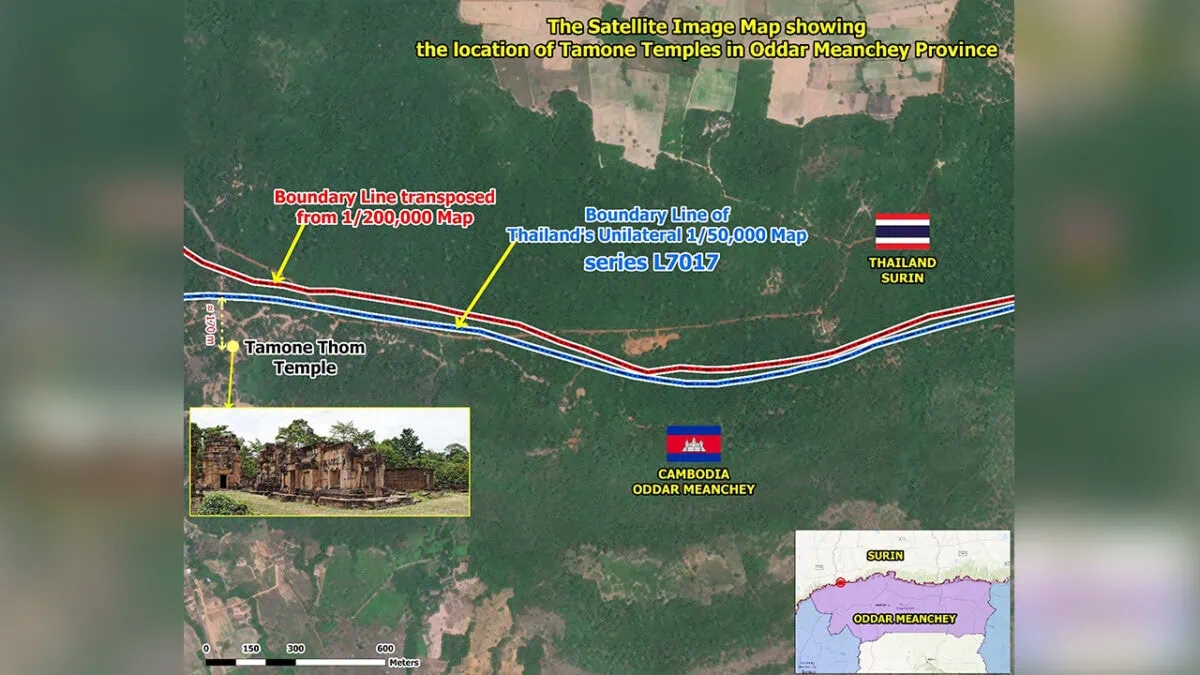 - Both French colonial era-maps and Thailand’s unilaterally drawn ones show that Tamone Thom Temple is located within Cambodia. SSBA
#opinion
The international legal order rests on a simple but indispensable principle: no State may acquire territory through the threat or use of force.
This rule is not merely a diplomatic aspiration. It is a binding principle of modern international law, embedded in the Charter of the United Nations and reinforced through decades of international practice and judicial decisions. It exists for one reason: to ensure that borders are determined by law – not by military power. That principle is now being tested along the Cambodia-Thailand border.
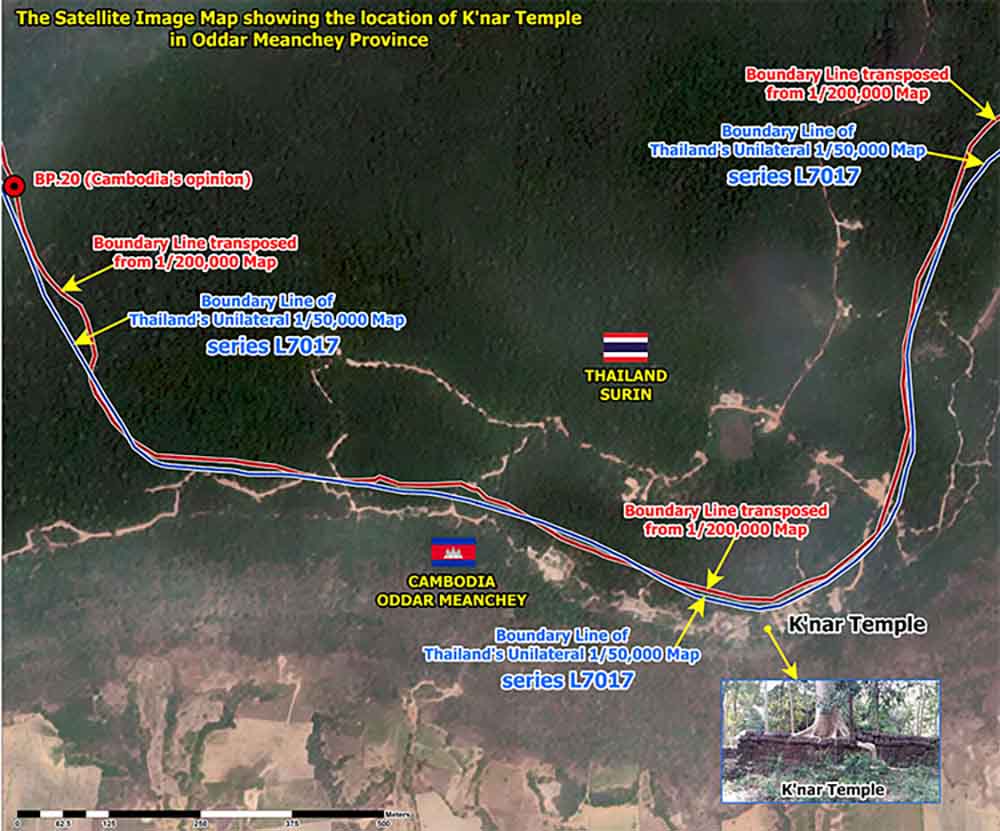
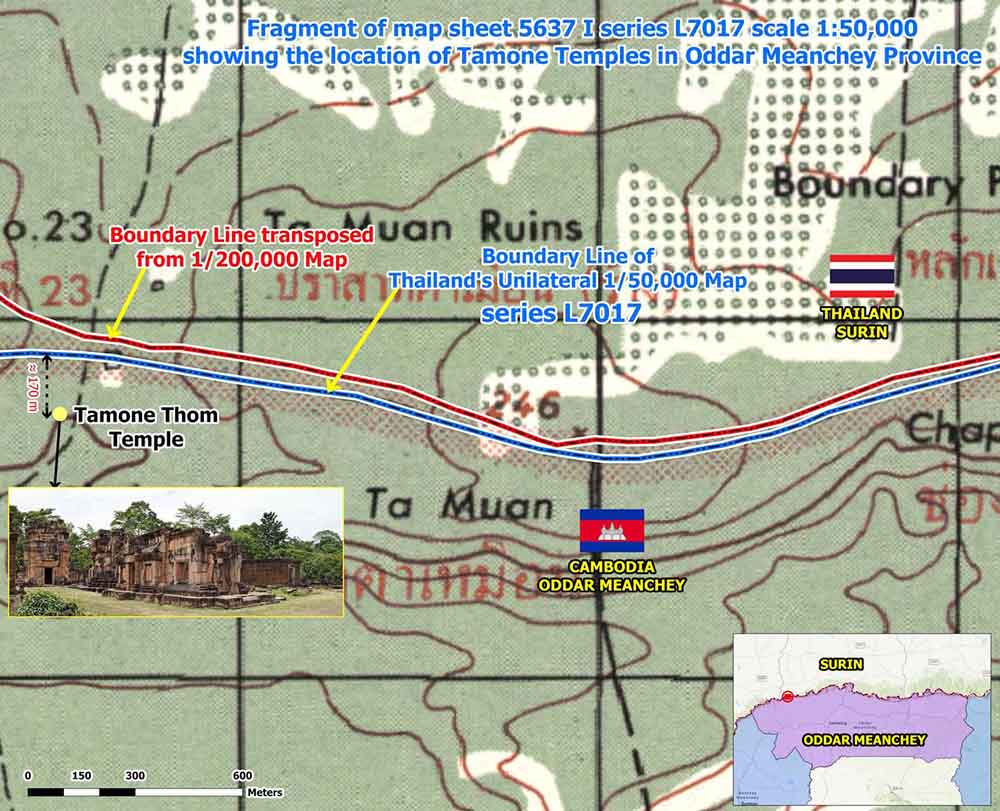
Recent technical presentations by Cambodia’s State Secretariat of Border Affairs have demonstrated, through historical treaty maps, internationally recognised boundary documents, and even Thailand’s own official cartographic records, that Khnar and Tamone Thom Temples and other illegal occupied sites by Thai army lie within Cambodian territory. The presentations further indicate that areas currently occupied by Thai military forces are likewise situated on the Cambodian side of the internationally recognised boundary. These findings raise a troubling question.
Based on publicly available information and continuing developments on the ground, it appears that the Thai military is attempting to establish a new boundary line designed to incorporate into Thailand the areas it currently occupies through military action. If that assessment proves correct, the implications extend far beyond the Cambodia–Thailand border.
It would represent an attempt to replace treaty-based boundaries with military faits accomplis. International law leaves no room for such an approach.
Whether Thailand relies on its unilateral L7017 military map or produces new maps depicting an expanded boundary, none can alter Cambodia’s sovereignty. Maps created unilaterally by one State do not possess independent legal force. They cannot amend treaties, revise internationally recognised boundaries, or extinguish the territorial rights of another sovereign State.
Maps may record a legal boundary. They cannot create one.
This distinction has long been recognised by the International Court of Justice. In boundary disputes, maps may serve as evidence when they reflect legal agreements or established practice, but they cannot independently create territorial title where none exists. Sovereignty derives from law, not from cartography.
The same principle applies with even greater force when maps seek to validate territory obtained through military occupation.
If a State could seize territory by force and subsequently publish maps depicting the occupied land as its own, every international boundary would become vulnerable to unilateral revision. The prohibition on the acquisition of territory by force would become meaningless. That is precisely why international law rejects such attempts.
Since 1945, the international community has consistently upheld the principle that territorial acquisition resulting from aggression or military occupation shall not be recognised as lawful. This doctrine protects all States, particularly smaller nations whose security depends upon respect for international law rather than military superiority. Cambodia’s position has remained consistent.
Cambodia has never recognised any alteration of its internationally recognised boundary through the use of force. It continues to advocate peaceful settlement through bilateral mechanisms, technical boundary demarcation, internationally recognised treaty maps, and international law. Cambodia has repeatedly demonstrated its preference for legal and diplomatic solutions over military confrontation.
The responsibility now rests with Thailand.
If Thailand believes its claims possess legal merit, those claims should be tested through lawful mechanisms—not enforced through prolonged military occupation or reinforced by unilateral cartography. International law provides numerous peaceful avenues for resolving boundary disputes. Resorting to new maps drawn around occupied territory is not one of them.
History offers countless examples of military occupations that ultimately failed to establish lawful sovereignty. Temporary control over land has never been synonymous with legal title.
The lesson is clear. No army can create sovereignty simply by remaining in place. No government can rewrite international boundaries by issuing new maps. No unilateral act can erase treaties or override the rules upon which peaceful relations between States depend. Ultimately, this is not only Cambodia’s concern.
It is a question of whether the international community will continue to uphold one of the most fundamental principles established after the devastation of the Second World War: that international borders cannot be changed through force.
If that principle is weakened in one region, it is weakened everywhere. Borders must continue to be determined by law, not by military occupation; by treaties, not by unilateral maps; and by justice, not by power. That is the standard Cambodia continues to defend. It is also the standard the world should insist upon.
Roth Santepheap is a geopolitical analyst based in Phnom Penh. The views expressed are his own.
-Khmer Times-