Governing from a conference room or the field: Is the Cabinet ‘over-meeting’?
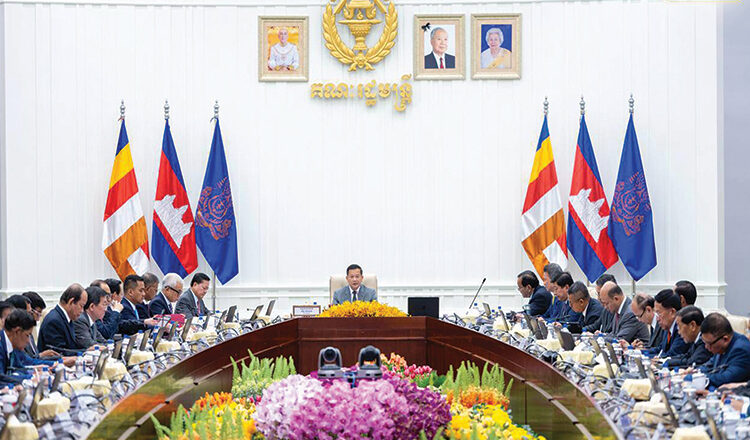 Prime Minister Hun Manet (C) chairs a meeting in Phnom Penh. STPM
#opinion
In the Cabinet meeting room, an important pattern has quietly emerged. A casual scroll through official Facebook pages reveals a recurring visual: the main cabinet meeting room is filled with nearly a hundred minister-level delegates; the observation room is packed with hundreds more secretary-of-state level delegates; and on the 25 provincial governors’ Facebook pages, hundreds more are in attendance.
On any given day, a single Cabinet gathering can bring together between 200 and 500 public servants.
This massive, collaborative effort is an undeniable testament to the government’s commitment to thoroughness and inclusion. Yet, as these high-level sessions routinely stretch past the five-hour mark—regardless of whether the agenda covers a national emergency or a routine administrative update—it is worth pausing to ask a fundamental question: Is the Cabinet “over-meeting”? Is this exhaustive approach to decision-making truly optimising the state’s most valuable resource: its leadership human capital?
This inquiry is not an argument about work-life balance. Rather, it is a constructive look at how executive efficiency, specialised leadership, and long-term national endurance intersect.
Cambodia is navigating a pivotal transition period. Success in the generational effort requires a sharp focus on governance and a deliberate strategy to preserve the physical and mental stamina of the leaders guiding the nation.
The architecture of decision-making
There is an old administrative maxim that equates long meetings with important meetings. However, when every single discussion becomes an endurance test, it becomes difficult to separate everyday operational choices from critical state decisions.
The practice of “everything is important, and everyone is important” can inadvertently dilute institutional focus.
A Cabinet meeting should ideally function as a high-level, decisive action or decision-making body. It is at its best when operating as a platform for swift, final decision-making, rather than a theatre for long debates, ministerial disagreements, or seminars for intellectual displays.
When routine, non-crisis topics receive the same five-hour deep dive, the executive agenda can lose clarity and become blurred.
To protect the core purpose of the Cabinet meeting, the government could adopt stricter procedural boundaries. Having timekeepers, strict agenda keepers, and clear participant selectors would streamline these vital meetings.
High-level agendas deserve all the time they need to be resolved, but they should have clear boundaries. By focusing attendance on essential personnel and delegating broader updates to separate informational briefs, the Cabinet can transition away from long debates and move towards rapid, executive actions.
Sustaining the health of the state
At its core, this perspective comes from a place of deep respect and care for the well-being of Cambodia’s leadership team.
True statecraft is an endurance race. The classic Chinese idiom captures this reality perfectly: “Distance tests a horse’s stamina; time reveals a person’s heart.” Yet, intense tests of physical and mental endurance are best reserved for genuine crises. Applying crisis-level pressure to everyday administrative routines risks wearing down leadership energy unnecessarily.
To keep the body in good health is a duty, otherwise we shall not be able to keep our mind strong and clear. Physical and mental energy are finite resources that cannot be taken for granted. A weak mind or an exhausted body cannot effectively serve the state.
This health balance is especially critical during Cambodia’s current leadership transition. While the younger generation of leaders brings great energy and enthusiasm to their roles, senior leaders must maintain their health and stability. Their physical well-being ensures they can comfortably remain in place to mentor, advise, and pass down institutional wisdom to the new generation.
Protecting the health of these key leaders from the toll of endless meetings is a practical strategy for long-term political stamina.
The cost of the empty field
Beyond the walls of the meetings in the capital city of Phnom Penh, the habit of prolonged meetings can create an unintended disconnect in the field.
When public officials spend their days preparing for consecutive meetings and sitting through hours of cross-sector presentations, they have less time to dedicate to their own portfolios. This dynamic can lead to a loss of specialisation. Instead of deeply understanding their specific sectors, leaders risk becoming professional meeting participants, tied to a desk in Phnom Penh.
This challenge is most apparent among subnational leaders, particularly provincial governors. By definition, the vital work of a provincial governor does not happen in the capital or in the Cabinet meeting room; it happens on the ground within local communities.
Currently, these sub-national leaders are caught in a demanding cycle: travelling to Phnom Penh for central meetings, and then attending a series of sectoral meetings held by individual ministries.
This trend is clearly visible on digital platforms. The social media feeds of many provincial and district governors are dominated by images of formal meetings, administrative ceremonies, or accompanying high-level delegations. These events are frequently presented as major professional achievements.
In contrast, it has become rare to see images of these same leaders working in the mud, visiting local farms, or sitting down with their constituents. When leaders are too busy travelling up the chain of command to meet with higher officials, they naturally have less time to go down to the community level to meet the people. The public service can unintentionally shift towards serving the internal hierarchy rather than the public.
Towards an agile governance model
The path forward does not require reducing collaboration, but rather refining how that collaboration takes place. By introducing structural limits on meeting lengths and moving towards a “less is more” approach for attendance, Cambodia can build a more agile governance model.
Subnational leaders should be systematically unburdened from long central meetings that do not directly impact their local jurisdictions. They need to be given the structural freedom to return to their communities.
When the success of a minister or governor is measured by the tangible improvements in their sector rather than the hours they spend in a briefing room, the entire nation benefits.
Streamlining these processes protects the health and sharpens the focus of top leaders. More importantly, it ensures that local officials can spend their time where it matters most: on the ground, listening to the people, and driving development from the grassroots up.
-Khmer Times-