Thailand’s identity crisis rooted in denial of Khmer heritage
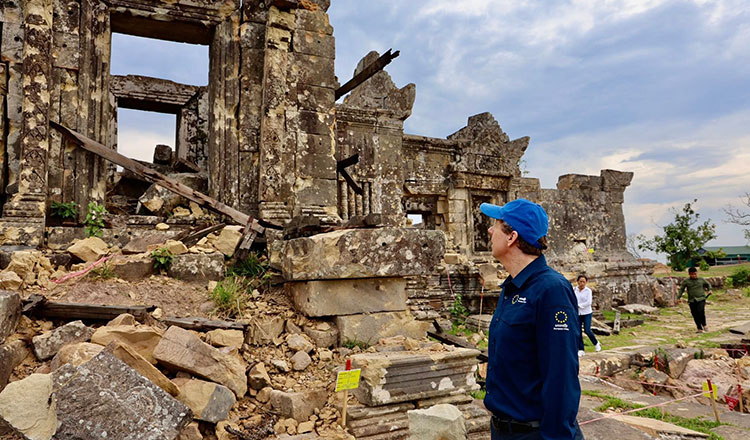 EU Ambassador to Cambodia Igor Driesmans surveys the damage done to Preah Vihear Temple by armed conflict on May 7. European Union in Cambodia
#editorial
This article focuses on two points: the observation that Thailand is having a lasting identity crisis that causes it to downplay its borrowing from Khmer culture and heritage, and the repeated pattern of the Thai establishment leveraging this identity crisis for political gain or control.
The Thai identity crisis in the context of Khmer heritage is a well-documented subject in Southeast Asian studies. Scholars have framed this as a disconnect between Thailand’s historical reality—when the Khmer Empire ruled much of present-day Thailand—and the modern Thai nationalist project to present “Thainess” as a unique, indigenous evolution.
Michael Wright wrote extensively on the “Khmer-ness” of early Ayutthaya. He argued that the early Thai elite were heavily Khmerised in their language, court rituals, and governance. His work suggests that downplaying this link is a modern nationalist necessity to maintain the myth of a pure Thai origin.
Many scholars argue that the Thai state historically engaged in a process of Siam-isation, rebranding Khmer heritage as Thai to strengthen national unity.
Thongchai Winichakul, in his seminal work “Siam Mapped: A History of the Geo-Body of a Nation (1994)”, argues that modern Thai identity was constructed in response to colonialism. By creating a geo-body, Thailand had to define what was Thai and what was other. Khmer heritage within Thai borders was often integrated into the national narrative as ancient Thai rather than acknowledged as part of a separate Khmer legacy.
Maurizio Peleggi, in “Lords of Things: The Fashioning of the Siamese Monarchy’s Modern Image (2002)”, discusses how the Thai elite used archaeology and heritage to legitimise the monarchy, often framing Angkor-style ruins in Thailand (like Phimai or Phanom Rung) as part of a continuous lineage of Thai kingship.
Thai education systems also emphasise a break from Khmer rule (liberation) rather than a cultural continuation. Nationalist historiography often relies on a Golden Age narrative, which is for Thailand the Sukhothai period.
While Thai textbooks celebrate Sukhothai as the first Thai kingdom that liberated itself from Khmer rule, archaeological evidence shows a deep and continuing synthesis of the two cultures long after the political split.
It is an identity crisis that has led to armed conflicts. The dispute over the Preah Vihear Temple is the most cited example of how heritage becomes a tool for nationalist mobilisation.
Pavin Chachavalpongpun, in his research on Thai-Cambodian relations, explores how Thai domestic politics used the defence of heritage as a way to attack political opponents. By claiming Khmer-style temples as Thai, politicians reinforce a national identity that is distinct from and superior to its neighbors. Puangthong Pawakapan, in “State and Uncivil Society in Thailand at the Temple of Preah Vihear (2013),” details how the crisis of identity is manufactured.
The Thai state’s difficulty in accepting the 1962 ICJ ruling (which awarded the temple to Cambodia) stems from a national identity that cannot reconcile the so-called lost territory that it has historically rebranded as Thai, even if the territory was originally Cambodia before the Thai invasions, occupations and annexations.
In recent years, this identity crisis has moved to social media, where cultural wars over the authenticity of ancient martial arts, Kun Khmer versus Muay Thai, traditional dress (sbai), and food have intensified.
The next issue is about how the Thai elite establishment manipulates thr identity crisis for political gain.
The Thai elite—comprising the monarchy, military, and conservative bureaucracy—utilises the tensions over Khmer heritage as a sophisticated tool for domestic political legitimacy and mass mobilisation. The manipulation follows several key strategic patterns:
1. Diversion from domestic crises
The most common strategic distraction is the use of the “Khmer threat.” When the elite face challenges to their authority (such as the political unrest of the 2000s and 2010s), they often amplify nationalist disputes to unify the public against an external enemy.
Conservative factions (the People’s Alliance for Democracy, or “Yellow Shirts”) used the UNESCO listing of the Preah Vihear Temple in 2008 to attack the pro-Thaksin government, accusing them of selling the nation. This effectively turned a complex archaeological/legal issue into a litmus test for Thainess and loyalty to the establishment.
2. The ‘Defender of the Realm’ narrative
By framing Khmer heritage within Thailand as Thai and characterising Cambodian claims as encroachments, the military and monarchy reinforce their role as the ultimate protectors of national sovereignty.
Conflicts over border heritage justify high military budgets and a central role for the army in civilian life, thus giving the military more legitimacy.
Thailand also continues to link royal patronage to ancient temples. The Fine Arts Department often focuses on the restoration of Khmer-style sites, like Phimai, to showcase the glory of the Thai kingdom, subtly rewriting history to place current institutions as the natural heirs to ancient civilisational power.
3. Moral superiority and ‘civilising’ historiography
The Thai establishment also promotes a narrative that portrays Thailand as a more advanced or civilised successor to the Angkorian empire.
Here, Thailand uses the vassal state myth to frame Cambodia as a former vassal, implying that its culture is a derivative or lesser version of the Thai evolution. This hierarchy allows the elite to claim Khmer cultural elements (like court language or dance) while simultaneously looking down on the modern Cambodian state as an inferior neighbour.
4. Creating an ‘in-group’ v ‘out-group’
Identity crisis also manifests in the manipulation of behaviour to discriminate between who is a patriotic Thai and who is not.
For instance, by defining Thainess (Khwam-pen-Thai), anyone who questions the official narrative regarding Khmer heritage or suggests a shared history is often labelled as unpatriotic or selling out to Cambodia. This effectively silences academic dissent and forces public discourse into a narrow, state-sanctioned box.
As Thailand continues to struggle with its identity, tensions often erupt when internal disunity surges within Thailand’s social, cultural and political spheres. And Thailand uses this eternal crisis as a weapon of convenience to control its mass population through, among others, creation of historical narratives and education that twists history via the national curriculum.
Nonetheless, historical longevity is based on academic integrity with proven impartial evidence, not through emotions, creations, coercions and suppressions.
Ultimately, the victims are the Thai people, who will continue to struggle with an identity crisis because they fail to acknowledge their Khmer heritage. They will continue to fight among themselves or with Khmer people, sometimes in armed conflict, for the truth that does not belong to them.
-Khmer Times-