‘Chameleon Diplomacy’ and the Deadlock in the Cambodia-Thailand Overlapping Claims Area Dispute
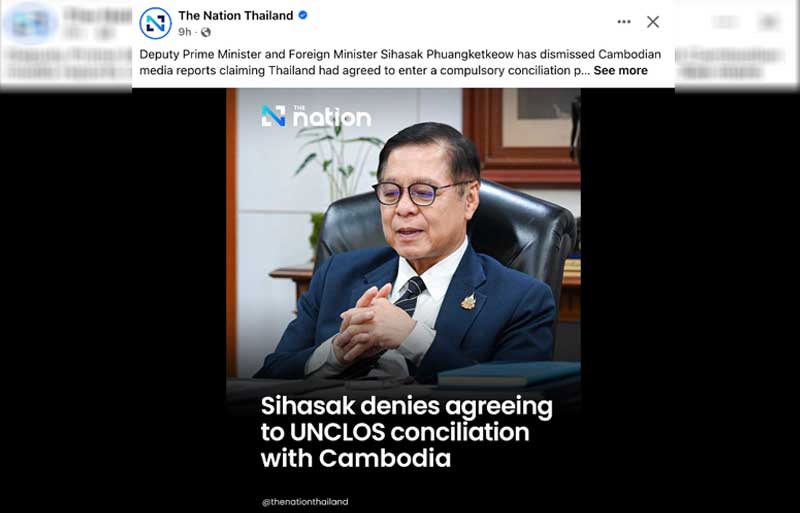 Thai foreign minister Sihasak Phuangketkeow denied that his nation agreed to UNCLOS mediation, despite the Thai prime minister announcing that it would engage. ANN/The Nation
On May 11, the diplomatic landscape between Cambodia and Thailand encountered renewed controversy after Bangkok publicly denied reports that it had agreed to the use of the “Compulsory Conciliation” mechanism under the UN Convention on the Law of the Sea (UNCLOS). This denial came immediately after the Cambodian head of government explicitly confirmed to the Thai prime minister, during a trilateral meeting in the Philippines last week, that Cambodia would rely on the legitimacy of this international mechanism to resolve the Overlapping Claims Area (OCA) dispute.
The Art of ‘Chameleon Leadership’
This sudden reversal of position and immediate denial is no coincidence; rather, it is a stark reflection of the “Chameleon Diplomacy” and leadership style characteristic of Thai leaders, particularly figures like Anutin. On various platforms, he frequently delivers eloquent speeches emphasizing honesty, sincerity and trust-building with neighbouring countries. However, in stark contrast to such diplomatic rhetoric, these last-minute manoeuvres reveal an ugly truth: he operates as a politician who constantly shifts colours, lying to and luring the Thai public solely to serve his own domestic political agenda.
Such shape-shifting tactics serve as a smokescreen to obscure a fundamental weakness and a glaring lack of genuine political will to seek a legitimate, rules-based international resolution.
Diplomatic Farce: The ‘Joker’ on the International Stage
The Thai government’s attempt to backtrack reached a new pinnacle of absurdity when its spokeswoman scrambled to clarify that the high-level exchange between Anutin and the Cambodian prime minister in Cebu did not constitute an “official discussion” or a formal diplomatic notification.
Such a flimsy defence effectively reduces Thai statecraft to a farce. It sets a rather comical, yet embarrassing, precedent for future international engagements: the next time Anutin steps foot outside of Bangkok, foreign dignitaries might be forced to pause and verify his operational capacity before even initiating a dialogue. They will literally have to ask him point-blank, “Are you speaking to us today as Anutin the joker, or are you actually representing the authority of the Thai Prime Minister?”
When a nation’s highest-level bilateral interactions are casually downgraded to unofficial banter the moment they become politically inconvenient, it completely strips Bangkok of its diplomatic credibility.
The Limits of Deception Against International Law
The critical question then arises: can Thailand’s deceptive posturing and outright denials actually stall the machinery of Compulsory Conciliation? From a strict international law perspective, the answer is a resounding no. Under the framework of UNCLOS, the very nature of compulsory conciliation is designed specifically to bypass such diplomatic deadlocks. It can be unilaterally initiated by one State Party even if the opposing State refuses to participate, objects to the process or publicly denies any agreement. The conciliation commission can still be constituted, and proceedings can move forward to issue a formal, internationally recognised report.
However, Bangkok’s political manoeuvring suggests a calculated — albeit legally flawed — belief that dragging their feet and leveraging public deception might generate enough geopolitical friction to stall the momentum. The Thai leadership appears to operate under the illusion that by muddying the waters, they can eventually force Cambodia to abandon the UNCLOS route and return to the bilateral drawing board — a closed-door setting where Thailand traditionally wields asymmetric leverage.
Ultimately, this “chameleon” tactic is less about legally defeating the UNCLOS framework and more about a desperate attempt to buy time, hoping to delay an inevitable international legal reckoning through sheer diplomatic obstruction.
Implications for the OCA and Cambodia’s Strategic Pivot
These delay tactics have profound implications for the OCA, a highly complex issue that both nations have been negotiating for decades, driven by the region’s immense potential for oil and natural gas reserves. Historically, finding a resolution has required a careful balancing act between upholding international legal frameworks and maintaining bilateral diplomatic relations.
However, the recent actions of the Thai side not only stall the negotiation process but severely undermine the very foundation of bilateral trust. When bilateral mechanisms are fraught with such ambiguity, comical excuses, and constant reversals, turning to UNCLOS is no longer merely an option — it is an absolute necessity and a robust legal and strategic step for Cambodia. It ensures the defence of national sovereignty and guarantees that any resolution is firmly anchored in international law, rather than being subjected to the shifting, chameleon-like political moods of Bangkok’s leadership.
Panhavuth Long is founder and attorney-at-law at Pan & Associates Law Firm. The views and opinions expressed are his own.